
8/14/2026
When the Grumblers are Too Loud: September 2026 Lectionary Preview, Year A, Matthew 20: 1-16
by Rev. Dr. David A. Davis

When it comes to “grumbling” in the gospels, as in “they grumbled against the landowner,” when it comes to “grumbling,” it is surprising how little “grumbling” there is in Matthew, Mark, Luke, and John.
I am referring specifically to the word “grumble” and its variations in the Greek New Testament. If I did homework correctly, I couldn’t find any grumbling in Mark at all. Maybe with Mark being so short, the gospel writer just couldn’t be bothered with “grumbling.” In John, the Jewish leaders “grumbled” in response to Jesus’s announcement that he was the bread of life. According to John, those leaders “began to complain about him because he said, “I am the bread that came down from heaven.” The word translated complain comes from the same word for grumble. Luke has the most “grumbling.”
Early in Luke after Jesus called Levi right out of the tax booth to follow him, Levi gave a great banquet in honor of Jesus in his house. The Pharisees and scribes “were complaining to his disciples.” (Luke 5). Later, when the scribes and Pharisees saw all the tax collectors and sinners coming near to Jesus just to listen, they “were grumbling and saying ‘this fellow welcomes sinners and eats with them.’” (Luke 15) And you will remember in Luke 19 when Jesus yelled up to Zacchaeus and told him he had to stay at his house today that “all who saw it began to grumble.” That leaves Matthew. And the only “grumbling” in Matthew is here in the parable the tradition labels “the laborers in the vineyard.” When the all-day, day laborers realized they were being paid the same as the one-hour day-laborers, “they grumbled against the landowner.”
Grumble. Grumble. Grumble.
When you stop and think about it, it is surprising how little grumbling there is in the four gospels. And the word “grumble” itself in English seems a little understated. The grumbling of the Hebrew scriptures seems to be very different than the grumbling here in the gospels. The murmuring, the complaint, and the lament of the Hebrew scriptures has a much deeper, profound, existential connotation. The people of Israel complaining in the wilderness convinced Moses brought them out there to die. The lament of Job at the suffering inflicted upon him amid God’s debate with Satan. Elijah’s lashing out at God under a broom tree and up on Mt Horeb because Queen Jezebel was out to kill him and he felt like he was the only one left trying to serve God.
The theological thread of complaint and lament that weaves all through the Old Testament is foundational to understanding the relationship between God and God’s people.
Lament and grumbling have no comparison. Grumbling almost has a petty feel to it when paired with lament. God hearing the people’s cry in bondage in Egypt has no comparison to Jesus having to listen to the grumbling that came in response as people in power, people of means, people steeped in faith and religion watched what Jesus did, saw who came to listen and eat with Jesus, heard what Jesus was teaching. What he did, who came to listen, and what he said and taught. The people grumbled.
When you stop and think about it, it’s not just surprising, it is shocking that there is so relatively little grumbling in the gospel narrative. Think about Jesus’ teaching. Think about what who he welcomed, the ones he touched, the people he so clearly cared for. Think about what the gospel of Jesus Christ actually says about forgiveness, and loving your enemies, and serving the poor, and loving your neighbor. Think about what Jesus actually taught when it comes to our money and to our stuff and to our attempt at piety and religiosity and our inability to do anything to earn, to gain, or to win our salvation. There had to be a lot, a whole lot more grumbling.
It’s surprising, it’s shocking, it’s unexpected, how little grumbling there is in the gospels when you and I live in a world, in a time where the grumbling is so much. The grumbling is so loud. The grumbling is pretty much everywhere.
A dear friend of mine is a deacon at the Roman Catholic church in town. He is deeply faithful and loves to talk about preaching when we have lunch.
Several years ago, he sold his company to a private equity firm. The complex deal involved multiple lawyers with negotiations right to the last minute that almost broke off several times. The owner about to sell the company he built and led for decades was sitting with his senior leadership team.
He told them that once the transaction took place, once all the funds related to the sale were received, he wanted to give a monetary gift to every employee. It was something like $1,500 or $2,000 for everyone from the Chief Financial Officer, to the head of Human Resources, to the truck driver, the warehouse staff, and the custodians. He knew it had to go through payroll and be taxed so he wanted to “gross up” the gift so employees would pocket the intended amount of the gift.
The executive team had trouble wrapping their head around his request. One kept using the word bonus.
“It’s not a bonus. It’s gift,” my friend responded.
Another suggested it should be an amount proportional to salary or hourly wage. My friend said, “No, it’s the same for everyone. It’s a gift.”
Again, the leadership gave another excuse: “Some employees have been here a lot longer. We just hired someone last week.”
Again, my friend responded, “I know. The point is that is the same for everyone. No matter what.”
The frustration of the senior staff kept rising and they wouldn’t let it drop. Finally, my friend said with some volume, salty language, and authority announcing the end of the conversation, “Look, if you want me to read the Gospel of Matthew to you right now, I will. It is a gift for everyone. The same for everyone.”
The grumbling ended in a lawsuit from a senior staffer that was settled a few years later for $15,000.
The grumbling, it’s so loud in the world. Yet, the gospels have so relatively little grumbling. Maybe that’s because the gospel writers didn’t want what Jesus did, who Jesus was with, and what Jesus said to somehow be overshadowed by any magnitude of grumbling. Because when the grumbling becomes so loud, when the grumblers become so loud, it can drown out the message of the gospel.
If the grumbling filled the gospel page it could so easily take the readers eye away from Jesus. And when it comes to the teaching of Jesus and who he welcomed, and the ones he touched, and the people he so clearly cared for while telling others to care for them too, when it comes to what the gospel of Jesus Christ actually says about forgiveness, and loving your enemies, and serving the poor, and loving your neighbor, and welcoming the stranger, when it comes to what Jesus actually taught when it comes to violence and power and economics, when it comes to the political implications of his gospel, yes, there is grumbling, lots of loud grumbling.
Yes, tradition labels the beginning of the Matthew chapter 20 as the “the laborers in the vineyard.” But it is really a parable about the unsettling, startling generosity of God. And little defines the human condition more than a desire among the powerful, the religious, and the wealthy to horde the generosity of God. God can be generous to me just not to you. Because that wouldn’t be fair, would it?
And a very real threat to faith when the grumbling is loud, when the grumblers are so loud, even when your own grumbling has become louder than you think; the very real threat when the grumbling gets so loud, is not being able to hear what Jesus teaches. One can see it all around when people spew an unrecognizable gospel.
Matthew, Mark, Luke, and John, they intend for the reader, the follower of Jesus, the disciple, the Christian, the church, they intend for you and for me to see Jesus. They were determined not to let the grumbling drown out the gospel. No, there isn’t much grumbling in the gospel narrative itself. But then, here in the gospel, when it came to what Jesus did, who Jesus was with, what Jesus said, the world didn’t just grumble. They killed him.
And in order to silence the grumbling, to make sure the grumblers didn’t get to define the gospel of Jesus Christ, in order to put an exclamation point forever on the unsettling, startling, unexpected generosity of God, God raised Jesus from the dead. Christ is Risen! He is Risen indeed!
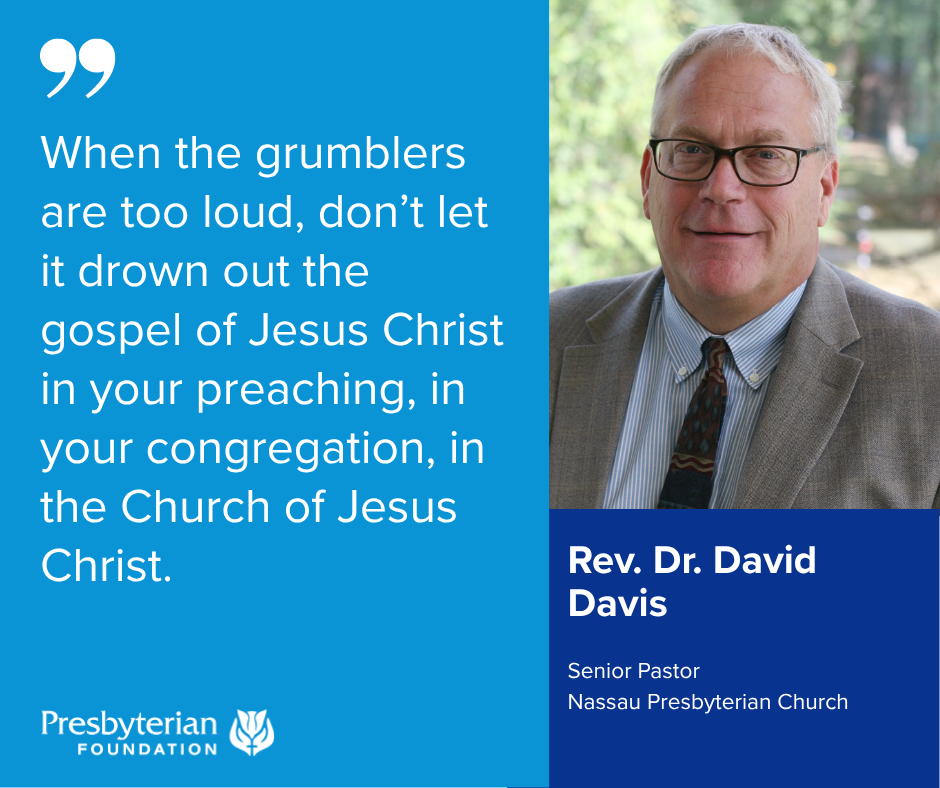
When the grumblers are too loud, don’t let it drown out the gospel of Jesus Christ in your preaching, in your congregation, in the Church of Jesus Christ.

Rev. Dr. David A. Davis
Rev. Dr. David A. Davis is the senior pastor of Nassau Presbyterian Church. He has served the congregation since 2000. David earned his Ph.D. in Homiletics from Princeton Theological Seminary, where he continues to teach as a visiting lecturer. His academic work has focused on preaching as a corporate act and the active role of the listener in the preaching event. Before arriving in Princeton, he served for 14 years as the pastor of the First Presbyterian Church, Blackwood, New Jersey. He has published two sermon collections, A Kingdom We Can Taste and Lord, Teach Us to Pray, and served on the Board of Trustees of the Presbyterian Foundation and the local Princeton YMCA. In addition to preaching in Presbyterian congregations around the country, David has preached to congregations in South Africa, Scotland, the Samuel Proctor Child Advocacy Conference of the Children’s Defense Fund, the Calvin Symposium for Worship, and on the campuses of Harvard and Duke University.
David grew up in Pittsburgh and did his undergraduate work at Harvard University where he was a member of the University Choir, singing weekly in Memorial Church and listening to the preaching of Professor Peter Gomes. David is married to Cathy Cook, a Presbyterian Minister, retired associate dean of student life at Princeton Theological Seminary. They have two children, Hannah and Ben and two grandchildren, Franny and Maddy.
 English
  Korean
  Spanish