
5/14/2026
Stewarding Community is Sacred Work for Churches
by Rev. Sandra Moon

Last year, after living in Louisville for 18 years of my adult life, I moved to Portland, Oregon — a place where I had no deep connections. Once I had physically settled into my new home, I moved onto my next project: building community.
It can be challenging to make new friends at any age, but especially as an adult. It seems that we’re a society that is overworked and overbooked, and it’s not easy trying to build new relationships on top of everything else going on in our lives. In an attempt to meet people, I’ve joined local Meet-up groups and Facebook groups based on different interests or affinities. My observations from these secular online groups is that there is a clear yearning to build community, but there is a significant disconnect between that yearning and actually making the effort to create meaningful relationships in person.
We know the statistics about loneliness. We’ve heard the warnings from public health leaders. Loneliness is not just uncomfortable; it is harmful, even deadly. And yet, in the midst of this crisis, the church holds a quiet, powerful gift: the ability to cultivate real, embodied community.
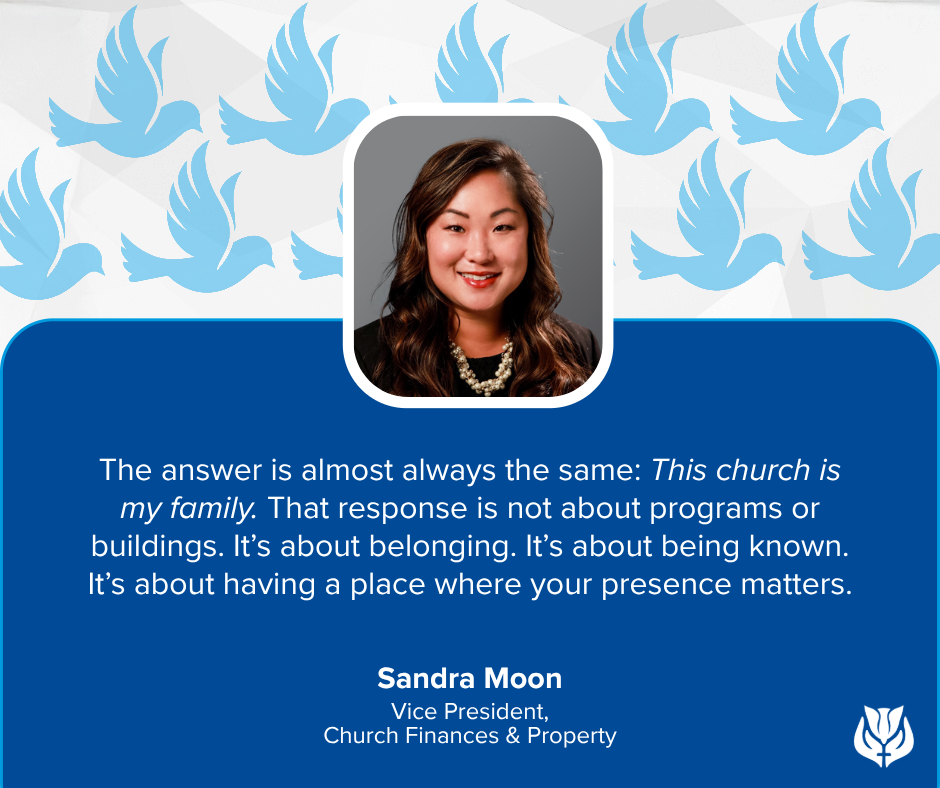
In my work with the Foundation, I meet with Presbyterian churches all over country —some navigating difficult financial decisions, others dreaming boldly about new ministries. I’m in the habit of asking pastors and elders why they serve their congregation, why they give of their energy and resources, and why they show up week after week. The answer is almost always the same: This church is my family.
That response is not about programs or buildings. It’s about belonging. It’s about being known. It’s about having a place where your presence matters.
Churches have a unique opportunity to model a kind of belonging that is spacious, justice-seeking, inclusive, and grounded in the radical love and hospitality of Jesus. We can be places where people of every identity, background, and story find room to breathe and be held, and to be seen and loved for who they are.
But community doesn’t happen by accident. It is cultivated. It is tended. It is stewarded. Community begins with compassion — real, attentive care for one another’s lives. Not the quick “How are you?” we toss over our shoulders, but the kind of care that pauses long enough to hear the answer. The kind of care that shows up as a casserole delivered after surgery. The kind of care that sits with someone in their grief or uncertainty. Churches build community when we practice empathy, when we check in on one another, when we notice who’s missing and reach out, and when we show up, ready to roll up our sleeves to get involved. Community requires consistency. It requires presence. It requires choosing to be part of something larger than our individual schedules and preferences.
In a time when loneliness is rising and connection feels fragile, the church has a sacred calling: to be a place where people can find belonging and purpose. Not a perfect community, but a real one. A community that practices caring, praying, serving, and showing up — not because it’s easy, but because it’s holy.
The work of community-building is slow, sometimes messy, and always worth it. May we each do our part to steward the sacred work of being the church in a world that so desperately needs the love, grace, and hope found in God.

Rev. Sandra Moon
Rev. Sandra Moon serves as Vice President of Church Finances & Property, and Adaptive initiatives at the Presbyterian Foundation. Sandra is an experienced civil attorney who brings a wealth of knowledge in property law, real estate, and ministry to her work at the Foundation.
 English
  Korean
  Spanish