
9/14/2026
How God Hopes that We Will Live: October 2026 Lectionary Preview, Year A, Exodus 20, Matthew 22
by Rev. Dr. Cynthia Campbell

In both church and seminary offices where I have served, there are bulletin boards where important regulations and policies are posted. The documents concern employee safety and rights regarding discrimination. They are really important, but I’m fairly sure no one (including me) has ever stood there and read them.
In many places in our country, there are furious debates about posting the Ten Commandments in the classrooms of all public educational institutions or on monuments on the lawns of courthouses or capital buildings. For most of those advocating these laws, I think the Ten Commandments symbolize something beyond their actual content. But if I am right that few of us actually read bulletin boards, perhaps this strategy won’t accomplish much. This makes it all the more important that we reflect in worship on what the Ten Commandments (what the Law or Torah) are actually about.
The lectionary in October gives us an opportunity to reflect on how God hopes that we, as heirs of the biblical story, will live our lives. The “semicontinuous” readings from the Hebrew Bible find us in Exodus, and the reading for the first Sunday is the Ten Commandments. The reading for the last Sunday in the month (Matthew 22:34-46) is the discussion between Jesus and one of his critics about the essence of the Torah, the Law of God. Bookending this month is the critical question: how does God hope (yearn) that we will live if we are to find abundant life?
Beginning with the Ten Commandments, we notice the pronoun “you.” In English, we cannot tell whether the word is singular or plural. But the context is clear: these words of God are addressed to God’s people as a whole; to a community; to a society. Yes, each person is responsible for living this way, but the words themselves describe how Israel, as a society, is expected to live. If we read these in the singular (addressed only to individuals), it is not impossible for us to say that we have not violated any of these commands.
Our Calvinist ancestors thought differently. The Westminster Larger Catechism (in our Book of Confessions) has a fascinating reflection on the Ten Commandments. It asks not only what each command prohibits (the negative), but what it requires (the positive). Many of the examples have to do with social and economic issues. In discussing the eighth commandment, “you shall not steal,” Westminster says that this prohibits the use of false weights and measures (i.e., cheating in business) and it requires us to “further the wealth and outward estate of others, as well as our own.” The authors clearly understood the social dimension of these words!
In Romans 13:9-10, Paul writes that the commandments “do not kill, do not steal, do not commit adultery” can be summarized by “love your neighbor as yourself.” “Love,” he concludes, “does no wrong to the neighbor; therefore love is the fulfillment of the law.” Paul draws some very concrete conclusions from this principle, but it can be misleading. Especially in our cultural context, it is not easy to separate “love” from “affection.” I do not like all my neighbors. You may not have affection for all your family members. But affection is not the point; it has little to do with what the law of love requires.
Is there another word that might clarify this? What if we substitute “respect” for love? Whereas “love” encompasses feelings as well as action, “respect” is an attitude accompanied by behavior. To respect something or someone is to show deference; to honor an idea or a person. I can (often do) respect someone whether I agree with their politics or even behavior or not.
How might this apply to the first or greatest commandment? To respect God with all of my being in how I think and how I act. Why do we respect God? Because God is the Source of all that is, and I am not. Because God is the beginning and the end, and I am not. Because God is Creator, and I am creature. God is holy and whole, and I am (we are) broken and frail. “The fear of the Lord is the beginning of wisdom.” When we honor, respect, stand in awe of God, we are on the right path.
What about the commandment that is “like” the first: you shall “respect” your neighbor as you respect yourself. Perhaps this makes us uncomfortable. Does everyone really deserve respect? I think that many, if not most, of us think that respect is something to be earned. Respect may be given based on decent behavior, special skills or abilities, or even social position. Respect in this sense is based on whether I approve and/or value another person or not.
But what if there is a different way to look at this? What if respect for others is understood as a “given” rather than an accomplishment? Genesis 1:26-27 says that God created human beings (men and women, all of us) in God’s own image and likeness. This is a truly radical idea: that every person is, by virtue of being human, being alive, worthy of our respect because every person carries within them the divine image. This means that human dignity is something inherent: it has nothing to do with status, wealth, accomplishment, or even good behavior. The Brief Statement of Faith puts it this way: “In sovereign love God created the world good and makes everyone equally in God’s image, male and female, of every race and people, to live as one community.”
This is the path God wants, yearns for us, to walk: to see in each other the reflection of the divine image; to extend hospitality to all as we would to Christ, especially the hungry, the naked, those sick and in prison (Matthew 25:31f). The implications for our daily discipleship are pretty clear, but they do not end there. Just as the Ten Commandments were the roadmap for how Israel was to live as a society, so the principle of respect for all persons should be the criteria we apply to our congregations, our neighborhoods and cities, our business life and national policies. What promotes the dignity and well-being of all? What advances the common good, not just my individual advantage?
In his first encyclical, Magnifica Humanitas (Magnificent Humanity: On Safeguarding the Human Person in the Time of Artificial Intelligence), Pope Leo XIV argues that Christians (he addresses all of us, not just Catholic Christians) should begin with Genesis 1:26-27.
Human dignity does not depend on a person’s abilities, wealth or position in life, not on the right or wrong choices made; instead, it is a gift that precedes and transcends each person, endowed by God as an expression of his unfailing love.” He goes on to warn against ideologies that see the value of persons only in terms of what they achieve or produce; that see people as “a resource to be used and exploited, and no longer recognized as a proper end in themselves.” (Pope Leo XIV, Magnifica Humanitas (San Francisco: Ignatius Press, 2026), pp.49-50.)
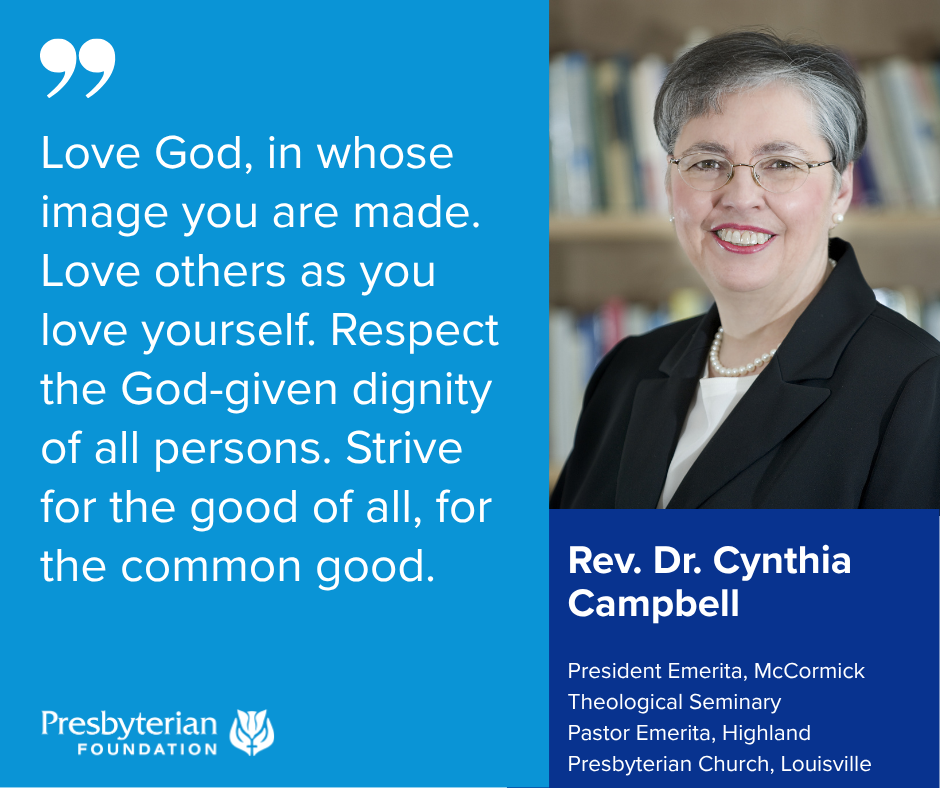
Love God, in whose image you are made. Love others as you love yourself. Respect the God-given dignity of all persons. Strive for the good of all, for the common good. Apply these values to how you live every day; to what agencies or causes you support; to what policies you advocate for; to how you vote.

Rev. Dr. Cynthia Campbell
Rev. Dr. Cynthia M. Campbell is president emerita of McCormick Theological Seminary and pastor emerita of Highland Presbyterian Church in Louisville, Ky. After retiring from McCormick in 2011, Cynthia moved to Louisville where she served as pastor of Highland Presbyterian Church until 2020.
Cynthia began her ministry in Texas and served in three congregations before completing her Ph.D. She joined the faculty of Austin Presbyterian Theological Seminary in 1981 where she taught theology and ministry and directed the Doctor of Ministry Program. In 1988, she was called to the First Presbyterian Church of Salina, Kansas, as Pastor/Head of Staff, one of the first women to serve a congregation of over 1,000 members as pastor. In 1995, she was named President of McCormick Theological Seminary in Chicago. She is the author of A Multitude of Blessings: A Christian Approach to Religious Diversity (2007), God’s Abundant Table (2011), and Christmas in the Four Gospel Homes: An Advent Study (2019). She is co-author with Rev. Christine Coy Fohr of Meeting Jesus at the Table: A Lenten Study (2023) and Meeting Jesus on the Road (2026).
 English
  Korean
  Spanish