
4/15/2026
Easter, Ascension, and Pentecost proclaim Christ’s new aeon: May 2026 Lectionary Preview, Year A, Acts 2:1-21.
by Rev. Dr. Jennifer L. Lord
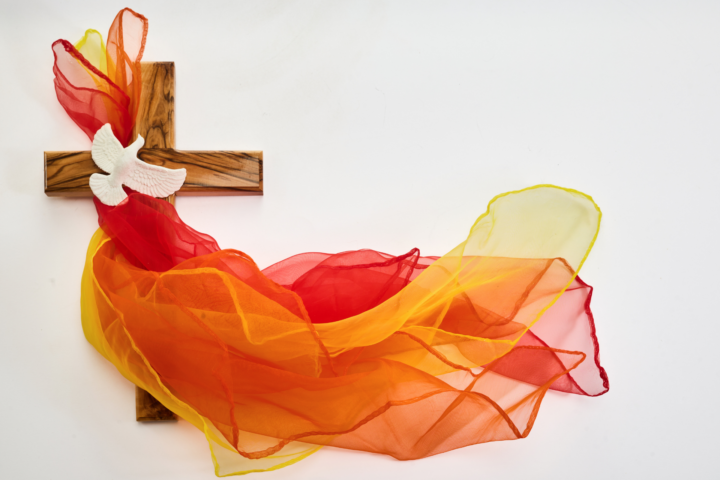
Our May calendars might highlight special events like Mother’s Day, Memorial Day, or the greatest spectacle in racing, the Indy 500. However, this May the church calendar holds us in the final days of Eastertide (including the Ascension), and the great feast of Pentecost.
Pentecost in the church’s year is the 50th day of the Christian Pasch, Christ our Passover bringing us from death to life (I Corinthians 5:7). And it is the culmination of half of the church’s year: this feast ends the portion of the church’s year when we re-enter Christ’s coming, birth, life and ministry, betrayal, passion, death, resurrection, and ascension. Our church calendars will shift to what is commonly called Ordinary Time. In the church, the month of May has us make this turn.
Long ago, Pentecost, in its present sense, was not on the church’s calendar. And long ago the first Sunday of Easter did not stand out from the other Sundays of Pascha or from the whole cloth of 50 days of rejoicing. Instead, the 50 days were truly kept as stretched-out rejoicing. They were not in between the first Sunday of Easter and Pentecost (since Pentecost was not yet a feast day), nor were they days after the first (read: most important) day of Easter. They were kept as one long swath of rejoicing in the resurrection, ascension, and giving of the Spirit, all facets of exalting Jesus as Lord.
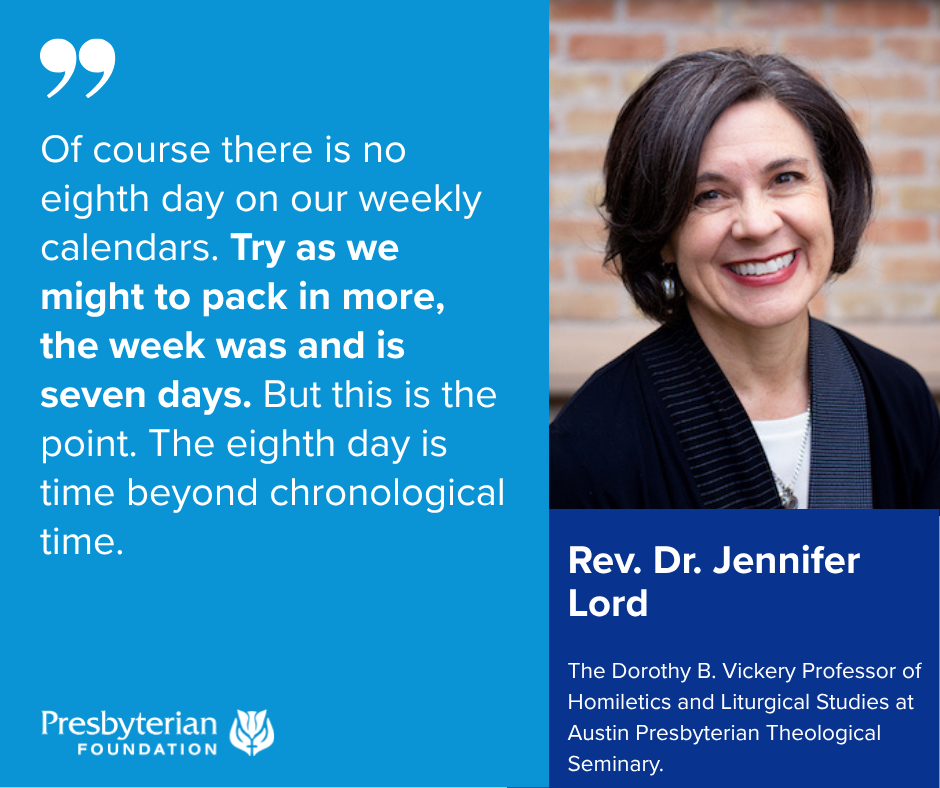
Liturgical math underscores this tumble into extended rejoicing. Sunday, the day of resurrection, is the first day of the week. And yet Christians also called it the eighth day (John 20:26). Of course there is no eighth day on our weekly calendars. Try as we might to pack in more, the week was and is seven days. But this is the point. The eighth day is time beyond chronological time. It is time beyond history. It is time beyond our repeating seven-day weeks. The seven days of creation now include the eighth day of Christ’s new creation. The first day is also the eighth day which is time beyond time. It is a different quality of time since it is always a sign of our passage in Christ into the promised age (aeon) of no more death, no more pain, no more crying (Rev 21:4). Christ’s resurrection has brought us to a new age. And any baptismal font with eight sides is purposeful: we are baptized into life in Christ, into his eighth day. We are already people who live in the end times, in the One who has conquered the powers of sin, evil, and death and who grants us true life.
And so, as it is said, Sunday is to the week as Easter is to the year. One day out of the seven days holds all of this, the first day that is also the eighth day. And the 50 days of rejoicing, Easter, are as seven multiplied by seven, seven-squared, a week of weeks, one-seventh of the year. And the additional day, the 50th day, is as the eighth day to the week: “The paschal season concludes with an eighth Sunday; the eighth Sunday of Easter is Pentecost.”[i]
Eastern Christians still number their Sundays following Pentecost by that designation “the (number) Sunday after Pentecost.” Prior to 1970, the Roman Catholic church did as well. My Presbyterian denomination used to use this designation and perhaps some of our printed calendars may still. This is ordinal numbering. The designation “ordinary time” never meant that we come to a time which is mundane, commonplace, or routine. In fact, it means quite the opposite. Ordinal numbering is not about how many of something there. Ordinal numbering is about the numbers being in a sequence and being implicitly connected to the beginning of the sequence. Liturgically, this connection to the beginning is explicit: the Sundays after Pentecost are anchored in Pentecost, in the meaning of the fifty days as one great day to the year: “You really can believe you are being made new; that the world is being made new; that God’s end, the telos, has arrived and all will be brought to completion, wholeness, good, and glory. It is our and all the world’s destiny to grow in and flourish in the life of the Trinity.”[ii]
Ordinary time is not ordinary. We are made to live as eighth day people, as 50-days people, protecting the humming of new creation in our hearts and souls so that we bear it in our bodies for the needy world. We are eighth day people, 50-days people, propelled by the flame that is the Spirit of the risen Christ who refines all that is not of God and enlivens all that is of God. We are eighth day people, 50-days people, trusting that God’s aeon is revealed and present and will have the final word. “Bless the LORD, O my soul. Praise the LORD!” (Ps 104:35b).
[i] Gail Ramshaw, “Vigil of Pentecost,” New Proclamation Commentary on Feasts, Holy Days, and Other Celebrations (ed. David B. Lott, Minneapolis: Fortress, 2007), 93.
[ii] “Pentecost and Trinity Sunday: Preaching and Teaching the New Creation.” Interpretation: A Journal of Bible and Theology 66, no. 1 (2012), 40.

Rev. Dr. Jennifer L. Lord
The Reverend Dr. Jennifer L. Lord is The Dorothy B. Vickery Professor of Homiletics and Liturgical Studies at Austin Presbyterian Theological Seminary. Her work focuses on liturgical theology informing renewal of Sunday worship practices, the sacramental life, preaching, worship leadership, spirituality, and keeping time in the church’s year. She served as President of the North American Academy of Liturgy and is the author of multiple books and numerous lectionary resources and articles. Current projects include: The Sunday Meeting: Reflections on a Liturgical Conversion; Preaching and The Church’s Year: Interpreting the Revised Common Lectionary. Current research includes the renunciation of evil in baptismal rites and the spirituality of time. She has walked over 2000 miles in five countries on the network of paths that form the Camino de Compostela de Santiago.
 English
  Korean
  Spanish