
4/10/2026
Values-based investing is a crucial part of stewardship for churches
by Robyn Davis Sekula
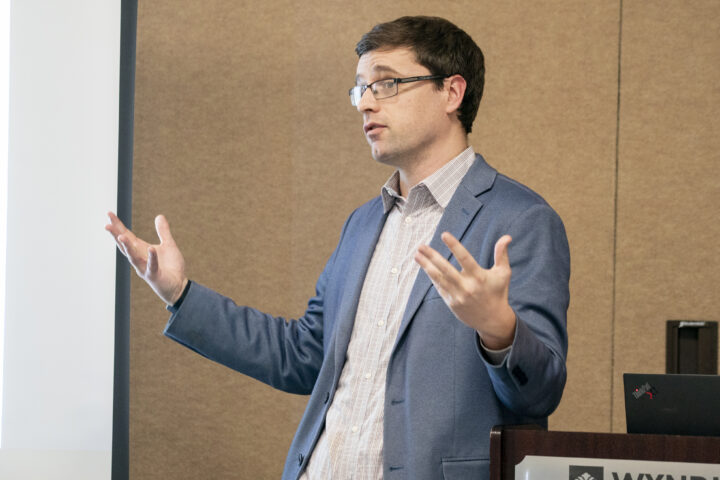
At the inaugural Luminosity conference, held March 9 to 11, 2026, in Orlando, Florida, a breakout workshop presented by New Covenant Trust Company invited church leaders to think deeply about the relationship between faith, stewardship, and investing.
Organized and sponsored by the Presbyterian Foundation, the first-year Luminosity conference brought together Presbyterians for learning, connection, and inspiration. In one breakout session, Angela Duffy, President and CEO of New Covenant Trust Company, was joined by James Carey, Vice President of Investments and Portfolio Management, and Bryan Dickerson, Financial and Investment Planning Associate, to explore what faithful investing looks like in practice for congregations and ministries.
Duffy opened the session by grounding the conversation in Christian stewardship.
“As you probably say every Sunday or hear every Sunday, everything that we have belongs to God,” Duffy said. “And everything that we have, we are to be the good steward of those resources so we can further God’s mission in the world.”
Church investing is about discipleship
For Duffy, that means investment strategy is not simply about returns, but about aligning resources with ministry.
“We see that faithful investing can be one of those ways that a congregation or an organization can fulfill the mission of Christ on Earth,” she said. “So we look at investing as a potential way to extend that discipleship, a way to align our resources with God’s purposes in the world.”
At the same time, she stressed that churches and ministries cannot ignore performance because those assets are critical to a church’s ability to serve.
That balance, she said, is central to New Covenant Trust Company’s approach.
“We often say that you can do well and do good at the same time,” Duffy said.
Duffy also explained New Covenant Trust Company’s role as a subsidiary of the Presbyterian Foundation, created in 1998 to serve congregations and institutions in the Presbyterian Church (U.S.A.) and beyond.
“Our primary focus has been on Presbyterian congregations and institutions within the PC(USA)” she said. “We really focus on how we can help and support you.”
She described the company’s service model as rooted in care rather than profit.
How the PC(USA) uses assets to push companies
Bryan Dickerson brought energy to the afternoon session with interactive questions for participants before turning to the historic roots of Presbyterian engagement in socially responsible investing.
“Church investment is more than just a practical question,” Dickerson said. “It’s also an instrument of mission and includes theological, social, and economic considerations.”
Dickerson then walked attendees through Mission Responsibility Through Investment, or MRTI, the Presbyterian Church (U.S.A.)’s framework for socially responsible investing. He highlighted priorities including peace, racial justice, economic and social justice, environmental responsibility and justice for women.
From there, James Carey expanded the conversation by placing Presbyterian investing in a broader historical and practical context. He traced that witness back to the early 1970s, when faith-based investors began asking what it meant to hold corporate stock responsibly, especially in the face of apartheid in South Africa.
Could the church use its stock holdings to push companies to change their practices to help end apartheid? That’s exactly what happened when the PC(USA), and other faith and values-based investors, urged companies including General Motors to cease operations in South Africa and cut ties with its apartheid government. Eventually, many of these companies responded to investor pressure, and those economic actions helped compel the country to end apartheid.
Investing is a tool for churches
Carey outlined several tools available to investors, including negative screening, positive screening, impact investing and shareholder engagement. He emphasized that faith-based investing is not just about avoiding certain companies, but also about actively supporting better corporate behavior and using shareholder influence for change.
“One of the duties is duty of loyalty to your organization’s mission,” Carey said.
That means church leaders making investment decisions should evaluate them through the lens of congregational mission rather than personal preference, he said.
“This is really about the church’s mission,” Carey said.
He also pushed back on the assumption that responsible investing necessarily means weaker financial performance.
“No one should confidently state as a fact that we can’t do responsible investing because we don’t want to give up returns,” Carey said. “That’s just not true in 2026.”
Carey pointed to long-running strategies and industry data suggesting that, over time, responsible investing can perform in line with market benchmarks when done well. He also made a strong case for proxy voting and shareholder advocacy as underused but powerful tools for churches and institutions.
“Don’t ignore proxy voting,” Carey said.
Policy statements are key part of strategy
Dickerson closed the workshop with practical guidance for congregations, encouraging leaders to work with providers who understand responsible investing, to document values and goals in an investment policy statement, and to follow sound investment practices.
“Documenting your investing goals and objectives, as well as your responsible investing criteria in an investment policy statement,” Dickerson said, is essential.
He also encouraged participants to make use of available resources, including Ministry Relations Officers from the Presbyterian Foundation. Ministry Relations Officers are field staff that work in geographic regions with congregations and ministries to create effective strategies for stewardship, property, and investing, among many other priorities.
“If you hadn’t done so already, connect with your MRO,” Dickerson said. “They’re free resources too.”
By the end of the session, the workshop had offered both theological reflection and practical guidance, making the case that faithful investing is not a niche concern but a meaningful part of Christian stewardship. For churches seeking to align their financial resources with their witness, the presenters made clear that investing can be both a ministry tool and a mission commitment.
Robyn Davis Sekula
Robyn Davis Sekula is Vice President of Communications and Marketing at the Presbyterian Foundation. She is a ruling elder and member of Highland Presbyterian Church in Louisville, Ky. She can be reached at robyn.sekula@presbyterianfoundation.org.
 English
  Korean
  Spanish