
4/9/2026
Luminosity conference closes with an examination of Acts and its call to the church today
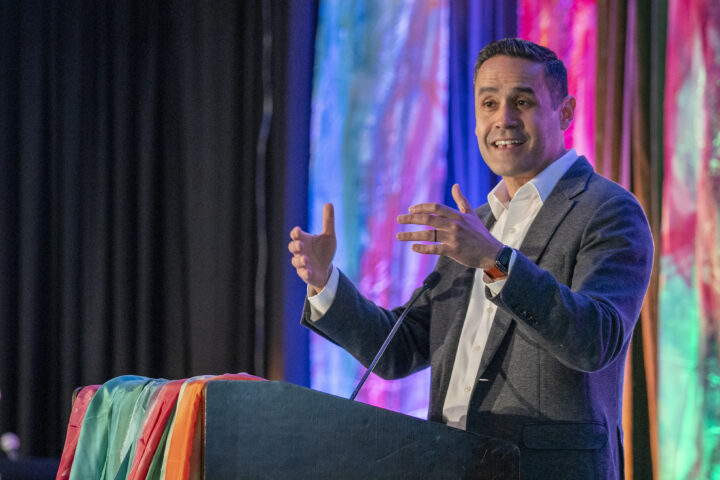
Dr. Eric Barreto opened the last plenary of the first Luminosity Conference by saying “I don’t know about you, but I am sick and tired of stories of the decline of the church.”
The sentiment found many friends in the audience. Barreto, who is the Weyerhaeuser Associate Professor of New Testament at Princeton Theological Seminary, qualified his statement: “I am not interested in denying realities we face every day, but we follow a God who is in the business of resurrection.”
Barreto was the closing speaker at Luminosity, a conference designed for pastors and church leaders to spark imagination and provide inspiration for leading in a changing world. The conference was organized and sponsored by the Presbyterian Foundation, and held March 9 to 11, 2026, in Orlando, Florida.
Barreto inspired the audience with his fresh and imaginary approach to the Acts of the Apostles, a book that is a continuation of Luke’s account of the story of Jesus and his first followers. “Resurrection life is hard to imagine in a world where death and destruction is around every corner,” Barreto admitted. “There are divisions throughout the church — not just politically, but even when it comes to deciding what color the carpet is.”
His humor tempered the reality of church contraction that we all know to be true. Instead of lamenting what was, his goal was to turn to the wondrous nature of stories for inspiring the church to reclaim and remember its mandate: to spread the good news to the ends of the earth.
“I want to convince you that the book of Acts is not an instruction manual for putting together the perfect church; it is not a Lego instruction guide. It’s narrative and stories, not rules…but sparks for imagination of how the church can be.”
The story of Eutychus
One of his favorite stories is that of Eutychus in Acts 20. This young man fell asleep listening to Paul’s talk, which Barreto notes, “went on and on.” While narcolepsy may be an ordinary occurrence for even the most engaging preachers, in Paul’s case, it led to tragedy, as poor Eutychus fell three stories to his death. As Barreto recalled the story, Paul went to see him and said, “Don’t worry, he still had life in him.” Then Paul “had a snack and resumed talking.”
Barreto paused and asked, “What are we to do with this story? It’s serious but also delightful…perhaps it is not about boring sermons, but about the people on the margins who are bored to death while we drone on.”
Pentecost
The next story he covered was the day of Pentecost, in Acts 2. Pentecost is one of the most familiar stories in the New Testament. At that event, people began famously speaking in languages they didn’t know. Reflecting on this fact, Barreto reminded the crowd that learning another language is much more than the mechanics of speech; it is learning another culture and history, and even different thought patterns that inform the language.
And then he asked the crowd what one of the more popular interpretations of the story of Pentecost is: “What is being reversed?” Many voices in the audience shouted in response, “the Tower of Babel curse.” That story from Genesis 11 predates the narrative of Abraham and God choosing a people. God’s act of diversifying the languages of the people is traditionally read as a punishment preventing the people of the earth from greater achievements than the tower they built.
But that interpretation leads Barreto to wonder, “is it a problem that I learned to speak Spanish first?” He then encouraged all to re-read the story and re-imagine that interpretation.
He said, “The people feared being scattered. They wanted to be together. But they also wanted to build walls around themselves, and a tall tower so they could watch for threats.”
Thus, Barreto sees this as a story of creation of many cultures scattered over the earth — an origin story for the gift of diversity. To bolster his argument, he said, “If Pentecost were a reversal of Babel, then the disciples would have spoken the same language and not heard all of the languages as their own. God learns the language that will most touch our hearts; our differences are a gift from God.”
As a further encouragement of our reimagination of the stories of Acts, Barreto asked, “What is it that someone who speaks a different language learns or hears in the message of Pentecost that we don’t? See the new neighbors you have not as a problem to be solved, but as a gift of God that we are to discover.”
Sharing everything in common
Barreto proceeded to his next “imagination” from Acts 4:32 to 5:11. In this account, the community shared everything in common “because of the common testimony to the resurrection of Jesus,” as Barreto framed it. “There are lots of reasons we don’t do this in the church today; so often, the church has shown itself to not be trustworthy with property or wealth.” Thus, when chapter 5 begins with the deception of Ananias and Sapphira, who kept some of their money instead of entrusting it to the disciples, they pay with their lives.
“This is a horror story smack dab in the middle of scripture,” Barreto said. “And it is a stark reminder that how we gather and how we treat one another matters. Community is a matter of life and death.”
The Ethiopian eunuch
The next imagination was one he labeled, “God calls us to nowhere,” from the story of the Ethiopian eunuch in Acts 8:26-40. Philip was tasked with going to a new place, and he encounters a eunuch, a court official who serves as a treasurer to the Queen of Ethiopia. “Eunuchs in Hebrew Scriptures have fascinating identities,” Barreto shared. “There are limits to their access to holy spaces; in Wisdom of Solomon, they are mocked, but in Isaiah 56, they are included and even exalted, “if they hold fast to the covenant.”
And in Acts, the Spirit told Philip to stay near the chariot. As he did so, he realized they were reading the scroll of Isaiah, and he asked them, “Do you understand what you are reading?” The eunuch’s faith was expressed in vulnerability: “How can I, unless someone guides me?” But Barreto wondered, “Does Philip realize the story they were reading from Isaiah also applied to the eunuch?” Barreto’s view is that the eunuch is also a Gentile, and thus would be the first baptized Gentile in scripture.
The road on which this encounter took place may have been the middle of nowhere. But “those ‘nowheres’ are not devoid, but full of God’s presence.” Barreto recalled mission trips he took when he was younger, in which they were taught that they were bringing the good news of Jesus, but discovered that Jesus was already there. “God has made nowhere God’s own home.”
Cornelius, the Roman centurion
Barreto’s final imagination was titled, “God is far ahead of us,” which came from the story of Cornelius, the Roman centurion, in Acts 10. Peter received a vision that seemed to be about what food he could eat, but turned out to be a sign that the good news of Jesus was open to Gentiles as well as Jews. Around that time, Cornelius was visited by an angel who told him to send for Peter. He did so, and Peter came. As he spoke, the Holy Spirit moved and fell on all who gathered there.
The Jewish believers who accompanied Peter and who were astounded that the Spirit fell even on Gentiles “make me mad,” Barreto admitted. “But then I remember how God’s grace surprises me too, in who it accepts. And such grace leads Peter himself to ask, “Can anyone withhold the water for baptizing these people who have received the Holy Spirit just as we have?
“God delights us with surprise,” Barreto said. “We are always catching up with God’s expansive grace…God will surprise us. Everything we thought we knew will be challenged. When the world turns upside down, how will we react? Can we turn from fear to delightful surprise?”
Barreto closed by reiterating that he is tired of stories of the church’s decline. And he left the audience with a more hopeful question: “Can we imagine how God is calling us into the future through the book of Acts, even if it’s the middle of nowhere?”
 English
  Korean
  Spanish