
1/30/2026
Pastoring in Ordinary Time
by Rev. Lauren Gully

So often the people in our congregations assume that we, their pastors, are something more than ordinary. Whether it is our role, the visibility of our work, or the sacred trust placed in us, it can be easy for others — and sometimes for us — to imagine that pastoral leaders exist on a level slightly removed from the ordinary realities of life. But the simple truth is that we are ordinary people. We carry heavy burdens. We navigate hard transitions. We experience joy and loss, exhaustion and hope, often alongside the very same struggles present in the lives of the communities we serve.
Much of life, when we are honest, is profoundly ordinary. Living is hard work: raising children, caring for aging parents, navigating financial stress, managing health concerns. Living is also deeply joyful: celebrating graduations, a spouse’s promotion, the birth of a child, or a long-awaited reconciliation. Nearly everything we experience could be called ordinary, not because it lacks meaning, but because it is shared human ground. These moments are not insignificant; they form the necessary framework of our lives, marking time with peaks and valleys that shape who we are becoming. The ordinary is where life actually happens.
It is striking, then, that so much of the church year is spent in Ordinary Time. During this season, the church is not dressed in the fancy colors of purple, white, or red. There are no major festivals to anchor the calendar, no clear narrative arc like Advent’s waiting or Lent’s studious reflection. Yet “ordinary” in the church’s usage does not mean unimportant or plain. The word comes from ordinal—the counting of time: first, second, third. Ordinary Time is how the church measures the long stretches between high holy days. It quietly proclaims that life continues after the big moments, after Christmas and Easter, after the mountaintop experiences. And it is precisely in this long middle — most of the year, most of our lives, and most of Jesus’ ministry — that faith is formed.
As pastors, we are called to lead the church during this Ordinary Time, when life often feels anything but ordinary. My own relationship to pastoral ministry during these seasons has shifted and changed in the midst of different seasons of my own life. I have led congregations through contentious election cycles and collective anxieties. I have celebrated milestone birthdays and watched the first grainy ultrasound images of my children. I have also sat beside my dying father. All of these moments unfolded during a season the church labels “ordinary,” and yet each carried its own weight clarity or confusion, and joy or sorrow.
These experiences have repeatedly reminded me that I am not only a pastor; I am an ordinary person living an ordinary human life. At times, this reality has energized me and sharpened my sense of call. At other times, it has made painfully clear that I needed to be pastored far more than I could pastor others. Ordinary Time has a way of stripping away illusions, especially the illusion that pastoral leadership requires constant strength, certainty, or spiritual surplus.
Ordinary Time also invites us to reflect on the ordinariness of the God we worship — or, more precisely, the humanity of God revealed in Jesus. Jesus’ life is marked not primarily by spectacle, but by presence. He wept over the death of a friend. He grew angry at injustice. He failed to meet people’s preconceived expectations and grew frustrated when even his closest companions misunderstood him. He experienced exhaustion and sought solitude when the people became overwhelming. Jesus’ ordinariness matters because this is how God chose to be known: not as distant or untouchable, but as someone who experienced emotion, vulnerability, and physical pain. He was someone who bled.
For those of us in pastoral leadership, this is both a comfort and a challenge. If Jesus led others while fully immersed in the human condition, then perhaps our own ordinariness is not a liability to be managed but a gift to be received. Perhaps being an ordinary person is precisely what enables us to be ordinary pastors who can walk honestly with ordinary people.
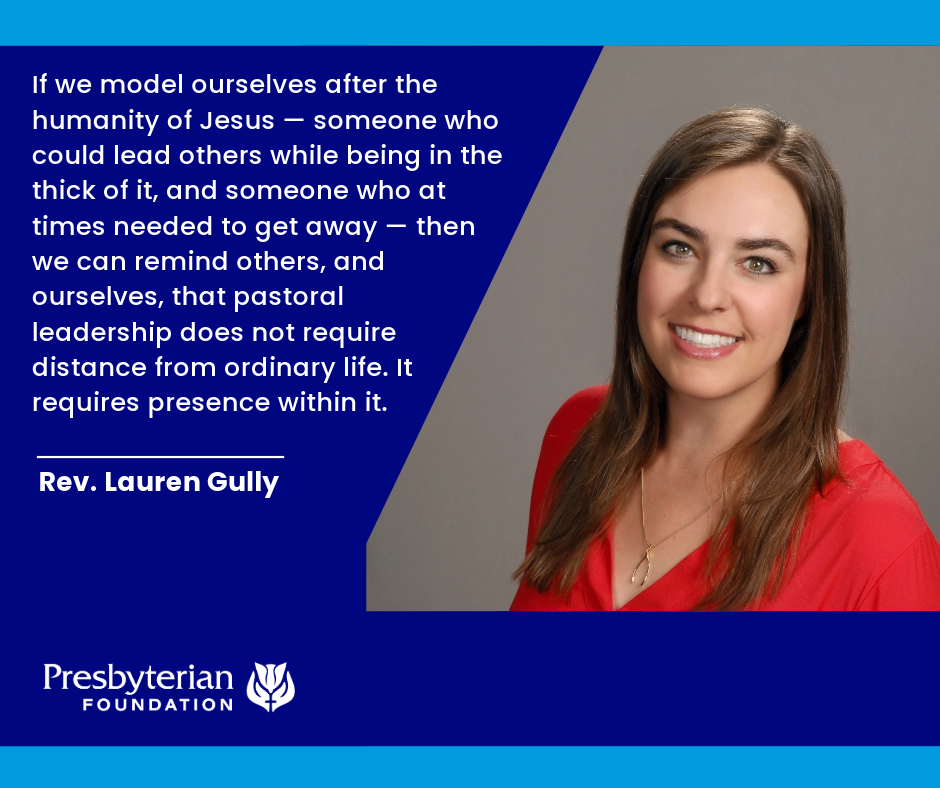
If we model ourselves after the humanity of Jesus — someone who could lead others while being in the thick of it, and someone who at times needed to get away — then we can remind others, and ourselves, that pastoral leadership does not require distance from ordinary life. It requires presence within it. Ordinary Time invites us to resist the pressure to perform holy significance and instead practice faithfulness: to lead while grieving, to preach while still becoming, to trust that God’s work is not diminished by our ordinariness but revealed through it. For most of the year, and for most of our lives, this is the work we are given.

Rev. Lauren Gully
Rev. Lauren Gully serves as the Pastor for Mission and Outreach at Lafayette-Orinda Presbyterian Church in California, where she previously held the role of Pastor for Spiritual Formation. Her background includes creative writing, global service-learning, interfaith dialogue, young adult ministry, and a strong passion for sustainability. Currently, Lauren serves on the board of Hope Solutions, a local housing non-profit, and is completing her thesis, “How to be Angry at God,” for her Doctorate of Ministry at Duke Divinity School.
 English
  Korean
  Spanish