
4/20/2026
Legacy conversations can include questions that provide insights
by Robyn Davis Sekula

I am at the stage in my life where I am having conversations about legacy that go in two directions. I’m talking with my mom, as she edges close to 90, about what matters to her and how she wants to spend her time and income, but also with my three daughters, who are all college students in their 20s.
My mom has been a faithful church member her entire life, landing in a beautiful PC(USA) church in Indiana that provides wonderful care and support to her. It is a spiritual home that guides her in her faith. The church is her number one charitable priority. I am so personally grateful for that faith community and I encourage supporting this congregation.
For my daughters, I want them to know what really matters to me. They are sharp observers, and they see how I live and how I spend my time. This holds true for both myself and my husband, as we are aligned on what matters to us and our legacy, and how we spend our time, talents, and treasures. We’ve also discussed with our daughters the basics of our estate documents and who our lawyer is so that they know who they can trust if something happens to us. They were reluctant at best to talk about this, but it’s important to normalize estate planning conversations. It’s simply legal paperwork that will be helpful someday, and that’s how I’ve presented it to them. We have tucked it away, they know where it is, and it’s there when they need it.
For my mom, the conversations are covering ground that we have covered previously at times. We have deep, honest talks about times in her life when things were challenging financially but also spiritually and emotionally. We talk about where she still wants to travel, and who she misses. We talk about how growing up on a farm shaped her ideas about work, legacy, and responsibility. Because she and my father had a strong sense of responsibility, were frugal, and were fortunate enough not to fall on hard times as adults, she is secured for the future. I realize how incredibly fortunate she is, and I am as well.
I’m finding that not everyone who is in this “sandwich generation” is comfortable talking about money and finances with their parents or other elderly relatives; conversely, some elderly parents think it is unseemly to discuss finances. Because of both of those factors, it can be hard to know where to begin.
With many folks in their 70s+, conversations about the past are far more vivid and insightful than anything in their life right now. You can ask questions that lean towards their childhood and the past that can provide good insight into their attitudes and perspectives on finances, resources, and money. As a former journalist, I’m a big fan of thoughtful questions that prompt conversation, so I thought I’d provide a few here that might help you to talk to your parents/relatives about money, legacy, and how they want to be remembered.
You can ease your way into questions that are more pointed, so that you also cover things that are vital for heirs to know, including estate document questions.
Here are some ideas of questions to ask your parents/relatives.
- What was your family’s attitude about money growing up? Was there a lot of anxiety around money? Did your family talk about money?
- Did you ever know how much money your parents made or how much money they had? Did your parents ever tell you how much the bills were that came in, and who they were from? (For older generations, the answer to all of that could be no.)
- Tell me a story that illustrates what your family thought about money or how money should be used.
- Were there times growing up when you did not have things that you needed?
- Did you feel that you were rich, poor, or somewhere in the middle growing up? What told you that you belonged in which category?
- What jobs did you have growing up for pay? What did you do with the money you received? Did your parents ever tell you what they thought you should do with it or provide any guidance?
- Did your family give to your church or any other charities during your childhood? If so, what were they and do you know why your parents supported what they did?
- Did you give to your church or other charities as a child?
- When you were raising your children, including me, did you support our church or other charities? How did that change over the years?
- Are you anxious or worried about money right now? If so, can I help you make decisions that may help you sleep better at night?
- What do you support now or what do you want to support?
- What do you believe God calls us to do with our resources, including money?
- Are there gifts you would like to make out of your estate? Can you give me specifics on that, especially if it is not in your will or estate plan?
- Why do those charities or organizations matter to you?
- Do you have estate documents, including a will? If so, where is that? Who prepared that for you?
- Do any of your estate documents need updating?
Not all of these questions work for every situation, and some of these you may have covered already. Use what is helpful to you.
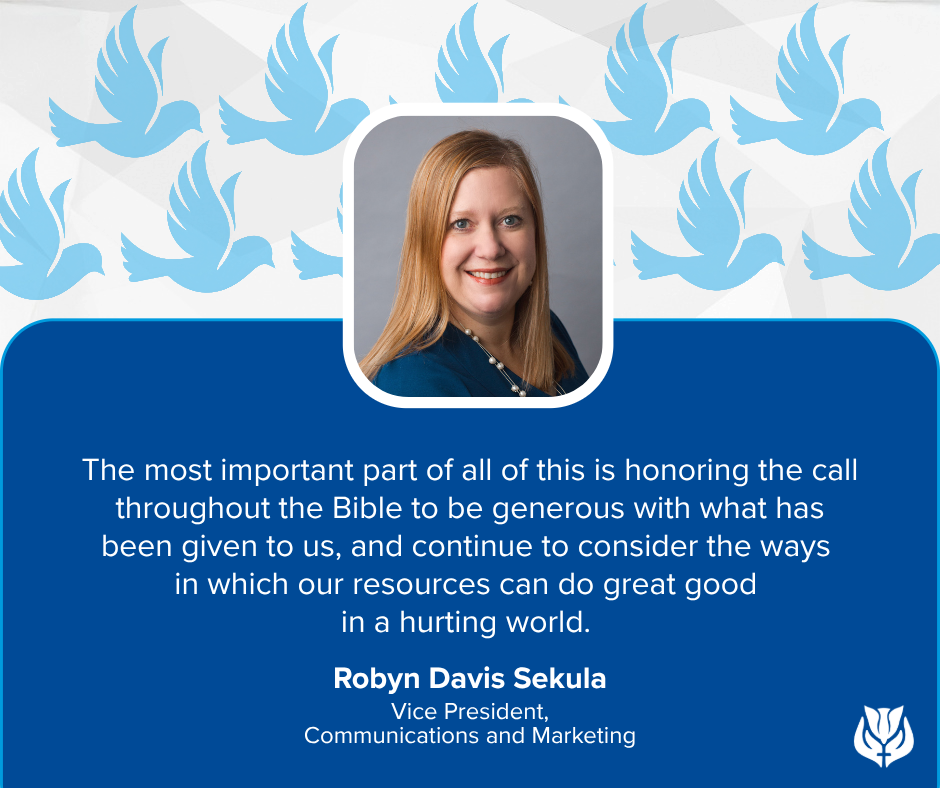
The most important part of all of this is honoring the call throughout the Bible to be generous with what has been given to us, and continue to consider the ways in which our resources can do great good in a hurting world. We should do all we can to help ensure that our parents or other relatives can meet this call as well, as they are able with the resources they have.
The first Sunday in May is designated as Legacy Giving Sunday in the PC(USA), and we have lots of great resources for individuals and churches on our website. I recommend checking those out here as you may find this helpful in your conversations around legacy.

Robyn Davis Sekula
Robyn Davis Sekula is Vice President of Communications and Marketing at the Presbyterian Foundation. She is a ruling elder and member of Highland Presbyterian Church in Louisville, Ky. She can be reached at robyn.sekula@presbyterianfoundation.org.
 English
  Korean
  Spanish