
3/18/2026
Creating a community centered on stewardship: April 2026 Lectionary Preview for the Fourth Sunday of Easter, Acts 2:42-47
by Rev. Dr. Donghyun Jeong

Through the resurrection of Jesus and its proclamation, God creates communities that embody the new reality inaugurated by resurrection. Acts 2:42-47 offers a vivid depiction of such a community, and it also has implications for our understanding of stewardship.
To grasp this vision, we need to look back at the closing scene of the Gospel of Luke, since Acts continues precisely where Luke ends: with the resurrection, appearances, and ascension of Jesus. In Luke 24, readers’ attention often centers on the affirmation that the risen Jesus possesses a body of flesh and bones.
When he appears to the disciples, they assume they are seeing a ghost. But Jesus insists otherwise: “Look at my hands and my feet; see that it is I myself. Touch me and see, for a ghost does not have flesh and bones as you see that I have.” (24:39, NRSVue). Perhaps the author was intentionally moving to expel any docetic misunderstanding?
Yet, Luke 24:13-53 highlights three additional features that are equally significant.
First, the risen Jesus shares meals with his disciples. After showing his hands and feet, he asks for food and eats a piece of fish before them (24:41-43). This may still be understood as his proof of corporeality. But it is more than that. In the earlier Emmaus episode (24:13-35), Jesus appears as one who blesses and provides food, thereby pouring grace on his people: “[Jesus] took bread, blessed and broke it, and gave it to them” (24:30). This language unmistakably echoes the words of the Lord’s Supper.
Second, Jesus opens the minds of the disciples to understand Scripture anew. As he walks with the Emmaus travelers, he leads them into deeper insight: “[B]eginning with Moses and all the prophets, he interpreted to them the things about himself in all the scriptures” (24:27). Later, he extends this teaching to the wider group, enabling them to recognize the fulfillment of Scripture in his death and resurrection, as well as the mission that now unfolds (24:44-47).
Finally, Jesus’s ascension transforms the disciples into worshippers. Rather than remaining in grief, they gather with joy, continually worshiping and praising God in the temple (24:52-53). The ascension thus culminates not in absence but in joy-filled worship.
When we turn to Acts 2:42-47, we find that these same elements—meal (and sharing of other resources), teaching, and worship—are embodied in the newly formed community of believers.
Acts 2:42 summarizes the community’s core practices: devotion to the apostles’ teaching, fellowship, the breaking of bread, and prayers. Jesus’s opening of Scripture continues through apostolic teaching in the community. The community’s breaking of bread (in liturgical and everyday forms), as well as fellowship, echoes the meals of the risen Jesus. Prayer expresses their shared devotion to God. In short, the patterns established in Luke’s resurrection narrative persist in communal life in Acts 2.
Acts 2:43-47 expands upon the concise description found in verse 42. The members of this community, who stuck together, held “all things in common,” practicing a radical form of communal economy: “All who believed were together and had all things in common; they would sell their possessions and goods and distribute the proceeds to all, as any had need” (2:44-45). This economic practice was accompanied by joyful worship and communion in every sphere of life—both in their homes and within the temple (2:46-47). This community was not created merely through the efficacy of human preaching (cf. 2:14-36), but by the descent of the Holy Spirit (2:1-13), the Spirit that bears witness to Jesus’s resurrection, ascension, and reign.
In a recent study that interviews over 80 Christian clergy and analyzes how they employ the language of stewardship, the authors observe that “steward and stewardship remain the most consistently employed language for congregational leaders when addressing money . . . [but] while pervasive, stewardship is not imbued with a single agreed upon meaning.” (David P. King, Mark Sampson, and Brad R. Fulton, “Exploring Theologies of Money: Religious Leaders’ Use of Stewardship, Its Strengths, and Limitations,” Religion 16, 866 (2025), page 11).
One of the most remarkable findings in this study is the shift in meaning, depending on whether the term is used as a noun or an adjective. As a noun, stewardship is often understood by most clergy as a “a theological claim about ownership” that encompasses everything: not only money, but also time, talents, and one’s own body (from the same study, page 8). Yet, when these church leaders apply the term as an adjective (e.g., stewardship season, month, drive, or sermon), the focus narrows significantly to “the giving of money by individuals to the church” (same study, page 9).
Now, we return to Acts 2:42-47 with this stewardship question in view. The passage, especially when read within the narrative arc beginning at the conclusion of Luke, does not provide a once-for-all solution to the dilemma. In fact, reading the Bible may complicate our practices, raise new questions, and unsettle our habitual rhythms. Our passage does not prescribe; it inspires.
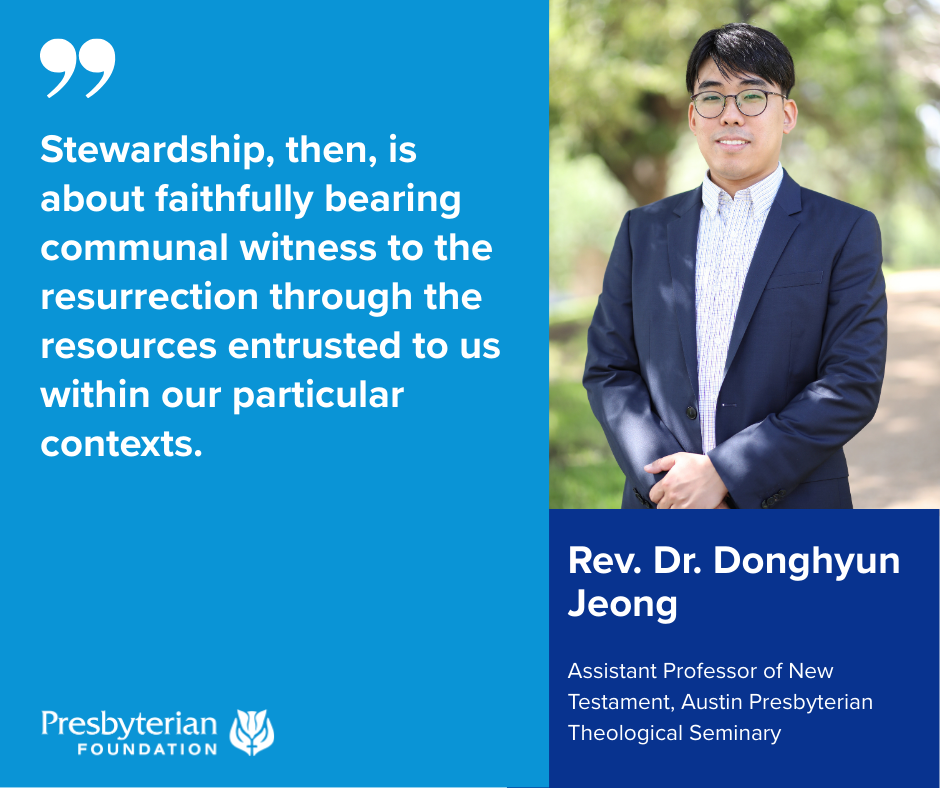
Rather than providing an answer sheet, Acts 2:42-47 invites us to ask how resurrection shapes our understanding and practice of stewardship within communities that bear witness to that very reality. Stewardship, then, is about faithfully bearing communal witness to the resurrection through the resources entrusted to us within our particular contexts.
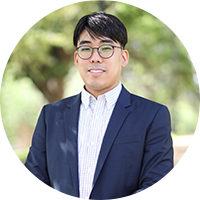
Rev. Dr. Donghyun Jeong
Rev. Dr. Donghyun Jeong is assistant professor of New Testament at Austin Presbyterian Theological Seminary in Austin, Texas. Prior to joining the faculty in 2022, he taught at Emory University Candler School of Theology and in Mercer University’s Department of Religion.
A native of Seoul, South Korea, Dr. Jeong earned a BA with high honors from Yonsei University in 2009. He received the MDiv from Presbyterian University and Theological Seminary in 2014, the STM from Yale University Divinity School in 2016, and the PhD from Emory University in 2021.
Dr. Jeong is ordained to the Ministry of Word and Sacrament in the Presbyterian Church (U.S.A.). For ten years he served churches in the U.S. and Korea and was a student missionary to the Democratic Republic of the Congo in 2010.
 English
  Korean
  Spanish