
2/13/2026
Church leaders can help generous saints find opportunities to help
by Rev. Joshua Kerr

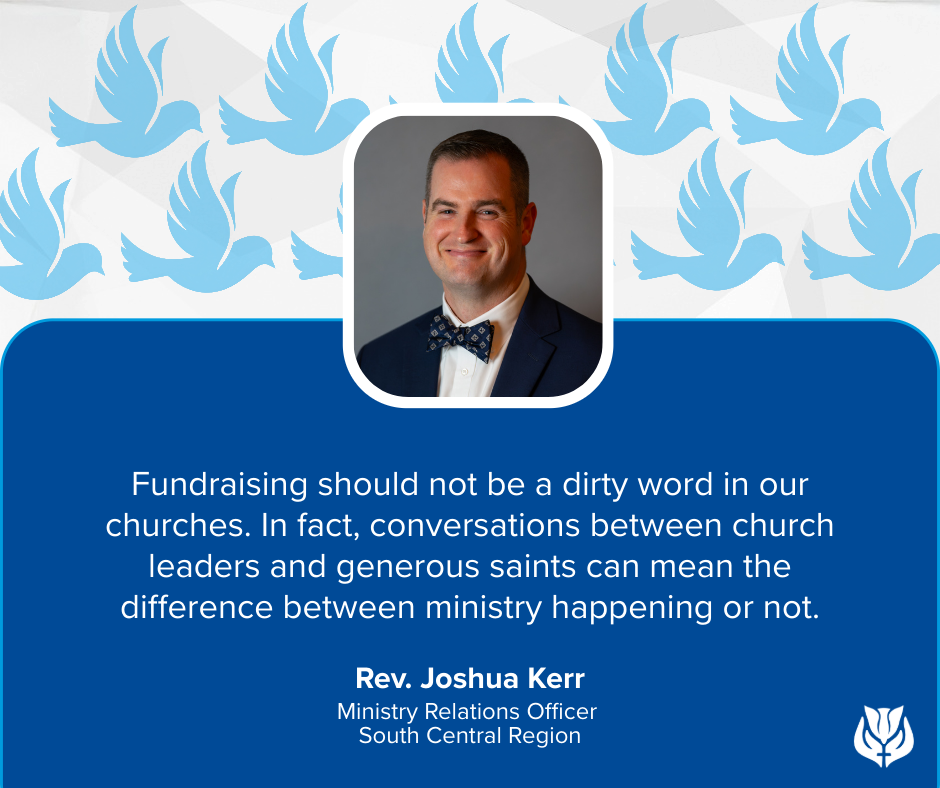
Fundraising should not be a dirty word in our churches.
In fact, conversations between church leaders and generous saints can mean the difference between ministry happening or not. Whether it is a pastor sitting down with a generous church member with the capacity to make a matching gift or a trusted elder gathering with peers to lead the way in funding a new mission initiative, your congregation’s new ministry may only be a conversation away — if you are willing to have that conversation.
Allow me to share two recent examples of church leaders who were willing to engage in bold fundraising conversations with church members, enabling their churches to serve in new and meaningful ways.
The first church is medium-sized and located in a relatively small town. This church has a history of employing paid Christian education staff for children and youth, but it had been many years since such a position was filled. The church has about 10 very active children and a faithful few youth who might benefit from staff to help their families raise them in the Christian faith. The church had the budgetary capacity to fund something very part-time, but the elders and the pastor wondered whether that would be sufficient to meet the needs of their young people.
This church also had an individual with significant giving capacity and a history of generous gifts both within the church and in the broader community. This generous saint also recognized the church’s diminished number of younger members relative to the past as a significant challenge. This meant that the church had a need, as well as a person with both the means and, potentially, the desire to meet it. Was there a leader in the church with knowledge of both the need and this generous saint’s capacity and passion who might have a ministry-driven fundraising conversation to bring them together?
In this case, the answer was yes. After discussing the possibility with a trusted confidant of the generous saint, the pastor of this church wrote a simple proposal that included a general description and goals for a Christian educator position, the estimated cost of the position, and the benefits of a full-time versus part-time position. The pastor presented this proposal to the generous saint, and after reviewing it with him and the trusted confidant, an agreement was reached between the generous saint’s family foundation and the session for a renewable five-year agreement to fully fund the position, with the church providing program funding.
At another larger church in a college town, a pastor was approached by city leaders about the church possibly serving as an overnight shelter during times of extreme cold. In addition to making the space available, the program would cost about $1,000 per night to fund. As in the first scenario, the pastor knew of a particular saint’s significant capacity for giving and their long record of generosity to the church’s missional efforts.
This situation was not without complication, however. In this church, some pastors in the past regularly approached members of means often, perhaps too often, to cover ordinary budgetary deficits and major repairs, so the pastor really needed to be thoughtful about both the legitimacy of the need and the approach. After considering all the factors, the pastor made the need known in a phone call, and the saint donated an above-and-beyond gift of $20,000 for the new ministry.
In each of these cases, a church leader was both willing and able to match a ministry need with others’ generosity. In order to do that, the following steps had to take place.
Step 1
The church leader needed knowledge of the congregation’s individual giving patterns. Congregational traditions around knowing individual giving range from absolute secrecy to relative transparency. The Presbyterian Foundation considers it best practice for pastors to have access to individual giving patterns within the congregation, in part, to facilitate these important fundraising conversations. If you are concerned about your pastor showing favoritism to those who give most generously to the church, you have a different and much bigger problem.
Step 2
The church leader needed to be willing to sit down and actually have the conversation. This can be a significant challenge for somebody who has never engaged in this kind of conversation before. Fortunately, there is excellent training available through programs such as the Lake Institute’s Executive Certificate in Religious Fundraising and the Presbyterian Foundation’s Church Financial Literacy and Leadership Program. Your Ministry Relations Officer is also available to support you as you consider these conversations.
Step 3
Finally, it is important to thank donors for their generous gifts, and to do so in ways they find acceptable and appropriate. For some, that is a handwritten card. For others, it may be a nice dinner out with the pastor or an update on how the ministry they are funding is going. As with the initial approach, the relationship will guide the specifics.
Both church leaders in the stories above felt led by the Spirit to connect the ministry needs before them with the passion and generosity of the saints in their midst. What greater blessing can we as church leaders offer than enabling these people to serve their churches and communities in new and significant ways?

Rev. Joshua Kerr
Rev. Joshua Kerr is the Ministry Relations Officer for the South Central region, encompassing Oklahoma, Louisiana, Arkansas, and Texas. He came to work for the Presbyterian Foundation in February 2024 after serving as a pastor for 10 years in two churches in Oklahoma.
Joshua grew up in Tulsa, OK, and attended Yale Avenue Presbyterian Church. During his childhood and young adulthood, Josh saw Yale Avenue transition from a larger congregation with lots of programming to a much smaller family-oriented church. These experiences gave him an appreciation for smaller church ministry and a zeal for church innovation and growth. He served as a summer camp counselor for Dwight Mission, where he developed his leadership skills and first heard the call to pastoral ministry.
Joshua holds a Bachelor of Science degree from Rogers State University, Claremore, OK, and a Master of Divinity from Austin Presbyterian Theological Seminary.
 English
  Korean
  Spanish