
11/12/2025
Advent emphasizes God’s purposeful time: December 2025 Lectionary Preview: Year A, Psalms 72, Isaiah 11, Matthew 3, Romans 13
by Rev. Dr. Jennifer L. Lord

One of my childhood memories is late afternoon, Indiana, December 24. I would ask “Is it Christmas Eve?”
I was told to wait for sunset. When the light slanted and touched our backyard bare trees just so and then disappeared, I would know: it was Christmas.
Even as a child I learned to love the gathering dusk because it meant that time turned toward the next day and this turning was especially exciting on the 24th! Our Christmas feasting started that evening with relatives and friends gathered for a festive meal before the 11 p.m. church service.
I still watch for dusk time. I join my ancestors and contemporaries in Christ marking one day’s end and the new day’s beginning at dark: “There was evening, there was morning, the first day.” (Gen 1:5).
The seasons of Advent and Christmas entice us to keep time. From marking our progression toward the feast of Christ’s birth by lighting weekly Advent candles, to rejoicing at the very arrival of the Feast of Lights with hymns and prayers, holy words and holy table, to marking not one but 12 days of Christmas stretching from the Nativity to the feast of Epiphany with gift giving, festive foods and gatherings, and special services, we keep time. Advent and Christmas keep us counting, marking, paying attention to the time we are in.
But what time is it? What time do we mark by our wreaths and calendars, candle-lighting and feast-keeping? What is the nature of this time that we keep this month? More than occasions for liturgical math or the annual challenge of a holiday events’ gauntlet, the Nativity feast and its season of preparation mean to confront us again, this very year of the Lord 2025, with life according to God’s time. Awake! Our very souls and the whole cosmos are caught up in God’s time.
God’s time is the time of salvation (Romans 13:11). God’s time is God’s reign and realm of righteousness for eternity (Psalms 72; Isaiah 11:1-10). Whereas God in Christ has redeemed all time, including our calculations of seconds and minutes, hours and days, weeks and months and years, God permeates our chronos with eternity (Matthew 3:2), with the fullness that God is all in all (Hebrews 1:10-12). Living according to God’s time means we know (and act accordingly) that in Christ we are anchored in eternity, in God’s realm.
December in the church, with its calendar of readings for Advent and Christmastide, tethers us to this way of being in time. Both are eschatological seasons bringing us face to face with God’s purposes for our lives and the whole of creation. Advent texts bring images of distress, destruction, and calamity or, as with this year, declarations of impending judgment. This judgment is God’s justice; it is the setting of things in right order (Psalms 72; Romans 13:11-14; Matthew 3:1-12).
Christmas, too, is eschatological. We keep the feast of the birth of God in the flesh, Christ our God now uniting heaven and earth, yearning for us to live as we were created to be: us in God’s imago, all creation dwelling in harmony, all in well-being, (Latin salus), evil and sin banished. This birth sets in motion the long arc of God’s salus, salvation (Psalms 146:5-10; Luke 1:46b-55; Luke 2:1-20; Hebrews 1:1-12; Johns 1:1-14).
We are kept, held, sustained day in and day out by this eternally present saving mystery: God in the flesh for us and for the life of the world. God’s saving restoration shapes our commitments, our behaviors, our ambitions. “The Advent mystery in our own lives is the beginning of the end of all, in us, that is not yet Christ.” (Thomas Merton, “Advent: Hope or Delusion?” in Seasons of Celebration.)
We live otherwise so much of the time. We live as if separated from God’s arc of time and God’s chastening and transforming work in our lives. We forget and live by a partitioned sense of time. Our pulse quickens at the passing of hours – we have so much to do. Anxiety comes: we cannot keep pace, keep up, keep our heads above water.
Our peripheral vision, metaphorically speaking, constricts: we only see what is in front of us. We lose the long arc, the horizon, the view of that which holds us, holds all in all, sustains. We lose the interconnectedness of all things. We flit from one thing to the next, on our devices, with our schedules, during our days.
We find ourselves living episodically, from one event to the next, no connective tissue, no undergirding foundation sustaining the whole. Time passes in fits and starts and we wonder: what have we been doing with our time? We live fragmented and disintegrated lives. Even our stewardship and giving can be episodic when we live this way.
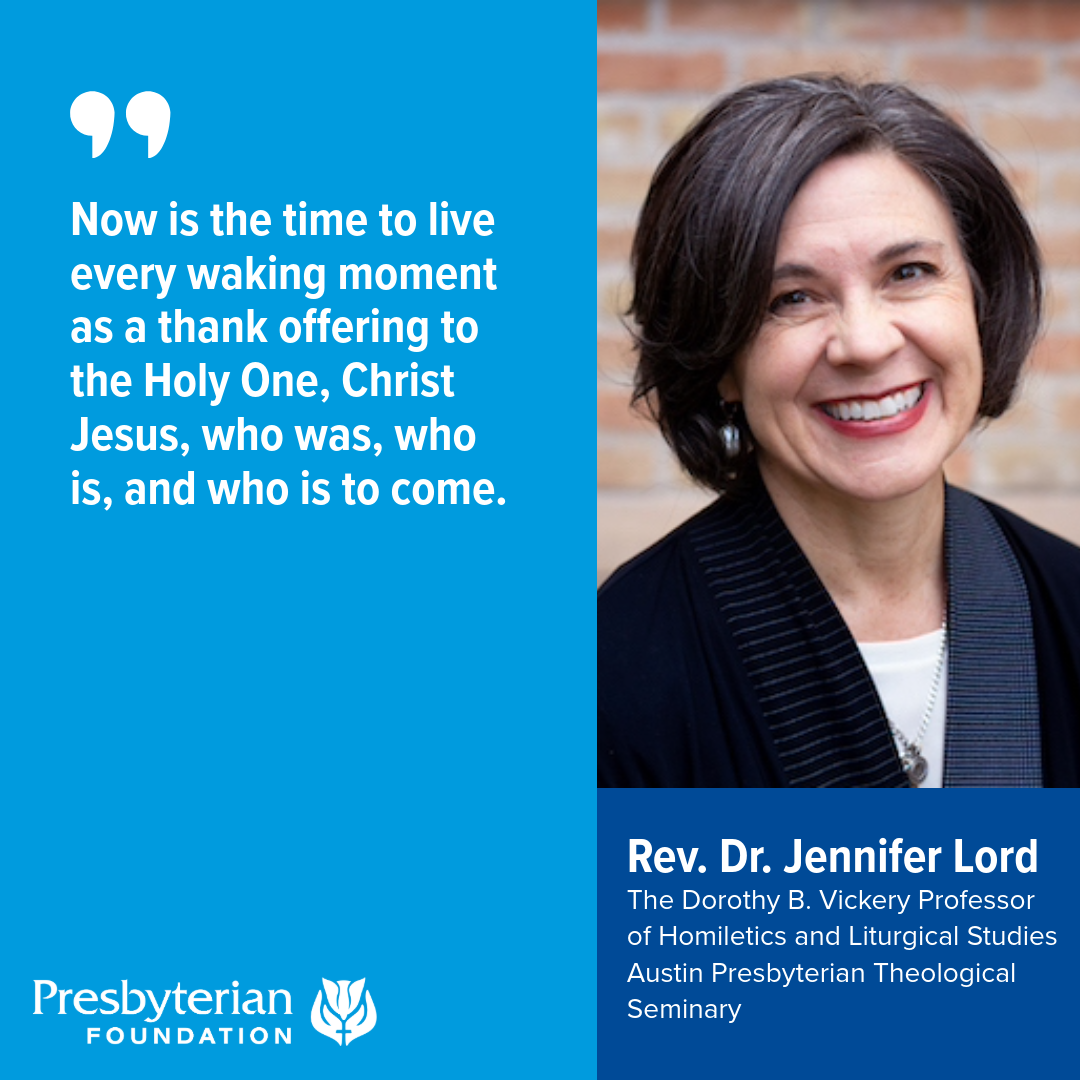
How shall we come to Advent and holy Nativity this year? “It is already the moment for you to awake from sleep” (Romans 13:11). Our very souls and the whole cosmos are caught up in God’s purposeful time. Let us attend: now is the time to live every waking moment as a thank offering to the Holy One, Christ Jesus, who was, who is, and who is to come.

Rev. Dr. Jennifer L. Lord
The Reverend Dr. Jennifer L. Lord is The Dorothy B. Vickery Professor of Homiletics and Liturgical Studies at Austin Presbyterian Theological Seminary. Her work focuses on liturgical theology informing renewal of Sunday worship practices, the sacramental life, preaching, worship leadership, spirituality, and keeping time in the church’s year. She served as President of the North American Academy of Liturgy and is the author of multiple books and numerous lectionary resources and articles. Current projects include: The Sunday Meeting: Reflections on a Liturgical Conversion; Preaching and The Church’s Year: Interpreting the Revised Common Lectionary. Current research includes the renunciation of evil in baptismal rites and the spirituality of time. She has walked over 2000 miles in five countries on the network of paths that form the Camino de Compostela de Santiago.
 English
  Korean
  Spanish