
10/15/2025
UKirk’s executive director kicks off a new season of ‘Leading Theologically’
by Mike Ferguson

“Leading Theologically,” which is produced by the Presbyterian Foundation and hosted this season by the Rev. Zoë Garry, made its season debut Wednesday with Garry’s 31-minute conversation with the Rev. Dr. Gini Norris-Lane, UKirk’s executive director. Listen here.
This season, “Leading Theologically” is focused on discernment. While studying at Baylor University, Norris-Lane recalled seeing posters all over campus posing questions like “What is God calling you to do with your life?” and “Is God calling you to ministry?”
During the second semester of her senior year, Norris-Lane was student teaching. Someone asked her what she wanted to teach the following fall, and “what came to mind, kind of unbidden, was, I want to teach people that God loves them,” she told Garry. “I thought, holy cow, I can’t do that in the public school system.”
But important conversation partners in her life, including the pastor of the church she was attending and her former pastor, “helped me see that there were a lot of other questions that surrounded discernment, and that maybe my own assumptions were not correct,” she said. “Maybe the limitations I was placing on myself, because I had been told that women couldn’t be placed in ministry, were not the limitations God was placing on me.”
She ended up at Austin Presbyterian Theological Seminary. “I think what I learned there, and have brought into my career in pastoral ministry, in collegiate ministry and now at UKirk, is that often when God is speaking to you, you need conversation partners to help you determine if what you’re hearing is from God or from someplace else,” Norris-Lane said. “I think there’s something about having people in your life that know you well enough to be able to affirm you’re on the right path, even if you don’t know the full destination.”
Garry, associate director of Theological Funds Development at the Presbyterian Foundation, asked Norris-Lane to name “some helpful actions someone can take to be a responsible discernment partner.”
“This is part of our work as the body of Christ,” Norris-Lane replied. There is, of course, the traditional invitation from the pulpit for recruiting, say, Sunday school teachers or members of the church’s mission committee.
“But what really changes people’s lives is when somebody says, ‘you know what? You’re really good at making food. Can you help run the kitchen for Vacation Bible School?’”
“It’s an individual invitation, and it’s specific,” Norris-Lane said. “It’s an awareness of where people’s gifts are. They don’t have to be gifts to change the world.” Instead, it can be along the lines of, “‘wow! You led that prayer and it was really meaningful’ or ‘you had us thinking about doing this mission project, and I’ve never done anything like that. That is amazing!’”
With the diversity of gifts in the church, “the first thing it takes is for us to pay attention and to affirm those gifts — in our youth, in our children and in our colleagues,” Norris-Lane said. “I think the Holy Spirit is always moving and calling us forth to serve, and so I think paying attention is really important.”
Campus ministry is “such rich soil” for vocational discernment, Norris-Lane said. The most vibrant ministries are the ones where students are asked, “why don’t you lead a small group study” or “why don’t you organize a fellowship event,” Norris-Lane said. That way, students can “practice their faith and practice their gifts in ways where they have a community, whether they succeed or fail, that is going to love them and remind them that they are beloved by God.”
“What does it mean,” she asked, “to pay attention and to give jobs away, and to allow people the opportunity to play and to practice and to lead?”
Since Norris-Lane speaks regularly to campus ministers all over the country, Garry wondered, “are there approaches you have to holding those conversations on discernment?”
“Yes and no,” Norris-Lane responded. In the current economy, many young people are anxious about landing just the right job following college. “For us to be faithful, we have to be realistic for this generation in particular,” she said. “Their fears are valid.”
Some students don’t want their work to take them far from their family. “There are cultural dynamics and there are financial realities, and I also believe the Holy Spirit is creative and works in and through these situations to help our young people discern not only their call to career, but their call as a family member — their call to marry or not, to be a parent or not,” Norris-Lane said.
“There is a vocation and an avocation we discern,” Norris-Lane said. “There are a lot of things at play, and yet the Holy Spirit is working in and through all of them.”
For youth and young adults, at the top of the list for “vocation and mental health, connection and belonging, for alleviating depression and loneliness, is relationship,” Norris-Lane said. “What better place than the church” to have a group of adults “who know your name and know a little bit of your story.”
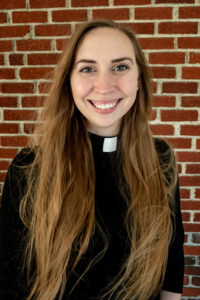
The Rev. Zoë Garry
“It’s one of those intergenerational places that’s truly relational,” Garry said, adding that one of her favorite moments baptizing a child “is turning to the congregation and asking them, ‘do you promise to love, to pray and be part of the faith formation of this child?’ Then you get the congregation saying, ‘we will.’”
“Everything comes down to that invitation and that relational sense of knowing, so that you can be in a position to call out and help people in this discernment,” Garry said.
In Darrell Guder’s book “The Continuing Conversion of the Church,” Norris-Lane notes Guder says that “the opportunity for the church is to commission every member of the church for mission,” no matter what different church members do for a living. “Name any kind of job you can imagine,” she said. “What does it mean for them to be commissioned to live their faith and to embody Christ’s presence in that space?”
Since God “has made each of us the way we are for a reason, we don’t have to be other people. We are called to be who God has made us to be, and the world needs that,” Norris-Lane said. Our faith community “can help affirm that and give us the opportunity to talk about that.”
The work of discernment and introspection is important work, Garry said. “They are often spaces we breeze past,” she said, “because we are so focused on accomplishments and milestones in our careers and our lives and relationships.”
Asked to offer a blessing to close out the conversation, Norris-Lane said the invitation is “that we each take a moment in our very busy, very noisy lives to stop and be grateful that we are each beloved by God, and to notice the ways that God has given us gifts to use … in the world.”
“I think,” she told Garry, “that’s the invitation.”
Mike Ferguson
 English
  Korean
  Spanish