
11/12/2025
Interactive Workshop Inspires a Holistic Approach to Faith and Money
by Rev. Jody Mask
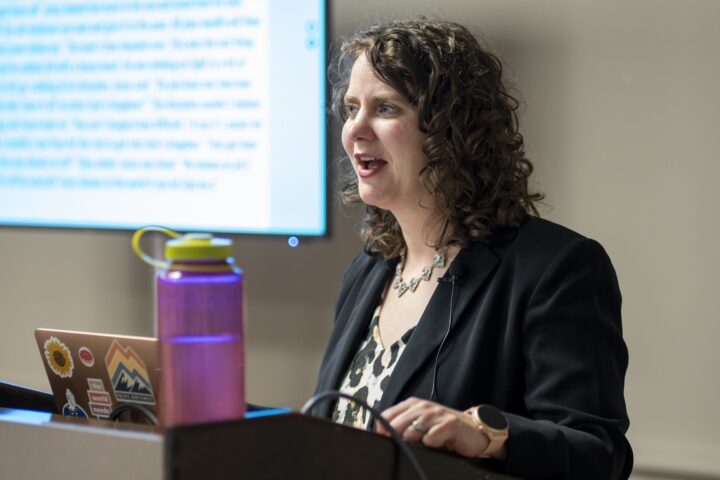
Grace Duddy Pomroy had never heard the word “stewardship” before coming to Luther Seminary. But as her mother dropped her off, she told her she was no longer paying Grace’s bills. Grace quickly sought work on the campus, and found her future at the Stewardship Leaders Program at Luther Seminary.
Pomroy, now the program’s director, conducted an interactive workshop at the Stewardship Kaleidoscope Conference in New Orleans in September. The workshop, titled “Faith & Money: Expanding the Conversation,” sought new insights from bible stories that typically makes pastors “itchy” when preaching on stewardship. She said that she intended the workshop, which was a hybrid of in-person and online participants, to “speak more to the heart than to the head.”
Pomroy’s approach was influenced by a 6-month experiment called the Faith and Money Learning Lab. She worked with a group of lay leaders and pastors who were interested in using money faithfully in every area of life, not just the part set aside for the church. Together, they wondered, “Do we care about how our values influence all the ways we use money?” and “Does God care about how we use the percentage of money we don’t give to charity and/or church?”
From this lab, Pomroy developed a set of spiritual practices that the other leaders used in their congregations in various contexts. They then offered their stories of what worked and what did not, refining the practices.
After telling the story of the workshop’s inspiration, she led the participants in a meditation, asking them “What does God’s love sound like?” She asked the same question using the other senses. One participant said, “being around Lake Michigan and hearing the waves and feeling the water.” Another admitted, “I had a super weird taste come to mind. I did not grow up in church, but there was a woman who always gave lollipops at my grandma’s church. We called her the Lollipop Lady.”
Next, a participant read Mark 10:17-27, the story of the rich young ruler, from The Message. Pomroy then led a meditation called “I wonder I notice” in which she read the text a second time and invited people to interrupt her reading with questions about what they wondered and noticed. Responses included:
“I wonder what ‘eternal’ means.”
“I wonder how old (the ruler) is.”
“I wonder if he (the ruler) was lying.”
“I wonder what Jesus saw looking at him.”
“I wonder what heavenly wealth is.”
“I wonder why it’s so hard for us to figure out what we have to give up and what we have to gain.”
Pomroy admitted that “I used to be more judgmental of the rich young ruler, but I now identify more with his situation as one who likes to check all the boxes and ask ‘Did I do this well enough?’”
Next, Pomroy shared some of what she and her colleagues learned at the Faith and Money Lab:
- The Bible speaks for itself — a spiritual practice can’t prepare us to hear what God has to say to us through scripture
- They should help listeners hear the story in a new way — for example, by engaging the senses.
- Lean into stories — the text itself as well as the stories of those in the room — both have a lot to teach us.
- Ground rules matter, such as the importance of confidentiality and giving “permission to try” new things.
- Invite congregants and other partners to take actions and be accountable.
Pomroy then introduced one of the New Testament’s most famous stories: Zaccheaus, the tax collector of Jericho (Luke 19:1-10). And she simply asked, “What do you think of first when you hear this name?” As most of the workshop’s participants hailed from a North American context, they mostly responded with the song “Zacchaeus was a Wee Little Man” that was very popular at one time.
Instead of singing or playing that song, Pomroy shared a song by Ellie Holcomb called, “Where Can I Go — Psalm 139.” This helped remind the workshop of its rootedness in spiritual reflection on money and finances. She then invited folks to share a time they experienced God’s presence and answer questions like “What happened?” “How did you leave the encounter changed?” and “What did God’s presence feel like?” In asking these, she invited participants to use those same questions to examine faith and finances in their own contexts.
Following the brief discussion, the class watched a filmed version of the story produced by The Lumo Project followed by more discussion questions like “Has an experience with God ever prompted you to make a change in your financial life?”
Pomroy wrapped up the workshop by reminding those present that they might use these practices in many aspects of church life: sermons, offering, bible studies, small groups, and team meetings. As people gathered their things, they continued to wonder and reflect on the workshop’s ideas. It was clear that a “faith and money” conversation transcends the boundaries of church life, and Pomroy inspired many to take that message back home.
Those who are interested in learning more about these faith and money practices can do so in this article and this online course.
Rev. Jody Mask
Rev. Jody Mask (he/him) is the temporary pastor of Grace Covenant Presbyterian Church in Orlando, Fla. He is an Orlando native who stewards his well-being through distance running, time in nature, and co-creating hijinks with his spouse, Ellen. Send questions or comments about this story to Robyn Davis Sekula, Vice President of Communications and Marketing at the Presbyterian Foundation, at robyn.sekula@presbyterianfoundation.org.
 English
  Korean
  Spanish