
9/25/2026
Good stewardship requires good relationships
by John C. Williams
New studies show that 25 percent of regular church-goers, defined as one or two days a month, don’t give at all to their church – this at a time of continuing declining church membership.
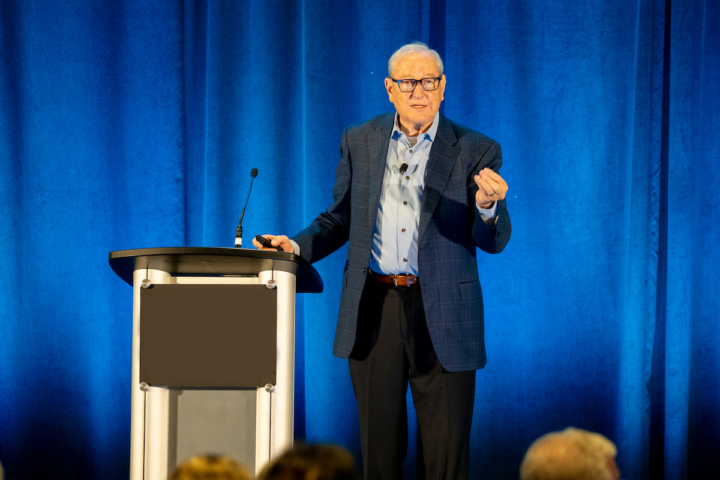
Part of the explanation, said Robert Hall, opening plenary speaker at Stewardship Kaleidoscope 2026 in Baltimore Sept. 21, is that more and more people say they are spiritual but not religious. “They are spiritual, but not relational … they don’t want to deal with the messiness and wonderment that goes with relationships,” he told the audience at the opening session. The annual conference is presented by the Presbyterian Church (USA) and Evangelical Lutheran Church in America.
“The very word ‘religion’ combines two words, re – again – and to bind or connect. Is there anything our society needs more today than to re-bind and reconnect? That’s religion,” he said.
His opening session focused on three crucial “ships” in ministry: Relationship, Stewardship, and Leadership. His presentation, “Leading and Growing a Relationally-Centered Stewardship Culture,” emphasized relationships as the core resource we have in church and in society.
Without relationships and trust, he said, his family would have lost the family ranch in 1936 – but because a family friend had known his grandfather and was willing to co-sign a loan, the rach and family stayed afloat. That was because of his grandfather’s generosity; the co-signer knew his grandfather as one of the most generous people he had ever known.
Hall said his granddad was “smart, gritty, hardworking, but none of those things saved the ranch. What saved the ranch was one committed relationship. What saved the ranch was the generosity that someone had for a relationship.
“Our relationships are our single most valuable, value-creating and value-releasing resource that we have,” he said.
Hall, a self-described “recovering CEO,” is co-founder and CEO of an international customer relationship management firm for more than 20 years. A Ruling Elder at Canyon Creek Presbyterian Church in Dallas, Hall was named by Ernst & Young as a finalist for Entrepreneur of the Year in the Southwest.
He has authored more than 200 published articles on leadership, strategic direction, culture and relationships. His work has appeared in Forbes, The New York Times, The CEO Magazine and The Huffington Post. He coaches CEOs and leadership teams in companies and nonprofits.
He said leading a church is among the toughest jobs out there – and quoted the late New York Yankees manager Casey Stengel who said, “the secret to managing is to keep the five guys who hate you away from the four guys who haven’t made up their minds.”
A 2026 report showed the number of pastors saying they were “very satisfied” with their jobs had dropped from 72 percent in 2015 to 52 percent in 2026.
In that light, how can church leaders help move to more relationally-centered and joyfully generous stewardship?
“Doing hard things can cultivate relationships. Often, pastors are reluctant to ask for money but maybe we think we are asking too much but in reality, we aren’t asking for enough,” Hall said.
In asking for money, statistics and data don’t move people, he said. Instead, tell a story that grabs people. Jesus used parables to couch big lessons in simple, easily understood stories that related to his audience. Keep that in mind, Hall said.
Many churches have shifted to a giving model based on transactions rather than generosity, on meeting calls to help fund equipment replacements rather than church programming. Hall urged the audience to return to Christ’s message, to love God and love your neighbor, and to give accordingly from the heart.
Tactically, repetition of the message also makes a difference, he said. Incorporate a year-round giving calendar to keep stewardship at top of mind – not the asking of money, but the sharing of stories and church needs. That way, when it comes time to make the ask, members are informed through repetition, he said.
The dance between high-tech and high-touch continues as churches expand the ways people can share their gifts, from writing checks to online giving and monthly deductions. In that, Hall said, it’s key to keep the personal touch.
As an example, he recounted visiting a restaurant in Dallas where the waiter wore a T-shirt that said, “Get in here before we both starve.” He said relational stewardship is just like that restaurant – we need people to get in before we all starve.
John C. Williams
John C. Williams is a veteran writer with his own PR firm specializing in helping K-12 education, government and non-profits tell their story. He is a 30-year member at Sea Island Presbyterian Church in Beaufort, South Carolina.
 English
  Korean
  Spanish