
4/15/2022
God’s Hidden Treasures provides hope and help for vulnerable Ukrainians
by Gregg Brekke
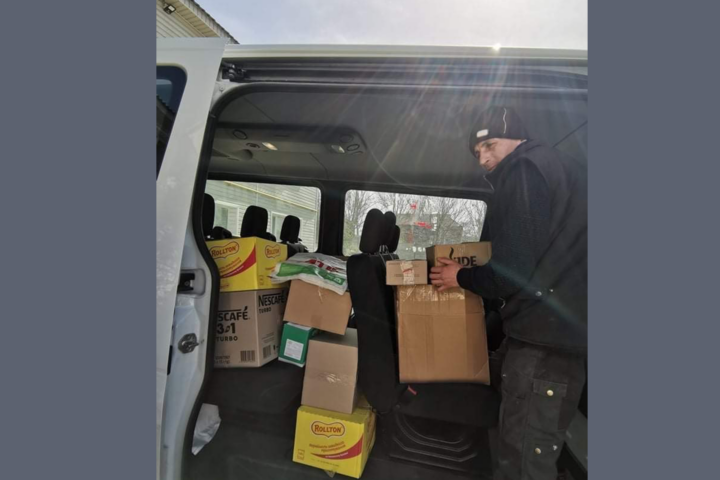
As the war in Ukraine approaches the end of its second month, logistic constraints and the targeting of hospitals and health care facilities by Russian forces have made delivering care to everyday citizens with health needs especially challenging.
In the middle of these challenges, one special partner of the Presbyterian Foundation is continuing to provide meals, wheelchairs, health services, diabetes care, and expert support especially for vulnerable Ukrainians including orphans, people with physical and mental disabilities, and stroke patients.
Gods Hidden Treasures is a ministry founded by Nita Hanson, a member of Emanuel Presbyterian Church in Thousand Oaks, California, though she now resides in Florida.
In regular recent updates, Hanson keeps an upbeat tone while speaking of the desperation in Ukraine. Two staff drivers are making regular trips with the organization’s “blue van” and “white van” to Ukrainian border towns with Poland, Romania and Slovakia, transporting people fleeing the fighting and returning with food, medicine, clothing, and other supplies. She says people want to leave the areas of fighting, but many don’t want to remain in Ukraine.
 “Many praises to God and many thanks to all of you for the prayers for the safety of our mini convoy to Kramatorsk,” she wrote on April 11. “Everyone was safely taken from Kramatorsk – many of them wanted to go to Dnipro which for me was hard to understand because it is not a safe place either – right now safer than Kramatorsk, but not for long if Russia has its way. I can’t tell you how relieved I am that they are safely on their way back home.”
After arriving back to the ministry’s headquarters in the town of Fursey a day later, she wrote: “It was an interesting group of people we picked up – not one of them wanted to go to a different country. Many were taken to Dnipro, several to villages near Kiev or Bila Tserkva – some to the village of Squirra and so forth. We still have one man who hasn’t decided where he wants to go. Praise the Lord that we were able to help close to 100 people get to safety!”
The war has made delivering services more difficult and medical supplies harder to get. Five staff members have left the country temporarily and one has relocated to western Ukraine due to the conflict. Other staff are coordinating with partner churches in conflict areas to help assess and deliver needs when the pathways are safe.
A recent purchase of iodine and water purification tablets is ready for distribution – iodine in case of nuclear attack or contamination, water purification for municipalities who’ve had their water supplies sabotaged by Russian troops. Over 7,500 people in God’s Hidden Treasures’ network will receive the pills in addition to a quantity to be distributed to Ukrainian soldiers.
These disruptions are on top of COVID protocols that put off some of the ministry’s services. Rather than in-person customized wheelchair fitting, technicians have had to help people remotely. Home visits have been curtailed and social workers have provided life-saving social support for clients and families over the phone. Referral services continue to assist those with special needs and, when possible, staff provides direct aid and medical support.
“We don’t have any people with disabilities”
Hanson first visited Ukraine during a three-week church mission in 1995, only four years after the country had gained independence from the Soviet Union. While she describes the Ukrainians she met as “poetic, heartfelt people who take you into their hearts and that’s where you stay,” she was shocked by the conditions she observed in orphanages and in the care of people with disabilities.
She entered her first Ukrainian orphanage, Veloshka, within the first two weeks of her arrival. There Hanson found several children languishing and unresponsive. The orphanage, like so many in the region, had adopted the Soviet-era methods of caring for children, especially those with special needs, which involved little more than feeding them and providing a place to sleep.
“When I first went there, even a newborn baby was fed with a bottle propped up on a blanket or something – they weren’t held ever,” Hanson remembers. “That affects your physical and emotional development forever.”
With little to no physical or mental stimulation, and no loving touch, Hanson could see these children – about half with mental and physical challenges, others merely handed over to the state by their parents – were never going to receive the necessary therapies to live lives outside of a clinical setting. She also learned that a panel of experts evaluated children when they turned three – classifying many as “imbeciles” thereby sentencing them to a life within the walls of an institution.
“I would go in there and hold all the children, and [the orphanage workers] would get mad at me and say, ‘When you leave, all the children cry,’ and I said, ‘Well, good, at least they’re not sitting there rocking back and forth to soothe themselves.’”
 Moved to action, Hanson returned in 1996 for volunteer year with the co-mission in Ukraine. She made her first solo visit in 1997 and started to build the relationships she cultivated in subsequent annual visits leading to the formation of God’s Hidden Treasures in 2000. For the first 15 years of the ministry Hanson says she spent more time in Ukraine than in the U.S. and just prior to COVID restrictions was spending half of each year there guiding the work.
Although Hanson has no medical or social services training – she worked in marketing before sensing the call to serve children in Ukraine – she was keenly aware of gaps in services received by these children, adults with disabilities, and other vulnerable people.
“There was nothing there for people with disabilities,” Hanson says. “When I first went to Ukraine, I never saw anybody with disabilities, except if they were a war veteran – and even that was suspect”
Her Ukrainian contacts, who had never been allowed to visit an orphanage, didn’t believe what she’s seen. They told her, “Oh no, you’re wrong because we don’t have any people with disabilities.”
Undeterred, Hanson brought her Ukrainian friends to see the children in their playground. They, too, knew they needed to extend the hand of Christian compassion to these little ones.
“They were the first ones to get people outside to see this and start encouraging them to think about providing services and tell these children that you can be somebody, you can go to school. You can!” she says.
Two children who received care from God’s Hidden Treasures have participated in the Paralympics. One graduated from the university in Kiev and is now a lawyer.
“It’s amazing the changes because when I first started doing this everybody just said, “We’re going to die early and that’s our future,” says Hanson.
From its origins with orphans and children with special needs, God’s Hidden Treasures has expanded its care network to include a wheelchair ministry that has delivered and custom-fit over 8,000 wheelchairs and mobility aids, diabetes detection and aftercare, a stroke rehabilitation program with an incredible success rate, and a meal program for economically vulnerable people.
The value of partnerships in mission
God’s Hidden Treasures primarily serves the needs of people living near its headquarters in the surrounding Bila Tserkva District in central Ukraine. The ministry delivers services and visitations to more than 1,700 families in 58 nearby villages and occasionally provides wheelchairs and referral services throughout the country.
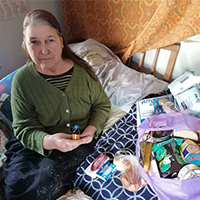 A shoestring budget of $200,000 per year provides for the needs of the 18 Ukrainian staff members, the purchase of wheelchairs, food, medical supplies, and organization vehicles. The staff includes three men who were helped as orphans along with a full-time doctor and nurse. Nita and her band of U.S.-based volunteers are not compensated for their work, ensuring all donations go directly to helping Ukrainians in need.
“Everything is run by the Ukrainian employees and I’m only there now to keep them on course,” Hanson says of her role at God’s Hidden Treasures. “I’m very, very careful with spending money. I feel that weight of responsibility that it’s God’s money, not mine.”
At 80 years old Hanson, who has a daughter, five grandchildren and five great-grandchildren, shows no signs of slowing down, though she realizes the need for long-term planning.
“I haven’t found anybody to take my place and that’s a big concern for me,” she says. “God used me to be the visionary. My two top people are training someone and they’ve taken over partial responsibility already. Our director has trained a new office manager, so we have some succession as that goes forward … God just keeps telling me, ‘Just keep doing what you’re doing. I could raise up somebody in a day.’”
Hanson says she’s never sent a fundraising letter, relying on her presentations at U.S. churches and word-of-mouth to spread the news about God’s Hidden Treasures and raise funds for the services it provides. One such presentation inspired a team from the Presbyterian Foundation, including President and CEO Tom Taylor, to visit in 2012.
“God told me when I started, you have two ministries, one to Ukraine and one when you go back to America, you need to tell people what I’m doing,” she says of her initial calling. “I was sitting out there in the pews and look what God has done.”
Hanson credits God’s Hidden Treasures’ employees in Ukraine for their creativity and ingenuity in responding to the ever-changing needs over the past two years and especially in recent months. The ministry’s work has continued through these difficult times, and she has faith its work will adapt as needs arise.
“All I can take credit for is that I said yes. What a privilege to think that God would work through me because I wouldn’t have used me,” she chuckles. “But it’s true, all God ever asks of us is just to be available.”
Gregg Brekke
Gregg Brekke is an award-winning freelance writer, editor, photographer and videographer. He is the former editor of the Presbyterian News Service. Send comments on this article to Robyn Davis Sekula at robyn.sekula@presbyterianfoundation.org.
 English
  Korean
  Spanish