
12/4/2025
‘God is so endlessly creative, and the body of Christ is so endlessly diverse’
by Mike Ferguson

Since this season’s theme for the Presbyterian Foundation’s broadcast “Leading Theologically” is exploring discernment, the show’s host, the Rev. Zoë Garry, knew just who to call to be her guest: her old friend and mentor, the Rev. Michael Gehrling. Their half-hour conversation is available here.
Gehrling, who’s worked eight years in the Interim Unified Agency’s 1001 New Worshiping Communities movement, where he’s currently associate for recruitment and assessment, is himself an experienced church planter. He recalled for Garry, associate director for theological education funds development for the Presbyterian Foundation, a memorable experience while still in seminary of hearing God’s voice while driving college students home in a church van.
“I very clearly heard God say to me that I was going to plant a church with my friend,” a fellow seminarian, Gehrling said. “I grew up in a church where things like that didn’t happen — and if they did happen, people didn’t talk about it.”
Gehrling “was experiencing God telling me to do something I wouldn’t have thought to do otherwise, and I needed other people in my life to help me interpret that.” He said he was fortunate to have mentors including Vera White, who at the time was the staff member at Pittsburgh Presbytery tasked with helping new churches to flourish. “She told me to start prayer-walking in the different neighborhoods of Pittsburgh, trying to determine where God was calling me to go,” Gehrling told Garry. “There was a lot of discernment around learning to trust that voice I had heard and also to invite the voices of other human beings into that work. I think that’s what discernment is — it’s listening to God ourself, but it’s also listening to the voice of God through others.”
Sharing with others that we’ve heard the voice of God isn’t something all of us are comfortable with, Garry said. Gehrling said he had a friend in the church youth group he grew up in who thought God does indeed speak today, but we just don’t know it.
Since hearing God’s voice that initial time, Gehrling has heard it several more times, “and I’ve had people teach me how to be more sensitive to the Spirit at work.” It’s changed the way he reads Bible stories, he said. “I used to read the stories of the prophets and the apostles and I assumed when they were hearing God speak, it was hitting them over the head a little bit.” But for Gehrling, “it was an undeniable voice, and if others were there they would be hearing and seeing the same thing. The more I learned about my own experience with God and how God speaks and hearing from others how God speaks to them, I’m beginning to realize it’s usually not that neat and tidy. There is a sensitivity to the Spirit we need to cultivate in ourselves.”
“In ourselves and also in community,” said Garry, who recently attended a 1001 New Worshiping Communities training that employed the Discerning Missional Leadership Assessment. She asked Gehrling to explain how potential church planters can use the assessment.
The assessment is part of a five-day retreat that includes conversations on the nature of the work of starting something new and “some of the activities involved in that,” Gehrling said. The conversation also includes a look at “how we speak about Jesus and how we alter or transform our language a little bit so we’re not using words that have meaning to us in the church but don’t have a lot of meaning to folks outside the church,” terms including “Lord,” “Savior” and “Messiah.” They also discuss how to best work with others and how to build a team. “We also reflect on who we are — what our strengths are, where we’re going to have to grow in ourselves just to really flourish in this work,” he said.
The strength of the DML assessment is twofold, Gehrling said. “One is wanting to give folks every opportunity to bring forward the best version of themselves,” he said, through written exercises, one-on-one and group conversations, and walking around the neighborhood and exploring it together. “We also wanted to make the process value-added for the participants,” he said. “We did not want this to be just hoop-jumping in order to get approval for funding.”
When Garry asked about the benefits the assessment provides, Gehrling thought of dancing, which he not only does but teaches, including partner dancing. When he’s teaching, he insists that dancers rotate periodically and dance with different partners, a practice that throws some a little off guard.
“What we say to them is, if you dance with everybody in the room, you’re going to be a better dancer,” Gehrling said. “If you dance only with your partner, you’re not going to learn the dance so much as you’ll learn to compensate for one another’s mistakes, and you’re not going to get better.”
Similarly, “When we limit our discernment to just our own people, it runs the risk of the people around us being blind to the same things we’re blind to, or they may not want to let us know what they’re seeing in us,” he said. “We need outside sets of eyes sometimes — folks who don’t know us well, so we can get some feedback from them about how we show up in a room and what kind of first impression we make, with as close to an objective set of eyes as possible. We can get feedback that isn’t affected by a long history or the affection that our friends might have for us.”
Such an assessment process involves “naming the awkwardness,” Gehrling said. “We’ve all been in this position of getting feedback from others. We know it can feel uncomfortable. We are doing this process wanting folks to flourish.”
“I tell folks I don’t care much if your new worshiping community succeeds or fails. We want them to succeed, of course,” he said. “But what I do care about is whenever God calls you to the next thing after you leave your new worshiping community, I want you to be able to enter that from a place of strength and not from a place of having been burned out.”
Even if the new worshiping community doesn’t work out as planned, “I want you to be able to look back on this season of your life as a season where you grew — spiritually, personally and professionally.”
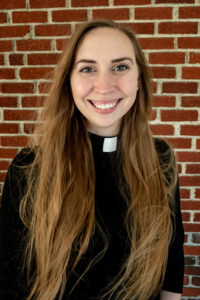
The Rev. Zoë Garry
Sometimes the conversation is around “the need to set permeable boundaries,” Gehrling said. At the outset of establishing a new worshiping community, “you’re not likely to have an office. You’re also not likely to have folks who are ready to call you ‘pastor,’” a term that might not be in their vocabulary, Gehrling noted. “They’re going to relate to you as a friend. You need to find that balance of honoring those friendships that are developing and also caring for yourself and recognizing your own limitations.”
Garry wondered how doing discernment work with others has shaped Gehrling’s own call.
It’s expanded his understanding of who God and Jesus are, as well as what church can look like, he said. “God is so endlessly creative, and the body of Christ is so endlessly diverse,” Gehrling said. He said he’s “constantly blown away” by the things that Jesus inspires the leaders of new worshiping communities to do, including holding services in former gymnasiums or on hiking trails.
When God is present, Gehrling said he can feel it in his hands. “It feels like electricity moving through my hands. I have learned to trust that when I feel it,” he told Garry, “and I’ve learned that that by itself is not sufficient. I need other voices too. I need folks to feed back to me what they’re seeing in my life.”
Watch previous editions of “Leading Theologically” here.
Mike Ferguson
 English
  Korean
  Spanish