
10/27/2025
Doing the work is a key part of stewardship
by Nancy Crowe
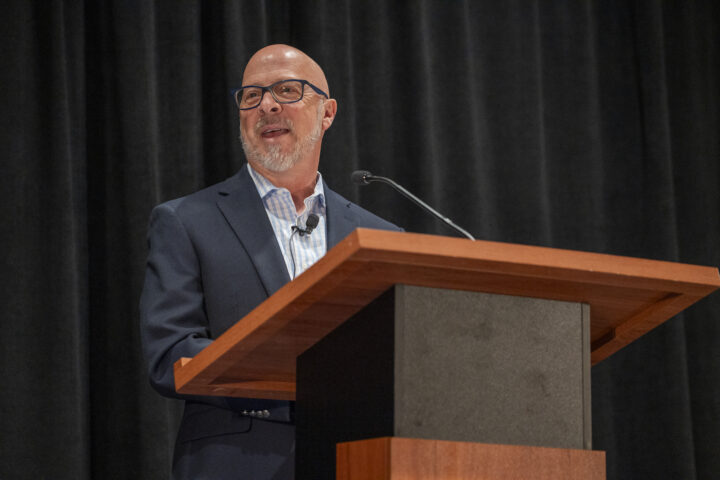
Rev. Dr. Corey Nelson once talked with a young graduate student who said he had a steady girlfriend — a soul mate. Yet there were other beautiful women on campus he wanted to date.
Nelson advised the young man to choose: be faithful to his current partner or end the relationship to be free to date others.
The student’s eyes widened. “But the Bible says with God all things are possible!”
Nelson couldn’t help but laugh, which inspired the young man to give the church a one-star Google review later that day.
Nelson, pastor and head of staff at First Presbyterian Church in Fort Collins, Colorado, shared this story during a plenary gathering at Stewardship Kaleidoscope Sept. 23 in New Orleans. The annual conference is presented by the Presbyterian Church (USA) and Evangelical Lutheran Church in America.
You can’t pray deficit away
Churches faced with budget shortfalls often cite the same quote (Matthew 19:26), which Jesus offered after advising a rich young man to give away his wealth in order to have treasure in heaven.
That’s not quite what Jesus meant, Nelson said.
Deficits, declining attendance and such can’t be prayed away, but they can — with God — be solved if church leaders are willing to put in the work, Nelson said.
Nelson came to his current call in 2016. An interim had helped the congregation heal from a schism caused when the former pastor urged the church to leave the denomination over its stance on LGBTQ+ issues.
Much work remained, especially on the financial front. Members were being asked for donations to meet the current shortfall, there was a large mortgage on the property, the budget was being balanced with “frozen funds” and staffing was inefficient.
What worked
Nelson shared what helped his congregation get to a much healthier place, both in money and mission, less than a decade later. Though every congregation’s situation is different, here’s what he would advise:
- Build trust “on the map.” Spend time on your congregation’s vision and self-identity, and build relationships. With the support of wife Miriam, Nelson hosted many dinners at his home in his first few months at FPC Fort Collins. (It was more lasagna than he’d eaten in his lifetime.)
- Project a responsible budget. About 80% of the church’s income is from pledges, but pledged amounts are not used to set the budget. Deaths, moves and other changes in active membership are carefully tracked; therefore, so is active giving.
- Use compelling communication. Nelson developed an “elevator speech” he uses every year during stewardship season. It emphasizes inspiration, not pressure; hope for a better world; and the opportunity to create a balanced budget to enable more focus on mission.
- Develop new models for personnel. Nelson put together a team of skilled human resources professionals and brought in legal counsel (worth the investment, he said) to handle potentially sabotaging issues of staffing changes and severance packages. The staff of 18 was reduced to eight, with no administrative assistants — employees handle their own administrative tasks — and lay employees instead of associate pastors.
- For planned income and expenses, use anticipated income for anticipated expenses and surprise (one-time) income for one-time expenses. Have a prioritized list of needs for one-time gifts and a gift acceptance policy.
Trust equals generosity, Nelson emphasized. “People are going to show up with gifts when they can trust us,” he said.
“I believe the local church, when it’s healthy and faithful, is the hope of the world.”
Nancy Crowe
Nancy Crowe is a writer, editor, and animal wellness practitioner based in Fort Wayne, Indiana. She is a graduate of Louisville Presbyterian Theological Seminary. Send comments on this article to Robyn Davis Sekula, Vice President of Communications and Marketing at the Presbyterian Foundation, at robyn.sekula@presbyterianfoundation.org.
 English
  Korean
  Spanish