
10/17/2026
Creating a stewardship sermon series that fits your church context
by Chuck Toney
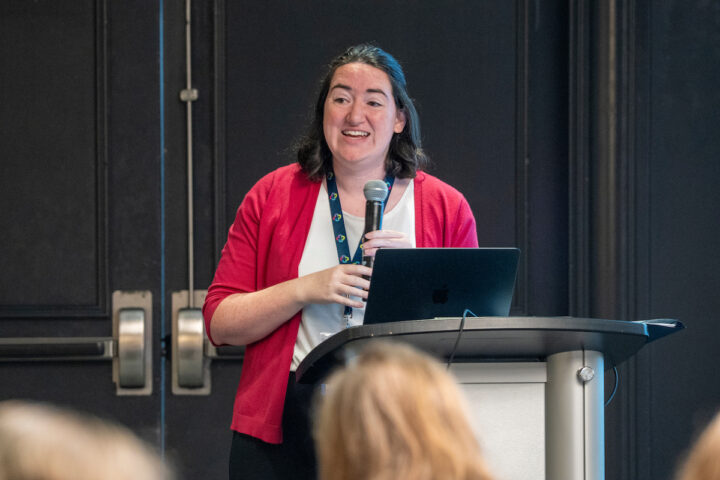
Rev. Carol Holbrook Prickett believes that a well-planned, well-researched, and well-delivered sermon series is a powerful tool for preaching on stewardship – and also for preaching generally.
Given declining rates of regular attendance in many congregations, the pedagogical repetition characteristic of a sermon series increases the chance that “the message gets to everyone.”
Prickett, pastor of Crescent Springs Presbyterian Church in Kentucky near Cincinnati, shared some practices that she has found fruitful during a workshop at Stewardship Kaleidoscope 2026, a conference presented by the Presbyterian Church (USA) and Evangelical Lutheran Church in America; this year’s conference was held in Baltimore, MD, September 20 to 23.
She also offered a lighthearted confession.
“Stewardship is my favorite season of the church year, and you can quote me on that,” she said to chuckles from attendees. “I am the daughter of a professional fundraiser; there was always conversation at our dinner table about how to raise money. I spent a lot of my childhood watching TV and licking nonprofit envelopes.”
Why choose a stewardship sermon series?
What Prickett learned as a child informs how she preaches about stewardship now. After asking her audience to share what motivates their stewardship practice, she offered four reasons of her own which can serve as the basis for preaching a sermon series on stewardship:
- It is a time to focus on the spiritual practice of generosity.
- It is a time to focus on the spiritual practice of caretaking.
- It is a time to tell the stories of your church’s mission and ministry.
- It is a time to cast a vision for the church’s future.
“Using this model to create a customized series for your congregation can help you speak better to the hearts that God has given you to care for,” she said. “In my congregation, the spiritual practice of caretaking is the most important one. They care for each other, for our building, and for me.”
Prickett is honest in her assessment of the small church she serves, proudly sharing a slide from a few years ago that shows her at the center of a group of a few dozen congregants.
“That’s all of us,” she said. “We went from a church that didn’t see itself as successful to a place we can be proud of because we saw stewardship as a chance to put faith into practice. It became a binding agent, and while the money didn’t always increase, engagement did.”
A sermon series is also good pedagogy.
“I approach a sermon series like building a unit in a college course,” she explained. “Repetition is a feature, not a flaw – it makes the message stick.”
She shared five elements for developing a sermon series.
Exegete your congregation.
- What is your congregation’s worship style?
- What is the accepted definition of stewardship? What motivates them to give to the church? What are the existing strengths in giving patterns?
- What are the emotions and mindsets that may need to be stretched?
Choose a central theme.
- Think about “who” (your congregation) before “what” (your theme). The preaching should capture their imagination while still speaking to the congregation you have.
- Don’t force a theme – be led by your knowledge of your people. “It is better to do something small well than something dramatic poorly. Do not make your people cringe. Pay attention to the mood of the congregation.”
- Imagine your series as a personal pastoral care opportunity. What scripture and images would you use? Apply the same practice to the stewardship pastoral care of your congregation. If you are not interested, they will not be interested.
Build out your series.
- Know your Bible.
- Choose the subthemes and scripture that supports them or find the scripture that illustrates your larger theme and let that determine your subthemes.
- Keep working the process to create a compelling collection of verses, images, and subthemes.
- Go beyond the obvious stewardship text and stories. People pay attention when they are surprised.
Think beyond the sermon.
- Find ways to bring the sermon series into the larger worship experience. Opportunities include liturgy, offertory, music, bulletin, or a Minute for Mission.
- Use your church’s other communications channels – website, social media, email, newsletter – to share the sermon series theme and message.
- If possible, integrate the theme into Sunday School classes, youth group, small groups, and other gatherings.
Finally, don’t let the theme distract from the overt stewardship message about needs and finances. “Ask, ‘Why is this particular church worth giving to?’” Prickett said. “I say it like this: As you think about what you are going to give, I want you to think about your giving and how it makes an impact on your soul.”
Prickett shared elements of a stewardship series that she preached during COVID, when her caretaking congregation was struggling with separation and isolation. She was drawn to the image of the woman at the well in John 4 and the idea of living water.
“The cool creative thing I was doing in 2020 was surviving,” she recalled. “Why would people give money to a church that has suspended all of its activities in person? Does this church still matter in the community? But by doing church in the hardest possible way, this church was giving something back to its members that was worth the work.”
The woman at the well, she added, was doing the hard daily survival work of drawing water from a well that someone else dug. “She was offered living water by Jesus, which is a perfect metaphor for the church. It is built by human hands and is where we receive the love and grace of Christ.”
Prickett archived this series and others at https://deepwellworship.com/.
A Deeper Well: Series Outline
Week 1: The Woman at the Well (John 4:4-15)
What Christ offers us is deeper than what the world offers us. The church is like a well. We need it to survive, but it can also be exhausting. It is dug by our hands, and the water we draw from is hefted by our own tired arms. Yet the water is Christ’s, and it is life-giving. Commit this year to sacrificing with us to dig this well, but also to drawing deeply from it when you are in need of grace, mercy, and comfort.
Week 2: Elijah and the Widow of Zarephath (1 Kings 17:8-16)
What we offer God sometimes requires us to dig deep with immense trust and sacrifice. The widow of Zarephath digs deep and sacrifices much to trust Elijah’s promise of abundance. How can digging deep to give meaningfully to the church help connect us with our trust in God?
Week 3: Rachel and Jacob (Genesis 29:1-14)
Church as the nexus of where love happens. In scripture, love stories, like Rachel and Jacob’s, often happen around a well. Church is also the site of love stories–not romantically, but the place where we fall in love with ordinary, sainted sinners. Encourage the congregation to reflect on the love they experience within the church community, and frame giving as an act of love.
Week 4: The Throng at the Throne (Revelation 7:9-19)
Relief at the end of the journey and why what we do is worthwhile. Revelation paints a portrait of the diverse throng around the throne, singing God’s praise, whom Christ will guide to the springs of the waters of life. Our faith promises us that there will come a time when we will no longer have to do the backbreaking work of well-digging to taste Christ’s goodness. We give to the church as a way of creating a glimpse of that kind of world, where all have comfort, grace, and truth.
Recalling the earlier remark about her love for preaching about stewardship and acknowledging the anxiety that many pastors feel about the topic, she reminded attendees that, as leaders of congregations, they can inspire confidence in their people.
“Tell them that you believe they can do this, because you know them and love them,” she said. “Tell them that they have something to offer their church.”
Chuck Toney
Chuck Toney is the founder of C. Toney Communications in Athens, GA. Chuck is an elder who leads the Generosity Team at First Presbyterian Church of Athens. Send comments on this article to Robyn Davis Sekula, Vice President of Communications and Marketing at the Presbyterian Foundation, at robyn.sekula@presbyterianfoundation.org.
 English
  Korean
  Spanish