
4/7/2026
Connection and vulnerability are keys to supporting faith communities, congregations
by Robyn Davis Sekula
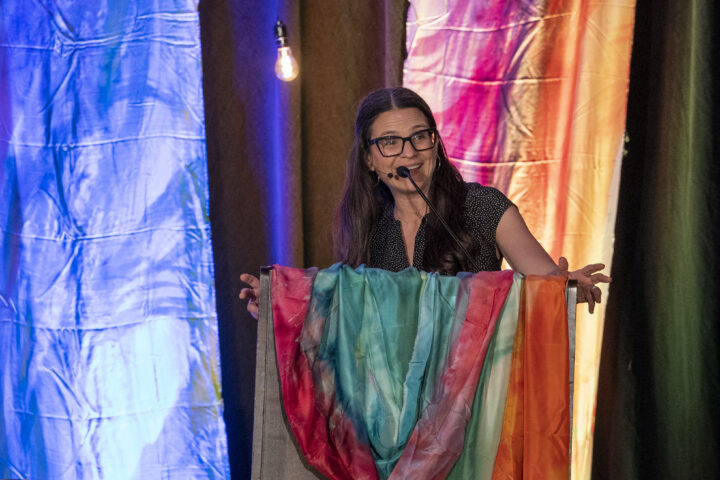
Rabbi Sharon Brous, senior and founding rabbi of IKAR in Los Angeles, urged church leaders to resist isolation, embrace vulnerability and deepen human connection during the opening plenary address at the Luminosity conference, held March 9 to 11 in Orlando.
The conference was designed, organized, and sponsored by the Presbyterian Foundation as a place for pastors and church leaders to come for inspiration and illumination.
Brous, author of The Amen Effect: Ancient Wisdom to Mend Our Broken Hearts and World, drew from Jewish teaching, pastoral experience and personal testimony to reflect on loneliness, grief, caregiving and the spiritual necessity of community. Brous gave the opening keynote at the conference.
“I want to share with you today how an obscure ancient ritual changed my life,” she said, “and helped me build a community in Los Angeles that’s become a great source of strength and moral clarity for me and for many other people, and has become kind of my North Star, for spiritual and moral leadership, for this time of so much heartache and division and uncertainty.”
Her address centered on an ancient ritual described in the Mishnah, in which those who were grieving, lonely or suffering would walk in the opposite direction from the crowd at the Temple Mount, allowing others to stop and ask about their pain.
That ritual, she said, carries a lesson for faith leaders and communities today.
“What I realized, after pastoring to my community for 10 years, was that 2,000 years ago, our rabbis constructed a system of ritual engagement that is built on an incredibly profound psychological insight,” she said. “It is precisely what we are most inclined to retreat from one another, that we must instead turn towards each other, with compassion and with curiosity. Because that, on some level, is exactly what it means to be human.”
Brous spoke at length about what she described as an epidemic of loneliness, social alienation and isolation, saying the crisis harms both individuals and the broader society.
“We were living through an epidemic of loneliness, of social alienation and isolation,” she said. “A condition that would only be exacerbated by COVID a couple of years later. And it was actively already breaking our spirits, hurting our bodies, and threatening our democracy.”
She framed connection not as optional, but essential.
“Human beings need connection,” Brous said. “It is connection that gives our lives meaning and purpose.”
Later, she added, “We have a profound human need to be seen as we truly are, which makes social connection, not a luxury, but actually a spiritual necessity.”
For pastors and other church leaders and caregivers in the room, Brous acknowledged both the calling and the cost of walking with others through pain. She emphasized that the work of ministry is not to solve suffering, but to accompany people through it.
“What we need when we’re hurting is not repair,” she said. “…Our task as a community, as friends, as pastors, is not to repair each other’s broken hearts, or to heal or save, or distract, or cheer each other up. I really believe that unless we are heart surgeons or car mechanics, our work is not actually to fix what’s broken. It’s just to sit together in the dark. It’s just to be present.”
At the same time, Brous said those who care for others must also allow themselves to receive care. “There comes a time when even the healers need healers,” she said.
Drawing on her own experience in ministry, she warned about the cumulative effect of carrying the pain of others without release. Even just taking tiny amounts of pain from each person ministered to adds up over time.
“If we take 160th of each person’s pain again and again, we eventually are saturated in pain,” Brous said. “It’s just math.”
She recounted a personal experience during sabbatical when, after the death of her cousin, a healer in Costa Rica helped her recognize the toll that years of accompanying others through grief had taken on her body and spirit.
“After 20 years as a rabbi, I understood that there was a heartache that burrows deep into our bodies,” she said. “If we fail to digest and release what we are absorbing from our community members, at some point, we will fill up 60 times 160th with other people’s sorrow and our own.”
Brous returned again and again to hope, and to the possibility of communities shaped by compassion, curiosity and courage.
“The call that I hear is to transform our communities, our churches and synagogues and schools, and organizations into places of true belonging,” she said. “In a time of so much dehumanization, to build and support spaces that rehumanize us, sacred pockets in which every single person feels that she is seen through the eyes of love.”
She closed by urging leaders to choose encounter over withdrawal, even in a divided and wounded world.
“That sacred circle reminds us that we can choose to turn to one another with compassion, with curiosity, and with courage,” Brous said. “And through the sacred recognition of each other’s humanity, we can make love our home. I believe that this may be the best and most enduring way that we can mend our broken hearts, our broken communities, and our broken world.”
Brous is widely known beyond her congregation for her public leadership. She has been named the most influential rabbi in America by Newsweek/The Daily Beast and has been recognized by The Forward and Jerusalem Post among the most influential Jews alive today. Her work has been featured in The New York Times, Los Angeles Times and The Washington Post, and her 2016 TED Talk, “Reclaiming Religion,” has been viewed more than 1.5 million times.

Robyn Davis Sekula
Robyn Davis Sekula is Vice President of Communications and Marketing at the Presbyterian Foundation. She is a ruling elder and member of Highland Presbyterian Church in Louisville, Ky. She can be reached at robyn.sekula@presbyterianfoundation.org.
 English
  Korean
  Spanish