
9/25/2018
Between scarcity and abundance
by Rev. Larissa Kwong Abazia
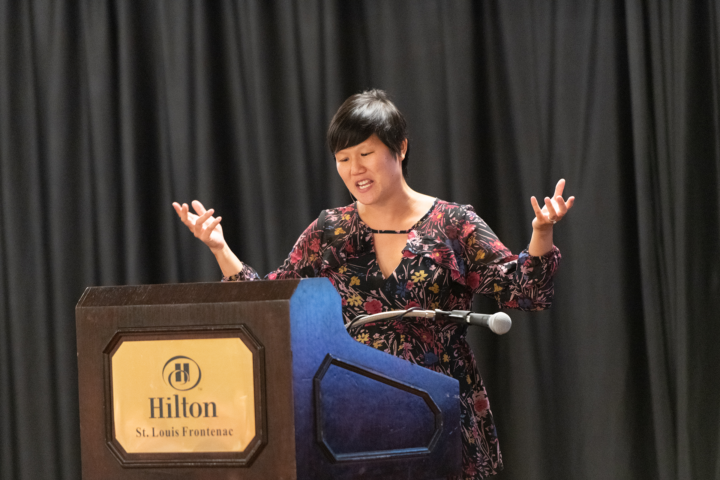
Editor’s note: Rev. Larissa Kwong Abazia was the Opening Worship leader at Stewardship Kaleidoscope 2018 in St. Louis. She preached the sermon below during worship on Genesis 47:13-26. The sermon below is her original material and should only be used or reprinted with attribution.
Out of desperation comes exploitation.
We all know that this isn’t the way it is supposed to be…this hidden chapter in the story of our hero, Joseph, as he rises from the pit to serve Pharaoh. It is a rags to riches story and a riches to salvation story as he is reunited with his family and, without hard feelings, places them in the best land within Egyptian boundaries so that they can be an asset to his royal boss and escape the famine in their own land.
But this chapter? This chapter is problematic. And it’s probably even more so because we never talk about it, never read it within our churches. Most of us might not even know that it exists.
Last we heard, Joseph headed up a strategic collection during the seven years of plenty for such a time as this and yet he charges the people for their own stocked up crops. And the masses, desperate to have something in their stomachs, pay him. The money goes right to Pharaoh’s coffers stocked up like the grain that we realize might not have been for the good of the people at all.
It very well might be possible that Joseph was strategic about taking the Egyptian’s money but not their livestock because the next year the people return with stories of starvation and struggle again. Faced with the demands to feed themselves and their animals, they proclaim that they have no money, but their beasts would be healthy collateral. It seems like a natural next transaction as Joseph takes every single horse, flock, herd, and donkey; almost every earthly possession so that they can eat for just one more year. It’s no surprise that the people have to return on year three, desperately struggling, saying, “We cannot hide from my lord that our money is all spent; and the herds of cattle are my lord’s. There is nothing left in the sight of my lord but our bodies and our lands. Shall we die before your eyes, both we and our land? Buy us and our land in exchange for food. We with our land will become slaves to Pharaoh; just give us seed, so that we may live and not die, and that the land may not become desolate.” (Genesis 47: 18b-19)
These actions and words are not from those who live under a thoughtful, compassionate leader. I imagine that Pharaoh’s yearning for security motivates Joseph’s own desire to stay in a land that is not his own. Both men yearn for power and authority, though perhaps motivated for different reasons. But the end result is the captivity of a whole nation and their land, while the rich continue to get richer and solidify their reign.
This is a story of people pushed to poverty and hunger in the shadows of the stores of grain that proclaim Pharaoh’s power. These are the words of people who have nothing left but to sell their own bodies so that they can live another day…and Joseph is the political leader who accepts the proposal without question.
What is so compelling to me throughout this narrative is the Egyptians’ rootedness in community and Creation in the midst of their desperation. While willing to sell their bodies, they acknowledge the waste if they and their land were to perish. Their request comes from a place of hope for the future, any future, despite the miserable prospects if Joseph rejects it…but their offer was something that he could not refuse. They bank on Pharaoh and therefore, Joseph’s, desire for productivity. Without the Egyptians, no one would till the land and harvest the crops. There wouldn’t be workers, which means no income, no continued political dominance. It’s a proposal that neither side can reject but only one ultimately wins.
While this may very well be the beginning of the struggle between scarcity and abundance in the Biblical tradition, it is an ageless story that connects to us today. (Brueggemann, The Liturgy of Abundance, the Myth of Scarcity: Consumerism and Religious Life.) It is, perhaps, the topic most approached in sermons and prayers in our congregations. The clashing consumerism and unending message of security and power coupled with a life of faith that supports anything but the tangible. We take pride in the theological foundation that our churches are meant to be communities of exploration and discernment.
“Be in the world, but not of it,” we say.
Yet when it comes to stewardship seasons, so many of our meetings are focused on what we do not have: attendance is low, buildings have on-going issues, renters add wear and tear to our spaces, visitors and regular attendees are uncertain about membership, we have to deal with the long list of other beneficiaries tugging at people’s wallets (the “competition”), and the Church as a whole has lost its place in larger conversations. We’ve become an afterthought in a long list of to-dos and sound bites: a less attractive exploration of prophetic imagination as activists take the frontlines while we squabble and debate within our sacred walls.
 While 11 months out of the year we want to deepen people’s faith journeys and exploration of discipleship (at least I hope that’s what we want to do!), many of us turn to a stewardship season where we go right back to the ways of the world. We measure numbers of programs/members/attendees/growth, attempt to tell a compelling story, and sell people on the money that we need to stay afloat. We work to convince them that we are really a good, worthwhile investment. Then we celebrate that final stewardship Sunday, collect pledges, re-dedicate our congregation to the work and then move on until next year’s pitch.
We’ve fallen into the trap of inside and outside: what happens inside our walls and what is outside of them. Yet if we learn anything from Joseph, it’s that the lines are much more blurred than that. The pressures of this world are, in fact, the pressures and anxieties of our own faith. More often than not, it can be easy to fall into the trap that our faith doesn’t provide enough tools for us to be able to navigate the treacherous pressures of the world. We may want to be in this world and not captivated by it, but the 167 hours during the week outside of worship are urgently pressing. If we were really honest with ourselves, we walk right into our worship spaces wearing the messiness of the world on us.
The pastor’s invitation was warm and inviting, “Friends, all is prepared at the Table. Come and break a piece of bread as large as the grace and love which you believe God bestows on you…not just a tiny crumb! Come and celebrate this feast hosted by our Savior, Jesus Christ.”
As the music played in the background, the gathered congregation formed two lines as they walked down the aisle toward the bread and the cup. My seven-year-old son stood in front of me, worried about what he had to do. Right before he got up to the pastor and elder serving in the front, he took a step backward and tightened his whole body. He turned to me and said, “I don’t know what to do.” He shook his head back and forth, wearing a very worried look on his face.
My son looked into her eyes, reached out again, and pulled with a bit more strength at the crusty loaf of bread. Smiling, he looked at the bread and then the pastor before sliding over to dip it into the waiting chalice. Popping the juice-soaked bread into his mouth, Jonathan proudly walked back to the pews grinning from ear to ear.
We need to worry that we are Joseph in the story, a faithful leader who went astray as the pressures of surviving in a land took over the guidance of his community of faith. We could do well to learn from him for sure.
But to be honest, the people I want to know the most about from the narrative for this evening are the priests. These tax-exempt religious leaders (sound familiar, friends?!), who keep their money and land under the willing glare of Pharaoh and his political leadership, we learn absolutely nothing about them form the written text. And here’s why I want to know about them: Because whatever they were doing during this oppressive famine must not have been enough because the Egyptian people come year after year to save themselves from starvation.
Whatever they were doing as the people languished around them, they were not counseling the political leaders on the moral and faithful imperatives of this particular time and place. Because if they were, maybe Joseph would have stepped back or Pharaoh would have let go of a bit of his anxiety to bend to the pressure of the religious leaders around him.
Whatever they were doing, or not doing, Pharaoh kept them in his favor because he needed someone to bless him. And my guess is that they were navigating far closer to the political leader to save themselves rather than challenge the oppressive enslavement of the community around them. How do I know this? Because the beginning of Exodus reminds us that their slavery extended for generations beyond Joseph’s reign…so much so that the ruling Pharaoh doesn’t remember the favor toward this Hebrew man in their larger history.
If you want to know where the stewardship portion of this sermon begins, the part about money, then I’m here to tell you that it begins with discipleship. It starts with embracing the church’s ministry to walk alongside people as they discern their own call as they uncover who they are created to be. It’s a pastor who leans down to look at a seven-year-old boy in the eyes and invite him to sit at the Table that Christ has prepared just for him. It’s when she tells him to take more because he deserves it and, even if he has doubts, he reaches out to tear off a larger piece of bread because the invitation is too wonderful to turn down. And then that same seven-year-old boy skips down the aisle from the Table, transformed from an abundant moment of grace and love that he never fathomed when he begrudgingly came to church that day.
It’s when that seven-year-old boy says over the clanging of the organ marking the closing hymn that Sunday, “That bread was soooo good. I want more of that!”
If our faith communities don’t know who we are and who we are meant to be as followers of Christ, then we have failed. We have allowed our churches to become “well-adjusted” to our culture so that we “fit into it without thinking” as the passage from Romans declares.
Throughout this conference, we will talk about strategies and approaches to transform stewardship in our churches. I trust that we will walk away with new skills in our toolkits to enhance the fundraising potential in our contexts. We will all leave knowing more than when we came.
But if we aren’t heard above the din of the countless other sources seeking the donations of our members, if we are wailing over the shrinking numbers in our pews while avoiding the reality that many people are finding more places of discernment outside of our sacred spaces rather than within them, if our story is just one of many and lacks a prophetic vision for a transformed world…that’s on us, not them.
So in these next few days as you are privileged to do this work, may you focus on the yearnings of your churches and congregations to respond to the brokenness of the world around them. Only then will we illustrate the abundance of a simple Table set with bread and wine; a Savior’s final meal that provides all of the nourishment that we need for the journey ahead.
Rev. Larissa Kwong Abazia
Rev. Larissa Kwong Abazia (she/her) is an ordained pastor in the Presbyterian Church (USA) and founder of Courageous Spaces, inviting others to co-create spaces for disruption, transformation, and change.Larissa has dedicated her life and career to racial and gender justice, exploring the ways the intersections of all parts of one’s identity can be embraced and celebrated. This work brought her to denominational leadership, including service as the Vice-Moderator of the 221st General Assembly of the PC(USA) and as a current member of the General Assembly Committee on Representation. She also serves as the Transitional Head of Operations for More Light Presbyterians and as a coach and consultant with NEXT Church.
 English
  Korean
  Spanish