
4/15/2025
Trusting God with all we have – May 2025 Lectionary Preview, Year C, Acts 9:1-20, Psalm 23, Acts 11
by Rev. Dr. Anna Pinckney Straight

The bridge was out.
The year was 1998 and I was in the middle of a six-day backpacking trip on the Wonderland Trail in Mount Rainier National Park. My companions were now friends but none of us had known each other just a few days before, and we were led by two experienced backpackers. It was a demanding trip that took us into the backcountry. Two years into parish ministry this was exactly what my heart desired: a pilgrimage on foot without access to a phone or a computer. Everything we needed was carried on our backs.
It had been a particularly rainy season, and one of the bridges had washed out, recently enough that it had not yet been discovered by rangers who would, in that era, have traveled there, helped us cross, and begun repairs. What was there to do? You could not go out or around, there was only backwards or forwards. We could retrace our steps from the last three days or continue forward to complete our trip.
Our phenomenal leaders found a place where logs could be placed across the river and tested their sturdiness for us to walk across the river on them. As they tested, the logs shook, but did not give way.
To say that I was uncomfortable with this plan would be a significant understatement. I am risk averse. I pay my credit card bill the day after the statement closes. You won’t ever find me without an extra dessert in the freezer (this is called an Emergency Dessert in my household and it is non-negotiable). I don’t like driving more than four miles over the speed limit. Carrying a fifty-pound pack over rushing glacier-cold water was NOT a part of my plan. My initial reaction was to say “no.”
Our leaders listened and did their best to reassure me, but it came down to a very simple question. Did I trust them? “Of course I did,” I responded, “but….”
I went over my options and realized that if I did in fact trust them, then I needed to move forward with their plan. Trust in word only is not really trust. And I did trust them. They had proven themselves over the previous three days to be wise, wonderful, and worthy.
We went forward. It was not easy, but they were right. We made it. And if we had fallen (Mount Rainier National Park is not Disney World, after all), they knew what to do. I remember the river as raging and the logs as shaky as aspen leaves in a fierce wind, but I suspect my memory has embellished it a bit. It was likely more of a serene stream. Still, I learned what trust was, really.
We are living at a very particular moment in history in which more is being asked of us. There are greater needs and larger divides. And the question is being asked, “Do we trust God?” How often do we answer that question with “Of course I trust God, but…”
If we trust God in word only, is it really trust?
If we trust God with everything but our schedules, is it really trust?
If we trust God with everything but our hearts, is it really trust?
If we trust God with everything but our treasure, is it really trust?
The invitation to trust God, really, with our treasure and what we learn from that trust is one of the things I love most about stewardship. As a wise mentor has reminded me on more than one occasion, Our treasure does not follow our heart; our heart follows our treasure. “For where your treasure is, there your heart will be also.” (Matthew 6:21) Stewardship is a way we can learn to trust God. Giving generously of our treasures, learning to see that everything is God’s, is a way to journey into greater faithfulness in all things.
The scripture readings for the Revised Common Lectionary in May of 2025 are filled with the kind of faithful trust of which our congregations are in particular need just now. Would you consider a sermon series in May on Faithful Trust?
On May 4 in Acts 9:1-20 (you should definitely include the optional verses) we are told of the conversion of Saul. While Saul’s post-conversion life might be a master class in trust, his conversion is more something that happens to him rather than something he desires. In this text it is Ananias who sets the example of trust. God asks him to go and help Saul. “Lord, I have heard from many about this man, how much evil he has done to your saints in Jerusalem.” Ananias questions. God responds. Ananias goes.
If trust is in word only, is it really trust?
May 11 brings Psalm 23 where we walk through the darkest valley (we do not take up residence there, our shepherd leads us through) and in John 10 Jesus reminds us that disciples won’t just believe, they will follow.
If we do not follow where God leads, is it really trust?
May 18 invites us into Peter’s dream found in the 11th chapter of Acts where the voice from heaven tells him “What God has made clean, you must not call profane.” To trust God Peter had to set aside something he had believed his whole life to be true and trust this new thing God was teaching.
If we are not willing to let go of the past, is it really trust?
And on May 25 the story of Lydia from Acts 16 has Paul now being the one who responds to a vision and goes to Macedonia where he meets Lydia, and her household is baptized. (The Gospel text includes the command to show our love by keeping God’s word.)
If we do not go when God calls, is it really trust?
This is a time when more is being asked of us. I’m sure your churches are seeing it, too. Food banks with rising demand. Worldwide missions trying to find new directions with critical needs all around. Financial uncertainty. This is not the time to back away from encouraging stewardship, it is the time to ask for more and share more. More giving. More offering. More trusting in the God who has promised to care for us in all moments.
Interestingly, one of the roots for the Hebrew word for trust speaks of a place of refuge. Not fleeing in order to find refuge, but a safe space that is created in the act of trust. I wonder about the refuge that is created when we are willing to go, love, and be lead that is not possible when we remain where we have always been. We cannot find our home in God without leaving home. In the Greek it is likened to being persuaded to obey.
In both languages, trust is a verb.
Most of us don’t come easily to this kind of trust.
“Trust in the Lord with all your heart, and do not rely on your own insight.” (Proverbs 3:4-5) We want our own insight and understanding to lead us to trust. God tells us that the understanding might come later, but that it should not keep us from trusting.
I’m reminded of what author A. J. Jacobs gleaned from his year of following all of the rules of the Bible, “the glory found in following things you cannot explain.” (This is from his book The Year of Living Biblically: One Man’s Humble Quest to Follow the Bible as Literally as Possible.)
Where do you and your congregations trust, and where are there whispers of that word “but?”
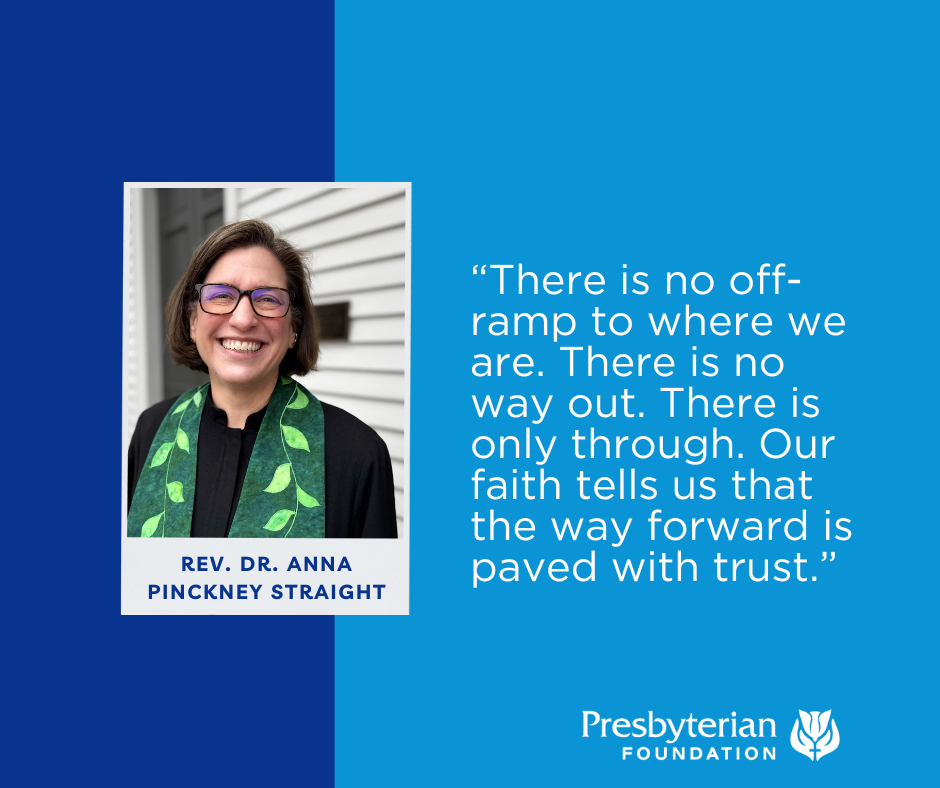
There is no off-ramp to where we are. There is no way out. There is only through. Our faith tells us that the way forward is paved with trust.

Rev. Dr. Anna Pinckney Straight
Rev. Dr. Anna Pinckney Straight is the pastor and Head of Staff of First Presbyterian Church in New Bern, N.C. A native of Charleston, S.C., she’s served congregations in West Virginia, Pennsylvania, and now (for the second time) North Carolina. She is a graduate of Agnes Scott College, Union Theological Seminary in New York City, and Wesley Theological Seminary.
 English
  Korean
  Spanish