
9/22/2025
The widow and the unjust judge – October 2025 Lectionary Preview, Year C, Luke 18
by Dr. Raj Nadella

One of the Gospel texts for October is the familiar story of a widow and the unjust judge (Luke 18:1-8). The story highlights the widow’s persistence and what she was able to accomplish despite the heavy odds that were stacked against her. Too often the judge gets credit for eventually overcoming his proclivity to injustice and doing the right thing. But did he really have a choice? The widow was persistent, but her persistence alone did not get the job done. It was her resourcefulness that eventually got the desired results. The Greek text suggests that the widow wore the judge down with her relentless pursuit of justice, but also by making him aware of the consequences of not doing the right thing (18:5).
The story is known for what it says about the valiant efforts of the widow, but it also stands out for what it does not say. Luke mentions other people in that town but says little about how they responded to the judge. If the judge was widely known to be unjust and little regard for human welfare, did anyone else try to hold him accountable? By all accounts, others in town were better positioned than the widow to hold the powerful judge accountable. Luke offers little evidence that they made any effort to challenge him or effect change in his behavior. The widow would have been the last person one might have expected to bring the unjust judge to his knees. That’s the surprise element in the story, and it raises the question of how a powerless widow succeeded where others failed or did not even attempt.
The widow refused to accept the narrative that the powerful who act in unjust ways could not be tamed. Given what was at stake for her, she did not have the luxury of accepting things as they existed. She refused to normalize the status quo wherein the powerless have little recourse to justice. She envisioned an alternative reality and believed in her ability to facilitate change. The widow had just a few resources and skills at her disposal but apparently put all of them to use. She exercised all her options and talents until she got what she needed for her life to be meaningful. When we see her story through this lens, the story of the widow becomes the parable of fully utilized talents.

Those at the margins do not always have all the resources to facilitate change but, paradoxically, they also do not have the luxury of not pursuing change. Their immense and urgent need to pursue change forces them to think outside the box and bring all that they have to bear.
In Luke’s gospel, it is often the people at the margins who act in surprising ways and play an outsized role in effecting change. At the beginning of the gospel, it is Mary rather than the powerful Zachariah who acted in liberative ways. It is the mustard seed that is highlighted as the example of faith that transforms communities in profound ways (13:18-21). The tax collector offers the appropriate prayer and has the right disposition towards God and people (18:9-14). The least are able to do big things or act in profound ways.
From their marginal locations, the least can see things others cannot. Their marginal status offers them the clarity of vision to see things differently and in transformative ways. They can envision possibilities that many others have written off. Too often we become too steeped in tradition and familiar ways that make us normalize the status quo and undermine our ability to envision new possibilities. What does it take for us to step outside our comfort zone and pursue new possibilities? Can we listen to those at the margins to see where God can take us in this new era that presents us with too many challenges?
Luke sets the story of the resourceful widow in the context of Jesus’s discourse about the reign of God. God’s reign arrives when people refuse to normalize the status quo and pursue the seemingly impossible. It becomes a reality when they refuse to give up hope amidst myriad of challenges and invest themselves in what they pursue. Whether we have sufficient resources and talents to realize our goals matters. What matters even more is our dedication and commitment to the cause as well as our ability to bring all our talents to the table, as the widow did, and act in liberative ways.
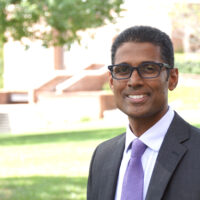
Dr. Raj Nadella
Dr. Raj Nadella is the Samuel A. Cartledge Associate Professor of New Testament at Columbia Theological Seminary. His research interests include postcolonial biblical interpretation, migration and New Testament perspectives on economic justice and their implications for the Church and society. Nadella is the author of Dialogue Not Dogma: Many Voices in the Gospel of Luke (Bloomsbury, 2011), co-editor of Christianity and the Law of Migration (Routledge, 2021) and co-author of Postcolonialism and the Bible (forthcoming). He is currently co-editing The Oxford Handbook of the Bible, Race and Diaspora. Nadella serves on the editorial boards of Currents in Biblical Research, The Society of Biblical Literature’s Review of Biblical Literature, Semeia Studies and Oxford Bibliographies Online: Biblical Studies. He has written for publications such as Working Preacher, The Christian Century, The Huffington Post and Sojourners. He served as the 2024 Living the Word monthly columnist for the Sojourners magazine. He has spoken and preached in numerous academic and ecclesial settings, including on Day1 Radio and at the Princeton University chapel.
 English
  Korean
  Spanish