
1/20/2026
The Story of Transfiguration: February 15, 2026 Lectionary Preview: Year A, Matthew 17:1-9
by Dr. Raj Nadella

By all accounts, the transfiguration of Jesus was a beautiful sight to behold. Jesus and his key disciples are on a high mount with sweeping views of the ground below. Jesus appears in all his glory and is flanked by two of the greatest figures in Jewish history. Transfiguration places Jesus squarely as a prophet and leader in the tradition of Elijah and Moses.
One can understand Peter’s excitement and grand plan to ensconce the moment by building three tents. Peter even articulates the right confession about Jesus’s identity. But Peter’s grand plan runs headlong into the voice from heaven that seemingly offers a Christological corrective.
Matthew’s readers might recall that the same voice was previously heard at the baptism. Jesus was declared as the son of God at baptism when he participated in and advanced the movement of repentance that invited people to turn their backs on oppressive political and economic structures rather than be complicit in them. The subsequent series of temptations that Matthew records foreground Jesus’s identity as the son of God. The Greek phrase, Ei huios ei tou theou should be translated “since you are the son of God…”
The devil was not necessarily questioning Jesus’s status as the son of God but was asking him to employ the power of his status to advance his own interests. At stake was not whether Jesus was the son of God but how that unique identity should play out and to whose benefit. Within that literary and theological context, Jesus’s response clarifies that being son of God entailed not pursuing one’s own power but placing it in service of others. It was not about turning stones into bread in order to feed oneself but about exploring all possible ways to make bread accessible to those who lacked it, as his subsequent ministry demonstrated.
Peter’s proposal to build three tents stands in stark contrast to Jesus’s articulation of his own identity as the son of God and reflects a proclivity to seek one’s own comfort and safety. It is also inconsistent with political choices made by Elijah and Moses, two prominent Hebrew leaders, who chose to confront powers of their time for the sake of people. Peter rightly acknowledges Jesus as Lord but does not realize that Jesus’s lordship was intrinsically linked to providing an alternative to the lordship of Caesar who was solely interested in advancing his own power and interests. Peter has the right title for Jesus but inaccurate understanding of what it meant to worship him.
Matthew juxtaposes the scene unfolding on the high mount with the crowd gathered below (Matthew 17:14-20). One would have hoped that Peter’s view from the high mount offered him clear idea of the crowds below and their urgent needs. Peter, however, was immersed in the glorious scenes unfolding within his vicinity and lost sight of the crowds below. Peter is keen to build tents for his own inner circle on the high mount so he could avoid coming down the hill and address the needs of people.
The voice from heaven firmly reminds him to listen to Jesus about what it meant to acknowledge the lordship of Jesus. Ultimately, Peter’s articulation of the lordship of Jesus and his knowledge of Jesus as the son of God will have meaning only as long as he, like Jesus, places his power and proximity to Jesus in service of those down the mountain.
Too often, we act as the Church that is more interested in glorifying Jesus and articulating right theology rather than in realizing what it means to worship Jesus as the lord and son of God. The voice from heaven reminds us that worshipping Jesus is not about remaining in a comfortable theological or political tent on a high mount but about attending to the needs of the crowds below.
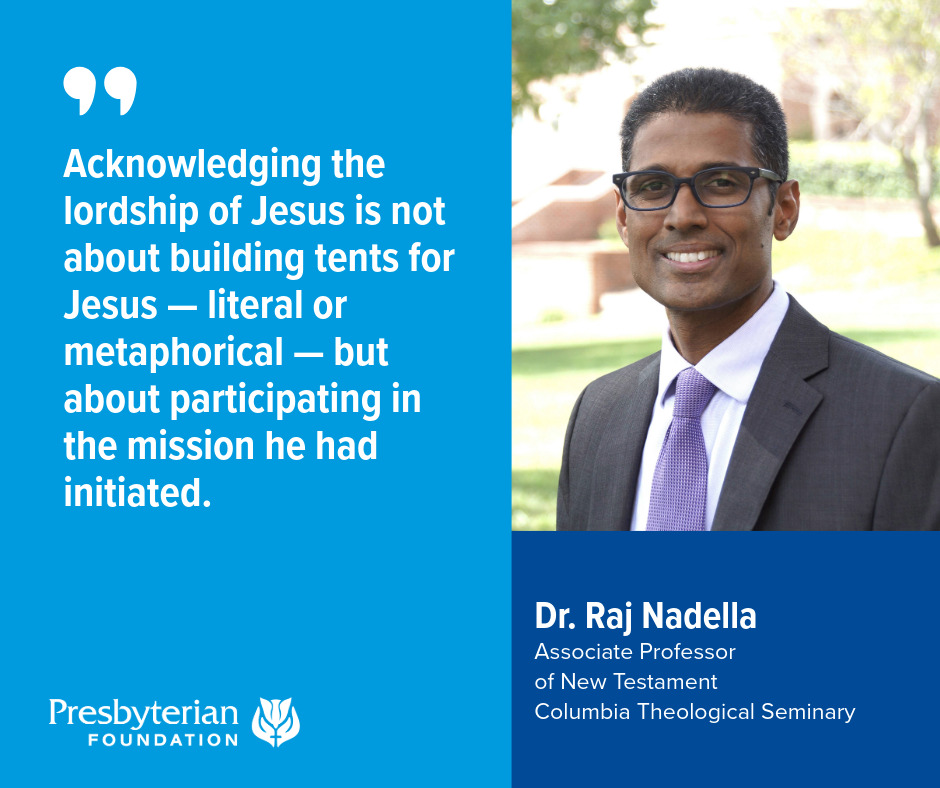
Acknowledging the lordship of Jesus is not about building tents for Jesus — literal or metaphorical — but about participating in the mission he had initiated.
Will we stay put in the comfort of the buildings of various types we have built, or will shift our attention from mansions to mission so that we can go down from the high mount and confront the harsh realities others are facing? The Church’s welfare and survival depend on our response to such questions.

Dr. Raj Nadella
Dr. Raj Nadella is the Samuel A. Cartledge Associate Professor of New Testament at Columbia Theological Seminary. His research interests include postcolonial biblical interpretation, migration and New Testament perspectives on economic justice and their implications for the Church and society. Nadella is the author of Dialogue Not Dogma: Many Voices in the Gospel of Luke (Bloomsbury, 2011), co-editor of Christianity and the Law of Migration (Routledge, 2021) and co-author of Postcolonialism and the Bible (forthcoming). He is currently co-editing The Oxford Handbook of the Bible, Race and Diaspora. Nadella serves on the editorial boards of Currents in Biblical Research, The Society of Biblical Literature’s Review of Biblical Literature, Semeia Studies and Oxford Bibliographies Online: Biblical Studies. He has written for publications such as Working Preacher, The Christian Century, The Huffington Post and Sojourners. He served as the 2024 Living the Word monthly columnist for the Sojourners magazine. He has spoken and preached in numerous academic and ecclesial settings, including on Day1 Radio and at the Princeton University chapel.
 English
  Korean
  Spanish