
4/22/2024
Stewardship Reflection: Legacy Giving – Tell the Second Story
by Rev. Kyle Nolan

In his excellent book Accompany Them with Singing, Tom Long notes that Christian Funerals are always telling two stories at the same time. The first story is the obvious one—the story of a death, the death of someone known and loved, along with all the details of separation and pain that accompany such a loss. When it comes to this first story, the Church’s task is to acknowledge the “sheer facts” and to do so with care and love.
The Church can and does tell this story—reliably in most cases. But the first story doesn’t necessarily require a church to tell it. Friends and family gathered in a funeral home might suffice. But then there’s the second story, “a story made possible by Easter,” writes Long, “a story that unmasks death’s lies”:
This story is that a saint of God, precious in the sight of God, is being carried by the faithful, not to the abode of the dead, but into the arms of God. We tenderly carry the body of the one we have loved to the place of farewell, weeping perhaps, but also singing psalms and Easter songs as we travel. This body of the saint is a sign of remembrance and thanksgiving for all that we have received in and through this person’s life and also a sign of hope that death has done its worst and lost, because the God who defeated death in the raising of Jesus Christ has also raised this child of God in an imperishable and glorified body (Long, 46).
Both stories need to be told. But it’s the second story that makes a funeral Christian. The Church and the funeral find their purpose in bearing witness to the second story.
The need to tell the second story doesn’t only apply to funerals. A human institution with a divine mission, the church is always striving to speak in two registers, always oriented toward God’s ultimate ends while minding a variety of penultimate ones.
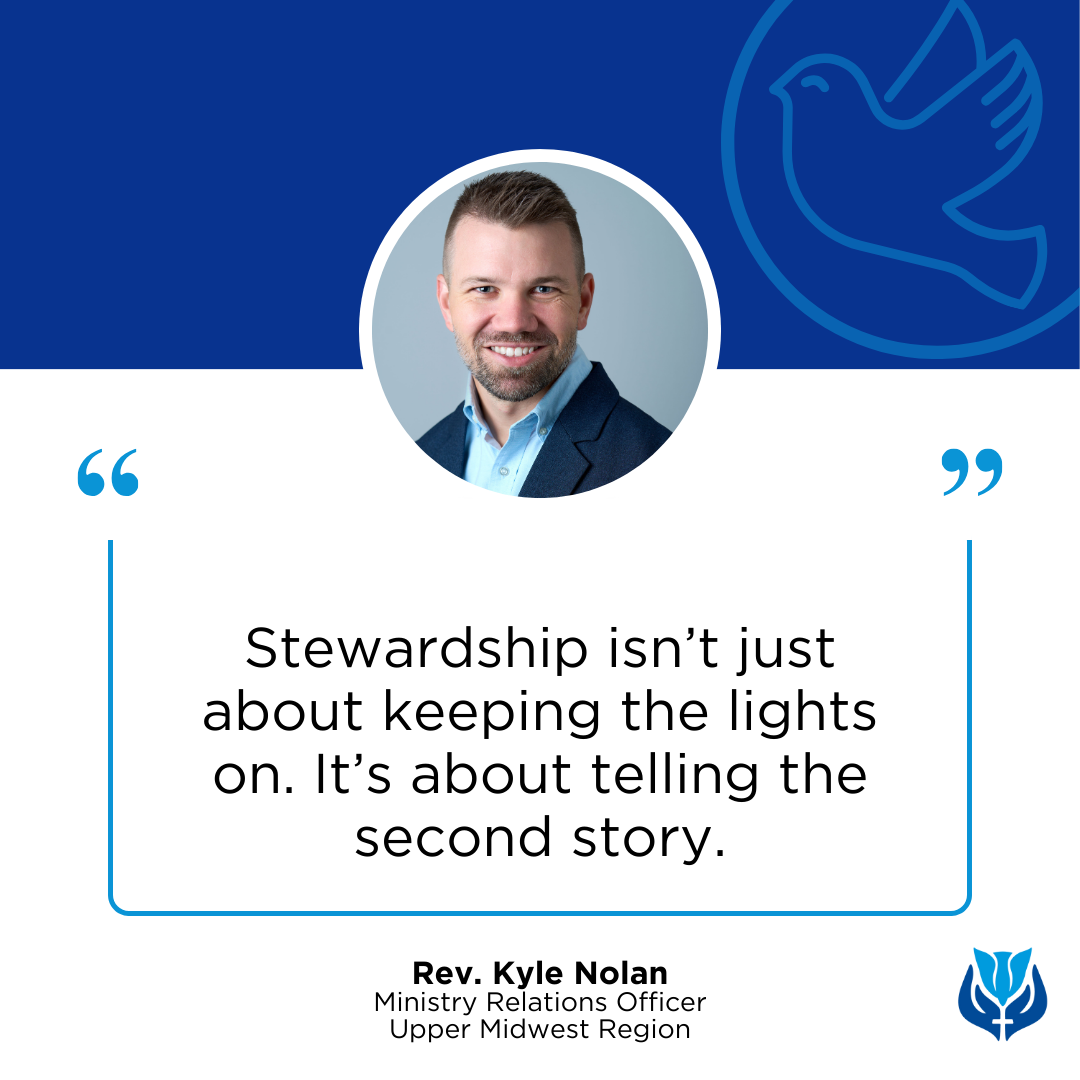
When it comes to stewardship, for instance, much of our work doesn’t look all that different from the sorts of things that you’d see in any other nonprofit. We manage budgets. We pay bills. We make appeals. We focus on impact. But at the same time, we’re aware that funding the operations of the institution is in some sense secondary to our offering our gifts of time, talent, and treasure as a thanksgiving to the One who gave us life and defeated death. And we celebrate whatever good use God makes of those gifts as a sign of the new creation. Stewardship isn’t just about keeping the lights on. It’s about telling the second story.
Legacy giving is similar. Universities, foundations, and all sorts of social good organizations invite individuals to pass on their values through a final estate gift. Churches are right to learn from them and do the same. But we can offer something more. If we’re faithful to our mission, we must.
Robert Jenson once wrote that the church’s message is a specific word, and the church’s mission is a specific act, which is “to act on those particular possibilities and hopes which are plausible if and only if what the gospel says about Jesus is indeed true—that he is in control of the future.” And to this, he added a word of caution:
If the church does not get this word said, all the other words it might say are better said by someone else…and if the church does not perform this act, all the other good deeds it might do are better done by someone else. (Jenson, Story and Promise, 4).
The Church’s specific word and the second story are one and the same. In the invitation to leave a legacy by passing on something of what we’ve received in this life, we shouldn’t simply see an opportunity to share our values. More than that, we should see a chance—even in death—to tell the second story. An occasion to proclaim, indelibly, the church’s word. To join with all the saints in proclaiming the mystery of faith: Christ has died. Christ is risen. Christ will come again.

Rev. Kyle Nolan
Rev. Kyle Nolan is a Ministry Relations Officer serving the Upper Midwest region, which includes North and South Dakota, Minnesota, Iowa, Nebraska and Wisconsin. He works with congregations to create a culture of generosity, offers seminars and workshops, develops gifts and fundraising plans for ministries, and provides coaching to finance, stewardship and endowment committees. He previously served as Associate Ministry Relations Officer at the Foundation.
 English
  Korean
  Spanish