
3/4/2026
Blessing and Benediction from Rev. Rebecca Mallozzi
by Rev. Rebecca Mallozzi

16 I do not cease to give thanks for you as I remember you in my prayers, 17 that the God of our Lord Jesus Christ, the Father of glory, may give you a spirit of wisdom and revelation as you come to know him, 18 so that, with the eyes of your heart enlightened, you may perceive what is the hope to which he has called you -Ephesians 1:16-18
I appreciate the parts of Paul’s letters that tell the people what he’s praying for when he thinks about them. I can imagine, for a community of faith, it would be helpful to know exactly what Paul’s prayers are so they get a glimpse of his expectations for them. It also lifts up a teaching for them to grasp onto. Paul is praying for the Ephesians, that, with “the eyes of your heart enlightened, you may perceive what is the hope to which God has called you” (Eph. 1:18). What I wonder is how we who read these words today perceive the hope to which God has called us.
God has called us to hope. This word hope shows up quite a bit in the New Testament writings. In Romans, Paul says hope doesn’t disappoint. In I Corinthians, hope abides, along with love and faith. The French writer Alexandre Dumas said once that all human wisdom can be contained in two words: wait and hope.
God has called us to hope, which is an expectation or desire for something to happen. Hope is trust. As a people of faith, we are waiting for Jesus. We live between the two advents: one where Jesus is born and the one where Jesus comes again in final glory. We live in the hope of God’s kingdom: thy will be done, on earth as it is in heaven.
Our task, as disciples, is to live hopefully. It was Paul’s prayer for the Ephesians, to perceive the hope God called them into, and I think it would be Paul’s prayer for us today. As disciples, we try to live hopefully. We acknowledge what’s hard, learn to be at peace with things out of our control, face the hard things we can face, and do all things with hope.
This does not mean we avoid grief. It does not mean we can’t be sad or angry or frustrated. Paul tells the Thessalonians to grieve, but to grieve as those who have hope.
Maybe this is why Emily Dickinson called hope “the thing with feathers that perches in the soul.” Feathers can have all kinds of textures. Feathers can be very strong, like hope. And some feathers are a little more delicate – also like hope. When we are brushing up against the rough edges of the world, it’s nice to imagine a feathered blanket of hope wrapping around us to keep us warm.
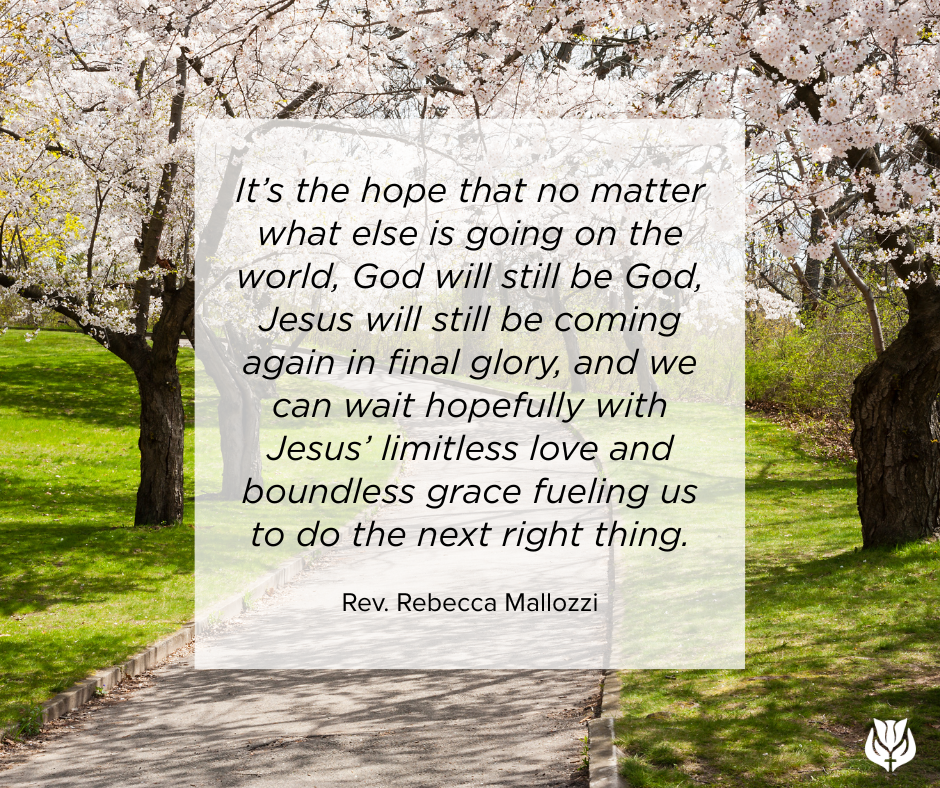
What is the hope to which God has called us? It’s the hope of resurrection. It’s the hope of Jesus Christ. It’s the hope that no matter what else is going on the world, God will still be God, Jesus will still be coming again in final glory, and we can wait hopefully with Jesus’ limitless love and boundless grace fueling us to do the next right thing.
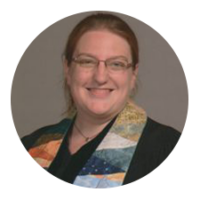
Rev. Rebecca Mallozzi
Rev. Rebecca (Becki) Mallozzi serves as pastor at Faith Presbyterian Church in Emmaus, Pa. She graduated from Waynesburg College (Pennsylvania) with her Bachelor of Arts in English and Communication and worked as a newspaper reporter before starting seminary. She graduated with her Masters of Divinity from Princeton Theological Seminary.
 English
  Korean
  Spanish