
11/16/2026
Make your church’s case for generosity through stories
Discover your why. Find one person. Write the story.
These three short sentences helped attendees strengthen their storytelling ability at a workshop called “Making the Case: Inspiring Generosity Through Story and Purpose” at the 2026 Stewardship Kaleidoscope Conference. The conference is presented by the Presbyterian Church (USA) and Evangelical Lutheran Church in America; this year’s conference was held in Baltimore from September 20 to 23.
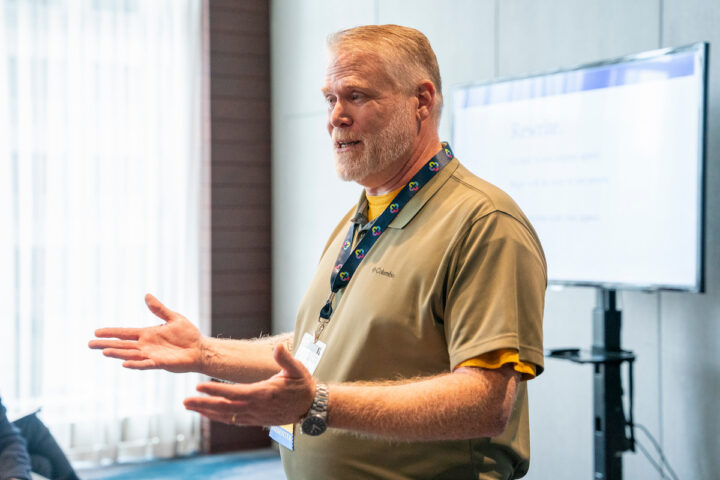
Michael Erwin, president of Church Campaign Services, a consulting organization that has worked with congregations on fundraising and stewardship since 1950, offered the interactive workshop. In it, he offered strategies that encouraged the practice of storytelling within church giving campaigns while providing prompted exercises for those present.
Erwin’s first prompt was, “Picture yourself as the pastor of a church, and someone says to you, ‘We need to raise money for such and such. I want you to stand up and talk about it.’ Next, write the opening paragraph of your next financial appeal.”
A personal perspective
As a pastor of a suburban church, I understand the challenges arising from owning a significant facility designed to serve the community as well as the church. Like many churches in perpetually warm central Florida, maintaining HVAC systems is vital to sustainable ministry. So I wrote the following opening paragraph:
We are in our creation care series. Remember the first message from Genesis, in which it says “A wind from God swept over the waters?” Well, that reminds me that we need more wind sweeping over our sanctuary — and our gym, our fellowship hall, and our daycare. The good news, friends: you can help make that wind happen as part of our HVAC replacement fundraising campaign.
Other participants shared their statements — pastors and members alike. At least one other “practice pitch” related to HVAC concerns. Another focused on the legacy of a faithful giver and how others could inspire giving as she did. Still others highlighted a parking lot and other maintenance issues. But one concerned a church interested in providing affordable housing to its neighbors.
Afterward, Erwin asked “What did you think each of those speakers wanted you to feel?” Answers included, “connection,” “be a part of this,” “community,” “compassion,” and “urgency.”
His next question was “How did they help you to feel what they wanted you to feel?” Respondents said, “humor,” “a sense of tradition,” “making God’s love visible to the world,” “calling on history,” “an invitation,” and “a personal story of one who made a difference.”
Purpose gives campaigns meaning
Erwin introduced the workshop with that exercise to drive home a foundational aspect of any request for financial contributions, but especially for an annual giving campaign:
“Before writing a compelling appeal, we must understand the deeper purpose behind the campaign,” Erwin said. “Projects are important, but purpose is what gives them meaning.”
This approach reflects Erwin’s work with congregations through Church Campaign Services, where fundraising is about more than meeting a financial goal. It is also an opportunity to strengthen leadership, deepen engagement, and connect generosity with the church’s mission.
Erwin then told his own story. As he was moving from a congregational ministry context to a traditional nonprofit, he needed immediate employment to pay the bills. He found it at Toyota. Part of that company’s lore is the engineer who came up with a process called “The Five Whys.” In other words, keep asking “why” up to five times until you reach the root of a problem.
Erwin stated, “The first answer to the why is usually true, but there’s more to it.” For giving campaign purposes, asking The Five Whys should also result in the core issue behind a ministry or campaign. The goal is not to ask exactly five questions but to keep asking until you reach what truly matters. At the workshop, attendees tried this process in pairs to get to the root of their campaign’s purpose.
Find one person
Next, Erwin asked the participants to identify one person who has been positively impacted by the church. Who is positively impacted because your church exists?
Erwin shared a small yet significant story to illustrate the point: he bought promotional pens with spinning sections built into them, designed for those who have a need to fidget or move during meetings. One woman who picked one up at his display table later told him, “You saved my life!” She gave one of the pens to a leader in her congregation, who had an annoying habit of clicking a pen repeatedly at every meeting. Removing the distraction and replacing it with a noise-free way to fidget led to more effective collaboration for the entire group.
Then he tasked those who paired up to tell a story about that person and the impact of church ministry on them.
“Stories do not need to be elaborate,” the accompanying slide reminded everyone. “Introduce someone, describe what happened, and show what changed. Simple stories are often the most memorable.”
Once the pairs completed their storytelling, Erwin directed everyone to reorder their appeal by starting with that story. As stories capture attention more effectively by emphasizing changed lives, they make natural launchpads for the ultimate appeal. And that appeal has also been shaped by asking “why” until the core issue is revealed.
Not all stories are about church members
One example that emerged from the ensuing discussion was about a pastor who met with a refugee from Afghanistan. The refugee was Muslim, but knew to come to a church in America for assistance. The pastor paid her rent, helped her get her car repaired, and helped her enroll in a phlebotomy course (even though it exceeded the usual benevolent account limit). Thanks to a young person who was also a phlebotomist, they found a way around the usual examination (conducted in English, which the woman did not speak).
Together, this church helped the refugee begin a new life in America, and the pastor was joyfully anticipating the blessing of the woman’s new home soon after the conference. This story of a changed life could easily inspire confidence in a church’s mission.
Erwin concluded the workshop with this reminder: “We are built to receive and hear and tell these stories. Not just because we want to receive money, but because we want them to be part of the story. Let’s do this together.”
 English
 Korean
 Spanish