
3/25/2026
Luminosity conference invites attendees to study the future of AI and accompanying ethical issues
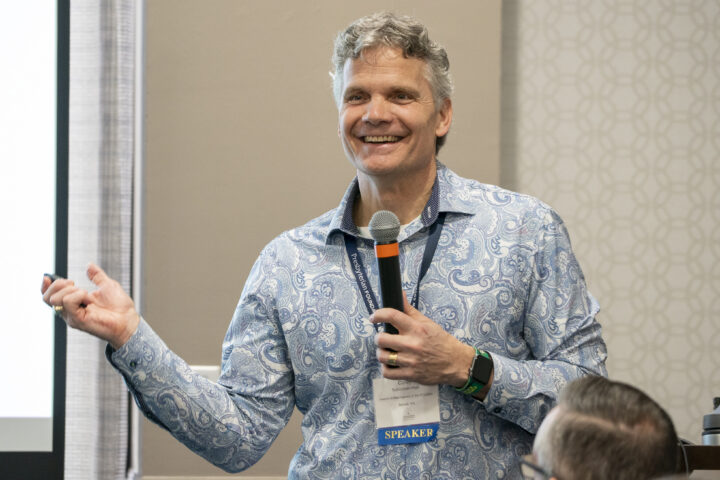
It’s not every day that you go to a workshop at a church conference and pretend to be your future self. But those who attended the “AI and the Council of Ethical Imagination” workshop at the inaugural Luminosity Conference enjoyed doing that and more.
Corey Schlosser-Hall, Ph.D. and Senior Director of the Interim Unified Agency of the PC(USA), led the interactive discussion and “social simulation.” He spoke during a workshop at the first Luminosity conference for church leaders, held in Orlando, Florida, March 9 to 11, 2026.
Schlosser-Hall advised the group upon arrival that he is not an AI expert; he’s just someone who is deeply concerned about it. And he is an advocate for church leaders to be theologians, moral visionaries and ethicists. He noted how the mainline churches (Lutherans, Methodists, Episcopalians, Presbyterians and other non-evangelical traditions) tend to be technology laggards today—something that was not the case in previous centuries.
AI and the Church
At the end of 2022, when the first version of ChatGPT was released, the Office of Innovation and 1001 New Worshiping Communities thought it wise to gather with representatives from other traditions to examine and discuss the ethical implications of the new technology. Thus, the first “AI & The Church Summit” occurred in Seattle in 2024. Ministries from the PC(USA), the Episcopal Church, and the Evangelical Lutheran Church in America sponsored and participated. In 2025, the summit met in Minneapolis at Westminster Presbyterian Church and online. It expanded to include the United Methodist Church’s Discipleship Ministries as another ecumenical partner, and it was renamed Faithful Futures: Guiding AI with Wisdom and Witness. The summit is scheduled to meet in Nashville in 2026.
Schlosser-Hall was one church leader at the 2025 conference who worked with Jane McGonigal, Director of Game Research and Development at the Institute for the Future, to design a game-like social simulation to help conference participants figure out how to inform and engage the larger culture with a moral framework for using AI, both inside and outside the church.
Thinking into the future
The workshop at the Luminosity Conference invited participants to create a bio of themselves 10 years in the future. Then, they gathered in groups of two or three to address a series of thorny questions at the intersection of morality, ethics, pastoral concerns, and artificial intelligence. This introduction to futurism helped folks understand that the discipline is not about predicting the future but imagining possibilities. As Schlosser-Hall noted, “We are often good at looking back, but not as practiced or skilled at looking forward.”
Each team then selected one or two of the following AI-related ethical issues and their “burning questions” as the most urgent:
- AI Companions: Can human dignity be preserved in AI-mediated relationships, such as caregiving bots or AI spiritual companions?
- AI Misinformation: How do Christians cultivate discernment in an age of AI-generated misinformation, deepfakes, and synthetic reality?
- The Jobless Generation: What is the Church’s role in a world where work no longer defines identity or worth?
- Planetary AI: What theological wisdom should shape AI governance of creation?
- The Church and the AI Rights Movement: What does your faith teach about soul, personhood, and the moral status of artificial beings?
- Digital Sabbath: Can the Church model a different relationship with time, attention, and rest in a culture of AI productivity?
- The Sanctuary Network: Is resisting AI surveillance a rejection of progress—or a prophetic stand for human dignity?
After the teams picked the issue(s) they thought most important, their next task was to select from among five “pathways of future influence” to address them:
- Moral Voice: Public Declarations, Convenings, and Ethical Frameworks
- Pastoral Guidance: Ethical Discernment and Individual Moral Formation
- Communal Embodiment: Practices, Rituals, and Countercultural Witness
- Spirit-led Innovation: Offering Products, Services, and Institutions
- Liberative Action: Organizing for Justice and Systemic Change
Inspiring conversations
This series of exercises engaged the workshop participants for the majority of the session. Conversations were loud and lively! My partner and I thought the AI Companions issue was the most urgent, and that communal embodiment was the most effective pathway of future influence, since bodies were at the heart of the issue.
Schlosser-Hall concluded the exercise and the workshop by mentioning that he would share the reports from both of the AI & The Church Summits, materials that allowed anyone to play the social simulation game in their own context with Jane McGonigal’s permission, and relevant papers from other churches and bodies. Together, these resources should continue to inspire overdue conversations in the church about what could be one of the most important issues affecting not only the church, but all of humanity.
 English
  Korean
  Spanish