
11/21/2025
Learning to lead with Brueggemann
by Nancy Crowe
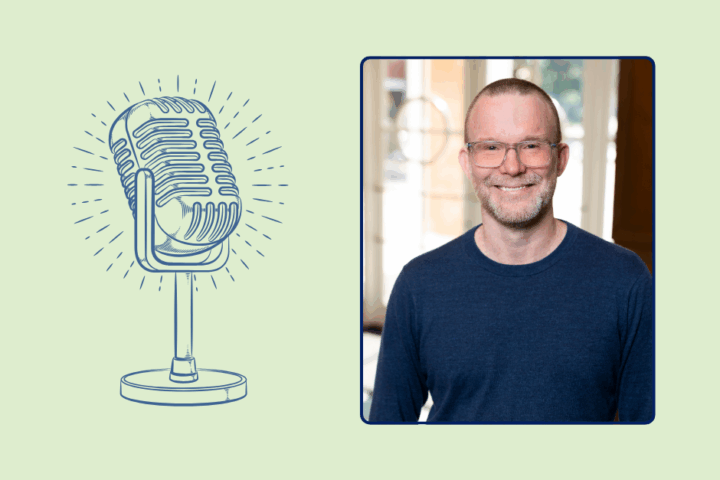
As a first-year student at Columbia Theological Seminary in Decatur, Georgia in 1997, Bobby Williamson found himself in a class with esteemed biblical scholar and author Walter Brueggemann.
“I had no idea who he was. I just heard the whispers in chapel: ‘Oh, that’s Walter Brueggemann,’” said Williamson, author of the just-published Reading the Bible with Brueggemann. He is Associate Professor of Religious Studies at Hendrix College in Conway, Arkansas.
In a Leading Theologically bonus episode, Williamson delved into his encounters with Brueggemann’s works — and the man himself, who died in June at age 92. The discussion, Reading Theologically, was hosted by Bill Davis, Senior Director of Theological Funds Development at the Presbyterian Foundation.
Brueggemann would say things like “The acids of modernity are dissolving your brain,” Williamson recalled. “I was like, what is this guy up to? I was fascinated by the way he talked about the Bible as giving us a way of thinking about the world that challenges everything we do, how we think and how we live.”
At the end of that first semester, Brueggemann took him out to lunch and told him he needed to get a Ph.D. in Old Testament. That had never occurred to Williamson, but hearing it opened a door.
“The life I have led since 1997 has basically been made possible by that one conversation he took the time to have with me.”
Texts and cycling through life
Williamson said Brueggemann was a strong proponent of looking at biblical texts by themselves, then integrating them into a broader theology. Over time, writing about how these shape the life of the church became a greater priority. That’s especially evident in his writing on the Psalms.
There is a movement of orientation, disorientation and reorientation in human life, Brueggemann said. Our world is structured and meaningful (orientation), and then something happens — an illness, a job loss or a death of a loved one — and upends everything (disorientation). When we find a way to piece the world back together, it’s never the same (reorientation).
The praise Psalms capture orientation, the lament Psalms describe disorientation, and the thanksgiving Psalms express gratitude for God getting us through disorientation, Williamson said.
“The Psalms keep people engaged with the community of faith through all of these,” Williamson said. “This is the way our relationship with God is. We are moving perpetually through these different stages of being.”
They also speak to a covenantal relationship between humans and God, as illustrated in Brueggemann’s 1986 essay, The Costly Loss of Lament. We have a voice, God has a voice “and we’re working this thing out,” Williamson said.
“Walter’s argument in that essay is that if we can do that with God, we can do that with earthly rulers. If we can’t do that with God, then we become like subjects who are trampled over by the whims of a dictator.”
God’s economics
Brueggemann’s Money and Possessions (2016) is one of his most important books, Williamson said. It was also one of his most difficult to write.
“I think he told me he gave up at one point, sent it back to the editor and said, ‘I can’t do this.’ The editor sent it back and said ‘No, we really need you to,’” he recalled.
From Exodus through Revelation, the book examines every passage in which money and possessions come up. It looks at stewardship stories from Pharaoh’s anxious accumulation of wealth to manna in the wilderness and Jesus’ teachings about wealth.
A theme emerges about the alternative economics of God, Williamson said.
“We are neighbors, and loving and serving God means making sure our neighbor is taken care of,” he said. “Whatever resources we have are not ours. They are given to us by a God who is generous beyond measure.”
That’s challenging in a world of anxiety over not having enough.
“What Walter is trying to get us to think about is: If we really trust that God provides enough, when we share with our neighbors we will be shared with in return,” Williamson said.
Nancy Crowe
Nancy Crowe is a writer, editor, and animal wellness practitioner based in Fort Wayne, Indiana. She is a graduate of Louisville Presbyterian Theological Seminary. Send comments on this article to Robyn Davis Sekula, Vice President of Communications and Marketing at the Presbyterian Foundation, at robyn.sekula@presbyterianfoundation.org.
 English
  Korean
  Spanish