
9/26/2018
Creating liturgy around stewardship
by Robyn Davis Sekula
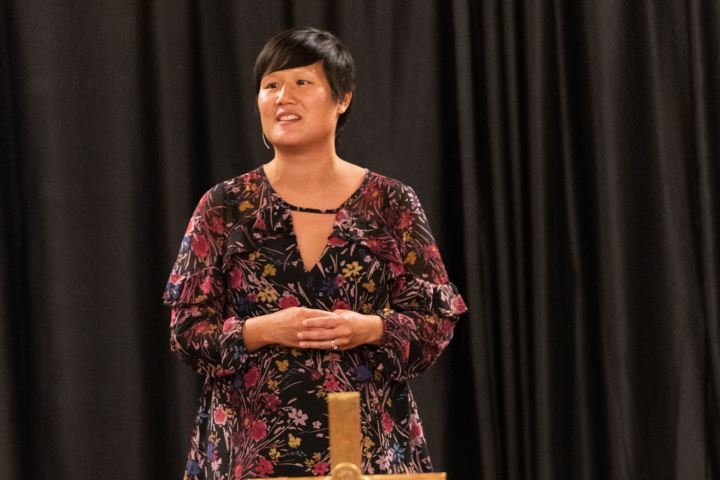
When it’s time for stewardship season, we often talk about stewardship in select parts of the service, says the Rev. Larissa Kwong Abazia, a workshop presenter and worship leader at this year’s Stewardship Kaleidoscope in St. Louis. But we don’t weave stewardship throughout the liturgy.
There are opportunities during all parts of the worship experience to help congregations discern God’s call to stewardship, but pastors need to look for them – and get creative.
Kwong Abazia shared with the gathered group creative ideas for stewardship that extend the practice into all areas of liturgy. The examples she offered are outlined below.
The Presbyterian Church of Chestnut Hill
The Presbyterian Church of Chestnut Hill in Philadelphia selected “Ask, Seek, Knock” as its theme for stewardship in 2017. The church decided to create a flash mob to kick off its season of giving, complete with a musical number inviting the congregation to engage in stewardship. “This church is very traditional in their worship style and how they approach things, but she (the pastor) felt that the church was really open to new and different things,” Kwong Abazia said. “We sometimes overcompensate on what we think people are capable of handling.”
Raising the roof
At Westminster Presbyterian Church in Grand Rapids, Michigan, Rev. Anne Weirich led an effort to give each church attendee a $20 bill in an envelope with a set of directions. The instructions said the money was being given with complete grace. If the person truly needed the money, they could use it as needed. But for those that could, the expectation was to invest that $20 in an activity that would raise funds for a future mission endeavor of the church. One church member bought ribs and cooked and sold them in his community, raising $200. Altogether, the congregation raised $65,000. (Rev. Weirich is now pastor at College Drive Presbyterian Church in New Concord, Ohio.)
As the congregation raised funds out in its community members engaged in conversations with people about why they were fundraising and about their church. “The money they raised is incredible, but I’m also amazed that they told so many people about their church,” Kwong Abazia said.
Modeling generosity
Stewartsville Presbyterian Church in New Jersey sent a check for $50 to every teaching elder member of Presbytery of Newton. The only instruction to accompany the note was that the funds had to be used for themselves, and could not be given away, as an expression of appreciation for their ministry. The checks went to 68 pastors.
While many pastors wrote to express gratitude and thanksgiving for the gift, the letter that struck the pastor, the Rev. Stephen Choi, as especially meaningful was a letter the church received from the Rev. Dr. Ed Halldorson at the Presbyterian Church of Chatham Township. Halldorson said he had been in ministry for more than 40 years and had never received a gift quite like it. He used the funds to buy a video series on Biblical archaeology for a Bible class he teaches and offered to teach it at Stewartsville Presbyterian as a way to say thanks. “It’s practicing generosity and modeling generosity,” Kwong Abazia said. “People sometimes feel the Presbytery can be this distant void, but this modeled for the church the way each member is connected to the ministry of other churches throughout the region.”
Making connections
Rev. Dawn Haeger has a relatively simple practice that reminds her congregation of the needs of others. The week before communion, the church publishes a list of things needed in the food pantry. The week of communion, members of the church bring in the items. All of the food they collect is brought to the front of the church during the offering. “When we are fed at this table, there are people who need to be fed as well,” Kwong Abazia said.
Community stewardship
At a church that Kwong Abazia served, a relatively simple practice changed how the church viewed the neighborhood. The staff of the church went for a walk. “We would talk about what was different, and what was the same,” Kwong Abazia recalled. “There was a lot of gentrification. We saw more children, but we also saw people who were being pushed out.”
Taking inventory
Rev. Katy Stenta, pastor of New Covenant Presbyterian Church in Albany, NY, asked members to list ways in which they served the community and the world. They simply wrote down all the things they did in the community that were acts of service. “There were 17 people who were in church that Sunday and there were about 300 things they did collectively in the larger community,” Kwong Abazia said. “We are all so impacted by numbers, and when you’re 17 people in a big sanctuary, it’s hard to feel like you have an impact. That showed how much those 17 people were doing.”
Candy eucharist
Rev. Julie Nelson, part of the Episcopal Diocese of Camino Real, invited children in her church to bring 10 percent of their trick-or-treat candy haul into church. The children of the church bring the candy forward at a designated time during the service. Arrangements to donate the candy to a local food pantry were made ahead of time.
Kwong Abazia notes that the exercise allows children to examine their “wealth” in a way that makes sense to them. Children know the difference between a fun size and regular sized candy bar, and this gives them an opportunity to reflect on value. “It’s a tangible way they can relate to what they can think about giving back to God,” Kwong Abazia said. “It’s become a tradition, and the adults love watching how excited the kids get.”

Robyn Davis Sekula
Robyn Davis Sekula is Vice President of Communications and Marketing at the Presbyterian Foundation. She is a ruling elder and member of Highland Presbyterian Church in Louisville, Ky. She can be reached at robyn.sekula@presbyterianfoundation.org.
 English
  Korean
  Spanish