
3/30/2026
Churches can change their stories from anxious to hopeful
by Chuck Toney
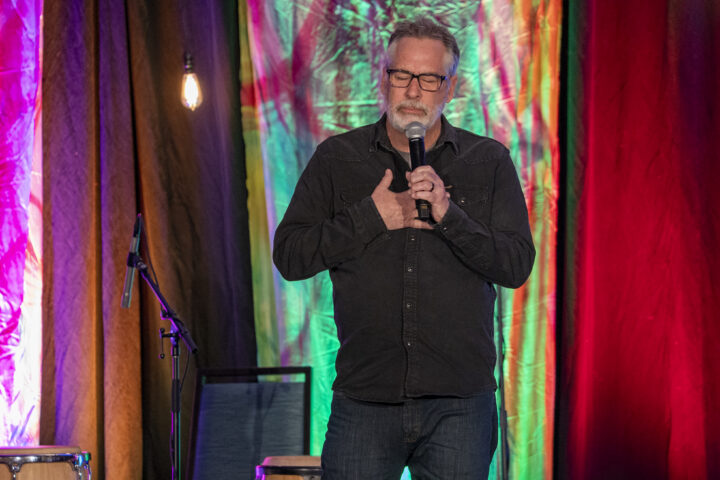
Mark Yaconelli remembers receiving a story Bible from his grandmother when he was five years old.
“It had all the glossy pictures; I especially remember an image of Jesus carrying a lamb,” Yaconelli recalls. “The cover was what looked like Jesus’s passport photo. I wondered what it would be like to be able to read this massive, thick book all by myself.”
Her gift became the foundation of his belief that “story is relationship – the morals, values, and plot lines that teach us how to live.”
Yaconelli is Founder/Director of The Hearth and a community builder, retreat facilitator, and author of Between the Listening and the Telling: How Stories Can Save Us. He delivered one of the plenary session addresses at the inaugural Luminosity Conference, sponsored by the Presbyterian Foundation March 9 to 11, 2026 in Orlando. The conference was designed to offer pastors and church leaders inspiration and thoughts on innovation.
Stories energize us
Yaconelli shared his nostalgia for the stories of his childhood – The Lion, the Witch, and the Wardrobe, and tales of wayward ships floating into the fog off the shore on Nova Scotia. In a time when the world can seem “horrifying,” it is the telling of stories that anchors us in what we believe.
“Remember what we know is true: Each of us came into the world as light. When a baby comes into a room, everyone smiles,” he said. “That was you at one point! You were the light, hungry for experience, hungry for connection, so excited by every new face. That was you; that was me. And we didn’t know what to do with all of that energy. One of the ways we figure it out is that people tell us stories that let us experience courage and creativity. They tell us stories that project the light into the future.”
Churches need to revisit the power of story, Yaconelli said, and especially the story they are telling about themselves.
“Many of our churches are stuck in a bad story,” he told the pastors and church leaders in attendance. “If you as pastors feel anxious, isolated, bitter, hateful, or bored, you are stuck in a bad story. Change it! The story of Jesus is full of life and adventure. It’s like a roller coaster or riding the rapids. Even when disaster comes we know what to do. A pastor friend of mine, who leads a church in Minneapolis and has been deeply involved in the protests, told me, ‘This is what we trained for. We know what to do as the church.’”
Connoisseurs of light
Yaconelli then offered an unexpected comparison for the pastors in the audience: competition cooking shows on television.
“You know the shows I’m taking about – chefs are given a set of crazy ingredients and they have to make a dish out of them,” he said with a grin. “Here’s sardines, a pineapple, and some Cream of Wheat. Go!” The chefs are connoisseurs of taste, he said. “We are supposed to be connoisseurs of light. We are supposed to be connoisseurs of love.”
He invited the audience to imagine a church with three widows, a multilingual congregation, and a bunch of kids. “Go! How do we make this church work? This is what we should have been learning in seminary. We are the healing response to the separation the world imposes. How do we bring us closer together?”
The rules of the cooking competition say you have to make something delicious out of the ingredients you have. The rules of being a pastor say you have to make light and love with the people you have in the pews. “Trust what you know,” he implored. “You know the thing in your church that needs to die – do it! You know what brings you and others light – do that! In living churches, the pastors are doing what brings them light and the church follows. Do the thing you love.”
An experience that defies explanation
Yaconelli closed with a powerful story that a pastor friend of his (also named Mark) shared. An older man in his church was dying, and he asked Mark to stay close to his teenage son following his passing. During an awkward conversation over a soft drink, the teenager asked how he would know that his dad was OK after he died. Mark, fumbling for a response, blurted out, “I promise you will know.” And immediately regretted saying that.
At the private graveside service following the funeral, a butterfly landed on the casket. “I made eye contact with the son as if to say, ‘Hey look! I told you you’d know.’” The boy looked back at Mark with “absolute scorn, probably thinking, ‘Some bug lands on my dad’s casket, and you think it means something? You’re disgusting.’” After the service, the boy just walked away from Mark.
When Mark got home, beating himself up over the gaffe, he got a call from the boy’s mother. “Please come to our house right now,” she said. “There’s nothing wrong, but you need to get over here.”
When he got to their house, she took him downstairs to the room where the boy was – a room filled with butterflies. The boy was sitting on the bed laughing and crying at the same time, as butterflies continued to fly in through an open window.
“The Jesus pattern was in my friend that day,” Yaconelli said. “It spoke to him when he told the boy he would know. By faith and by trust and by living into the light God has given us, the boy became free. We are that boy and that pastor. Let us live radically into the light; even the darkness isn’t dark enough when we do.”
Chuck Toney
Chuck Toney is the founder of C. Toney Communications in Athens, GA. Chuck is an elder who leads the Generosity Team at First Presbyterian Church of Athens. Send comments on this article to Robyn Davis Sekula, Vice President of Communications and Marketing at the Presbyterian Foundation, at robyn.sekula@presbyterianfoundation.org.
 English
  Korean
  Spanish