
10/29/2025
A Small Tennessee Church Makes a Big Impact in its Community
by Rev. Jody Mask
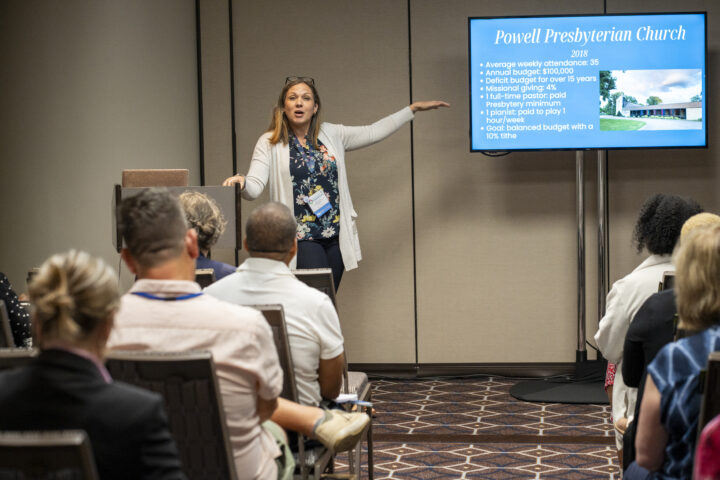
Two thirds of all congregations in the PC(USA) have fewer than 100 members. Given this reality, Rev. Dr. Katina Sharp’s workshop at Stewardship Kaleidoscope, “Small Church, Big Impact” shared strategies and a template for growth in the community.
How can such small churches be meaningful? For Sharp’s church, Powell Presbyterian Church outside of Knoxville, Tenn., the first step was to acknowledge that it was not the same church that it once was. This was not a value judgment, but acceptance of reality. With that honesty, the church could begin to imagine new ways to minister within the community.
Sharp’s workshop was part of Stewardship Kaleidoscope in New Orleans, held in September 2025. The annual conference is presented by the Presbyterian Church (USA) and Evangelical Lutheran Church in America.
Powell Presbyterian’s weekly worship attendance in 2018 was 35, its annual budget was $100,000, and the church had run deficit budgets for the previous 15 years. Given these challenges, Sharp recruited congregants to help her do some “asset mapping.” This exercise asks questions including, “What property do we own?” “What are our financial reserves?” and “What are our connections in the community?” Once these items were determined, the people of the church could begin to discern patterns or common themes.
Here are some of the distinguishing characteristics of Powell Presbyterian that emerged from their asset mapping exercise: it sits on 5 acres of property, and 4 of them are wooded. The church’s backyard is fairly flat and consists of a parking lot and half-acre field. The grounds include a covered pavilion. The church is across the street from a very large neighborhood. There is a middle school and a high school close by. One church member is a fundraiser with Relay for Life. Another is a leader in the Knoxville Track Club. And hosting Family Promise (a ministry to homeless families) is a prominent mission focus.
Assessment in hand, Powell saw an opportunity to host a summer community festival. The first Blackberry Festival was a one-day event including a 5k, vendors who rented 10-foot square parcels, a food truck, and an old-fashioned bake sale. A local rental service provided the church with a rock-climbing wall for free. Sharp’s spouse, Whitney, engaged the makerspace she oversees at the University of Tennessee to make the race medals. They gave the local School of Rock (a franchise that offers rock band lessons for youth) a free tent if they supplied entertainment. And many members pitched in to help however they could.
The festival was a successful fundraiser in its first year, but its true power emerged from the community that it connected and awareness of the church’s desire to engage more thoughtfully with it.
That is not to say that all went smoothly, of course. Powell Presbyterian learned some lessons from the first year. First, don’t be afraid to ask for what you need. They were able to secure free parking at the schools, and a local car dealer provided shuttles to those lots. Second, have many eyes go over the plan for your event, if you hold one. Third, consult your insurance agent and check local laws for permit requirements of zoning issues. Most importantly, know that your mistakes are opportunities for growth.
Even as Powell Presbyterian ruffled a few feathers with the first event, they had enough community goodwill to hold it a second year, and it was even more successful. They continue to host the Blackberry Festival to this day, as it has blossomed into an event that the whole town looks forward to.
Regardless of what your faith community endeavors, Sharp said, ask these questions:
- What are the needs of the community? (Also, what is not needed?)
- Are you looking for a short-term idea or an ongoing project?
- Will you need heavy volunteer efforts or something less intensive?
Such questions will help you create a feasible plan. What is important is not shying away from doing something new and different. So give it a try — even if it flops, you can always debrief, make a plan for improvement, and try again.
But if your event is successful, remember to debrief anyway. Celebrate success, practice gratitude (by writing thank-you cards to community partners, for example), and most importantly, rest.
Today, Powell Presbyterian Church has a balanced budget, they contribute more than 10% of
their in29come to mission, and they are experiencing congregational growth.
Rev. Jody Mask
Rev. Jody Mask (he/him) is the temporary pastor of Grace Covenant Presbyterian Church in Orlando, Fla. He is an Orlando native who stewards his well-being through distance running, time in nature, and co-creating hijinks with his spouse, Ellen. Send questions or comments about this story to Robyn Davis Sekula, Vice President of Communications and Marketing at the Presbyterian Foundation, at robyn.sekula@presbyterianfoundation.org.
 English
  Korean
  Spanish