
9/4/2025
Carrying summer’s slower rhythm into fall allows us to embrace being human
by Rev. Mihee Kim-Kort
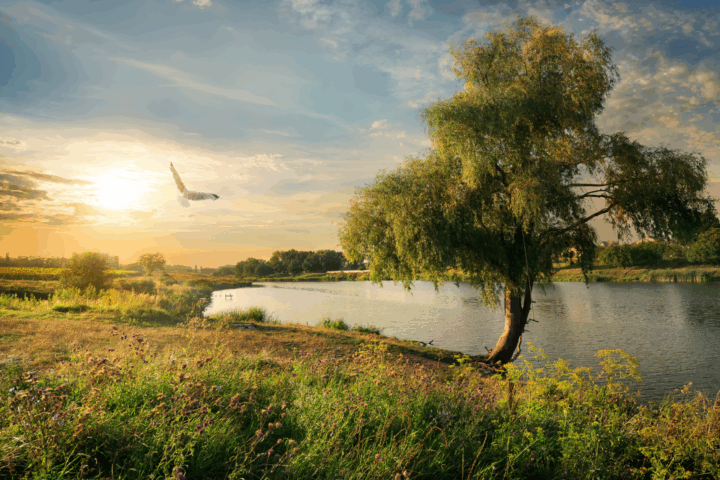
“They are like trees planted by streams of water, which yield their fruit in its season, and their leaves do not wither. In all that they do, they prosper.” Psalm 1:3
It’s the slow afternoons I’ll miss the most. The quiet mornings when the sun begins to light the world at 5:30 am. The birds that begin their song well before the sun rises. And, the days that stretch a little longer into lazy evenings that invite leisurely and meandering walks with the dog or the kids getting on the scooters that are now too small. Even in the heat, there’s a kind of ease to the tail end of summer — the last meals off the grill, unstructured evenings, and the spontaneous pickup game of basketball in the driveway, and the kids’ laughter and screams echoing all around the neighborhood.
Soon, all of that gives way to calendars and committee meetings. To session retreats and stewardship work. To Rally Day Sundays and brochures about events and activities. To the launch of the new program year with its urgency and promise.
But I wonder: What if the gifts of summer — its lingering pace, its gentle hush — weren’t something we just squeezed in before the return to the “real” work? What if they might provide an ongoing lesson of the possibility of a kind of posture for our work in the world?
This summer, even in the midst of driving kids to and from camps and high school sports summer workouts, to friends’ houses and to the mall, I practiced walking slower. Literally. I took fewer steps per minute, even if just between the parking lot and the grocery store, the kitchen and the couch. I paid attention to how often I was rushing and asked myself gently, why? Who told me I had to hurry?
On hikes, too — slow, measured, quiet. During Covid, I remember reading about forest bathing, or shinrin-yoku in Japanese. It is the practice of immersing oneself in a natural forest environment with mindful attention and presence. Unlike a hike or workout, it’s not about distance or exertion, but about slowing down, breathing deeply, and letting the sights, sounds, and smells of the forest gently reawaken the senses. Studies have shown it can lower stress, reduce blood pressure, and enhance feelings of well-being. It’s a return to relationship — with the trees, the soil, the sky overhead — reminding us that we are not separate from creation, but part of its living rhythm. In a world that moves fast, forest bathing invites us to move at the pace of wonder.
It’s a practice of lingering. I folded and put away the laundry, slowly. I read books, slowly – unhurried and unbothered. No deadlines, even the library doesn’t have overdue fines anymore.
There’s a rhythm that the land teaches us. That God teaches us. That Jesus shows in his earthly ministry. A pattern that is more breath than grind. A cycle that doesn’t demand constant output, but instead abides by season and tide and sabbath. Indigenous spiritual traditions have long honored this rhythm, grounding life in relationship — with land, with ancestors, with the seen and unseen — reminding us that time is not linear, but circular and communal.
In Korean ancestral rites, too, there is a reverence for pausing to honor those who came before, to bow, to breathe, to remember that we are never alone in our striving or our rest. The practice of han, the deep cultural awareness of sorrow, of grief, of angst, held in the body and spirit, teaches us that healing is slow and collective, and that restoration often emerges not through fixing, but through presence and witness. These traditions remind us that sabbath is not a luxury or an escape, but a returning — a way to be restored to ourselves, to the land, and to one another.
The wisdom of our ancestors and the soil says: slow down. Pay attention. Linger in the moments.
This is not the same as laziness or apathy. It’s the kind of active rest that takes trust. Trust that the work doesn’t all depend on us. Trust that growth is not always visible. Trust that sometimes the most faithful thing we can do is stop striving, and instead, take a nap. ( I hope by now you have discovered the important work of Tricia Hershey’s Rest is Resistance: A Manifesto. This ministry is also on Instagram @thenapministry.)
I am learning that the church’s witness is not just in its programs or its preaching, but in its pacing. In the way we model being human again — tender, limited, and attuned to the rhythms of grace. There is something profoundly faithful about a community that resists urgency, that pauses long enough to notice who is missing, who is tired, who is blooming quietly on the margins. The church becomes a sign of God’s presence not just through its proclamations, but through its posture: how it rests, how it breathes, how it lingers at the table, how it indulges the quiet. In a world that rewards speed and spectacle, our slow, attentive presence can be a kind of resistance, a quiet declaration that we believe in a God who walks and waits and dwells. To be human again — together, gently — is perhaps one of the most sacred things we can offer.

Human, as in limited. Human, as in made for delight. Human, as in neighbor.
The theologian Willie Jennings writes that the church is called to “form us to be the kind of people who know how to join with others in the mundane, the ordinary, the everyday.” Not in spectacular feats of performance or production — but in joining, showing up, being with.
What if that was our program year goal? Not growth in numbers, but growth in being human together. In practicing the kind of rest that restores imagination. The kind of quiet that helps us to see and listen to what is deeply human about each neighbor we encounter no matter what their politics? The kind of sabbath that reminds us we are not machines, but people knit together by Spirit and song and shared bread.
I want to carry some of summer with me into the fall. Not just in my memories, but in my body. In the way I schedule (or unschedule) my days. In how I show up to meetings. In how I listen to someone’s heartbreak without trying to fix it. And when I forget — because I will — I want to remember what I’ve been learning again and again this year:
I can always begin again. And just show up. I don’t have to start from scratch, but from the center. From the breath. From the table. And there, in the ordinary acts of gathering around word and song, of prayers, of breaking bread, we might find, and even be, Jesus — fully divine, fully human — once more.

Rev. Mihee Kim-Kort
Mihee Kim-Kort is co-pastor of First Presbyterian Church of Annapolis, Maryland along with her spouse Andrew Kort. She has written and published for various venues, including Time Magazine, Huffington Post, Christian Century, and Sojourners, and she is the author of Outside the Lines: How Embracing Queerness Will Transform Your Faith (Fortress Press, 2018) and co-author with Andrew of Yoked: Stories of a Clergy Couple in Marriage, Family, and Ministry (Rowman and Littlefield, 2014). Previously, Kim-Kort has served as associate pastor for College Hill Presbyterian Church in Easton, Pa. (2006-2011), and United Presbyterian Church in Flanders, N.J. (2005-2006). She was director and co-founder of the UKirk Campus Ministry program at Indiana University from 2012-2017. She received her Ph.D. in religious studies from Indiana University.
 English
  Korean
  Spanish