
3/12/2024
Stewardship Reflection: A Year-long Season of Stewardship
by Olanda Carr, Jr.

Whenever I am asked to speak on stewardship, I usually begin by asking the participants in the room (or on screen) a simple question: “what does stewardship mean?”
After all, we really can’t a expect committee to lead their congregation with stewardship efforts if they aren’t sure what the word actually means. As you may suspect, the responses to my question usually vary – some will mostly focus on the financial obligation of supporting one’s church, while others will focus more on the caring of all of God’s creation. [Spoiler alert – I tend to prefer definitions that are more similar to the latter, tending to all that God has placed in our care – time, talent, and treasure]
One thing is common among all recited definitions, however. No one ever says that we should only be concerned about stewardship in the fall. Imagine that! Or that our concern for God’s creation stops in November, only to be picked back up in late summer the following year. I am always pleased no one says this, as it would certainly lengthen seminar time to dispel such a myth!
Yet, if we don’t believe that stewardship is seasonal, why do we often program in such a seasonal fashion? Excellent question!
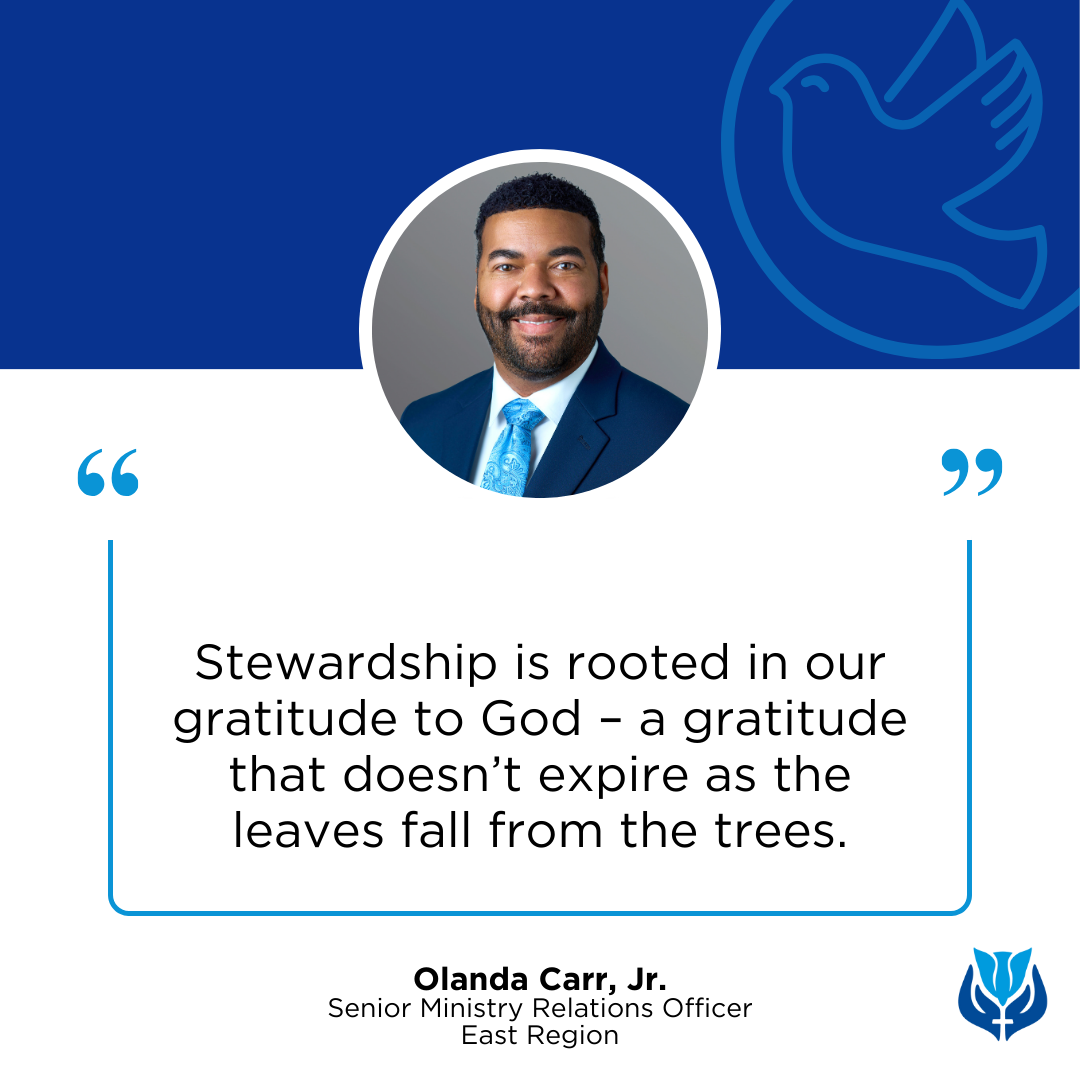
Of course, the answer to the posed question is that we should not seasonally plan stewardship efforts within our congregations. Instead, we should focus on stewardship throughout the year, perhaps using the fall as a time to jump-start our efforts as we plan for the following year. Stewardship is rooted in our gratitude to God – a gratitude that doesn’t expire as the leaves fall from the trees. It is therefore incumbent upon us as stewardship leaders to find ways to keep our stewardship efforts constant and consistent.
One such way to promote consistent stewardship practices is to use a theme that will connect all aspects of your stewardship initiatives. I suppose it helps if the theme is catchy, but it is more important for the theme to be practical and rooted with a Biblical and spiritual cause.
Over the years, I have heard some really good ones that meet these criteria. Themes like, “Living in God’s Abundance,” “Grateful Hearts,” and many others connect the importance of demonstrating gratitude through the way we live our lives and share our resources. The best themes, however, live beyond the fall campaign. The best themes live well into the new year, often connecting the various ministries of the church to the theme. After all, if we were ‘living graciously’ in October, let us remember to do so in the spring and summer months!
“Off-season” stewardship can take many forms. Strategically scheduled announcements throughout the year are a great way to remind parishioners that consistent stewardship is always important. Further, referencing the stewardship theme during such a morning announcement by someone who is not usually known for giving announcements often makes folks take note. It’s always good to add an element of surprise! Speaking of surprises, similar can be said of Sunday sermons. Encouraging the pastor to speak on stewardship throughout the year (not just the fall) is often a way to add a little spice to your stewardship program.
Lastly, it is important to note that a theme can be used to connect to all ministry giving opportunities, not just the financial support of the budget. A theme is intended to touch upon and encourage the generous spirit of your membership. Once impacted, the generous spirit isn’t restricted to gifts of dollars and cents for church support. Rather, a generous spirit is excited to give in multiple ways. Denominational special offerings are perhaps once such way, as your stewardship theme can be used to link missional generosity beyond the walls of the sanctuary. Themes can be used just as easily with outreach collection drives as well – such as hats/gloves during the winter or back-to-school supplies in the late summer.
Admittedly, it will probably take many of us some time to integrate year-round stewardship practices. Resisting the temptation to just take a few months off after an intensive fall effort definitely takes intentional work. Moreover, our liturgical calendar is full of other events that seemingly trump stewardship. I’m sure we all agree that the Advent and Lenten seasons are examples of such important events. The key thing to remember, however, is that it is not an ‘either or’ but a ‘both and’ scenario. Looking for ways to weave in stewardship messaging into the existing liturgical events, programs, and missions of the church is what is needed. As the old adage reminds, “God is good, all the time. And all the time, God is good.” Let our actions therefore reflect our gratitude to God’s consistent goodness throughout the year, not just at times of seasonal convenience.

Olanda Carr, Jr.
Olanda Carr, Jr. is the Senior Ministry Relations Officer serving the East Region. He works with congregations to create a culture of generosity, offers seminars and workshops, develops gifts and fundraising plans for ministries, and provides coaching to finance, stewardship and endowment committees. Olanda holds a BBA and MBA from Montreat College (North Carolina) and is an elder and assistant treasurer of First United Presbyterian Church. He resides in Charlotte with his wife, Monica.
 English
  Korean
  Spanish