
4/13/2026
Re-thinking church space leads to innovative ministries and better neighborhood connections
by Chuck Toney
Coffee, collisions, conversation, and community.
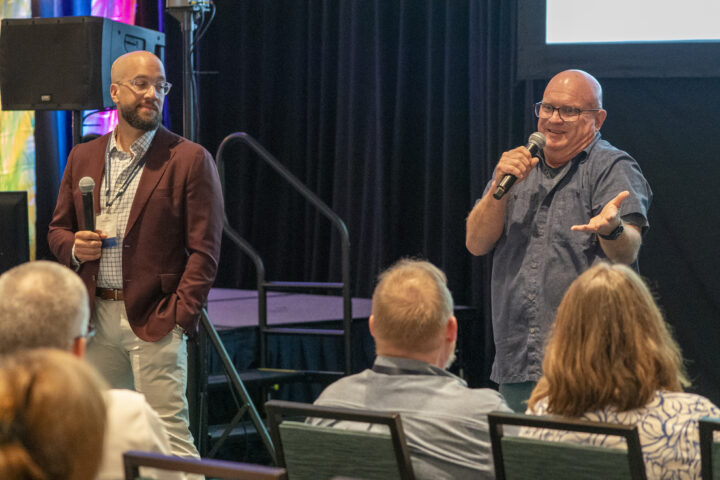
That is the alliterative pattern described by Brian Clark, Director of the Missional Incubator, and John Molina-Moore, General Presbyter, both of National Capital Presbytery in the Washington, D.C., area, during a workshop entitled “It’s Not Weird!” Clark and Molina-Moore presented one of the sessions at the inaugural Luminosity Conference, sponsored by the Presbyterian Foundation March 9-11, 2026 in Orlando.
“As church leaders, we are often managers of facilities that we use 10-15% of the time,” Molina-Moore told the attendees. “Everything is there to support what we do on Sunday morning, when our neighbors are looking for new ways to do faith. We hope that now is the time for us to pull out of ‘Sunday Morning Sickness’ to build new relationships with our neighborhoods.”
Coffee shop serves as third space
Riverside Presbyterian Church in northern Virginia, where Clark previously served as pastor, was co-located with a title company. Since the building was used by a variety of businesses and as office space every day, the church expended very little on maintenance or support. Clark asked his session, “What are we doing that our community wants and needs? We built a coffee shop in an unused part of the building because people in our community needed a third space.” (In sociology, third spaces are the social surroundings that are separate from the two dominant social environments of home and workplace.)
The difficulty for some members of his church was accepting that the goal was not recruiting new members. “We didn’t open a coffee shop expecting people to come to church – that was hard for some of our members,” Molina-Moore said. He introduced the term “mixed-economy ministry” in describing this approach.
“This was an opportunity to engage with individuals who would not be attracted to a more traditional church,” he said. “We were not doing this to save the status quo. People would smell that a mile away. This is to try new ways of forming relationships so that God can provide.”
New “collisions”
Coffee, then, led to “collisions” between people who might not otherwise have met, creating opportunity for conversations and community. Clark offered the story of the 10 years the Apostle Paul spent in Tarsus after his conversion, learning the family leather repair business. “I believe that time prepared him to go into the marketplace with a viable skill,” he said. “In the marketplace – or the coffee shop – there is conversation which leads to relationship which leads to community.”
National Capital Presbytery created the Missional Incubator, a nine-to-twelve-month program designed to equip and empower missional leaders and entrepreneurs to launch innovative, mixed-economy worshiping communities. Pastors commit to weekly meetings with their colleagues, putting aside the usual objections to new ideas and instead feel free to explore.
“This is about helping our churches love their neighborhoods,” Clark said. “We give leaders of churches the time and space to dream with other leaders. And most of them have some really cool things they are working on.”
Caring for the neighborhood
Molina-Moore told the workshop attendees that churches face an existential choice: Either sell the church and move to where the passion is, or have a passion for the people where you are. He offered a simple example. “Most churches don’t know how bad a neighbor they are,” he said. “We had some big snows in D.C. last year – did you shovel the snow on the sidewalk even if it weren’t Sunday so your neighbors could walk by? Or did you shrug and wait for it to melt in time for you to come to church? Often, we look too much internal and don’t really care about the people in our neighborhoods.”
Clark asked the members of his session to walk in pairs through the neighborhood every year. They have to eat a meal while they’re out and bring back a token of some sort. Churches, he said, sit inside their walls and wonder why people aren’t coming in, when at the same time, the people in the community are wondering why the church isn’t doing anything to make their lives better.
How the church ministers through coffee
The pair shared examples of how collisions had built community:
- A mother who was the administrator of an online mom’s group stumbled into the coffee shop after a doctor’s appointment. Impressed by the children’s play area, she posted a picture to her 20,000 members. “Everything changed after that,” Clark said.
- Before the pandemic, a group of widowers met every week at the coffee shop. During COVID, employees delivered coffee to each of them at their homes. None of the widowers were members of the church.
- Following the October 2023 attack in Gaza, Jewish and Muslim parents found the coffee shop to be a safe place where they could meet to talk. “We accomplish being interfaith through relationship,” Clark said. “Those conversations would never have happened in our community without the business.”
- A new resident to the area walked three miles to Riverside Church on Christmas Day, because he knew that was what he was supposed to do. He began worshipping there, and was soon hired at the coffee shop. Unlike some of his colleagues, he wanted to work more hours. He told Clark that he wanted to go to college; his financial position, though, wouldn’t allow him to pay for classes or get any kind of loan. “We told him that we will pay for every class you pass,” Clark recalled. The student started at community college and is now a senior at George Mason University with a 3.8 GPA in business. He is one of the assistant managers of the coffee shop and oversees payroll for 55 employees.
“We can do our church business in a profoundly different way,” Molina-Noore said, citing Psalm 127:1 (“Unless the Lord builds the house, the people who build it labor in vain.”) “But we have to have a tremendous amount of faith in miracles happening; we have to release authority from us and return it to God.”
Chuck Toney
Chuck Toney is the founder of C. Toney Communications in Athens, GA. Chuck is an elder who leads the Generosity Team at First Presbyterian Church of Athens. Send comments on this article to Robyn Davis Sekula, Vice President of Communications and Marketing at the Presbyterian Foundation, at robyn.sekula@presbyterianfoundation.org.
 English
  Korean
  Spanish