
11/11/2025
Purple Church, Red State: Navigating Stewardship in an Age of Polarization
by Chuck Toney
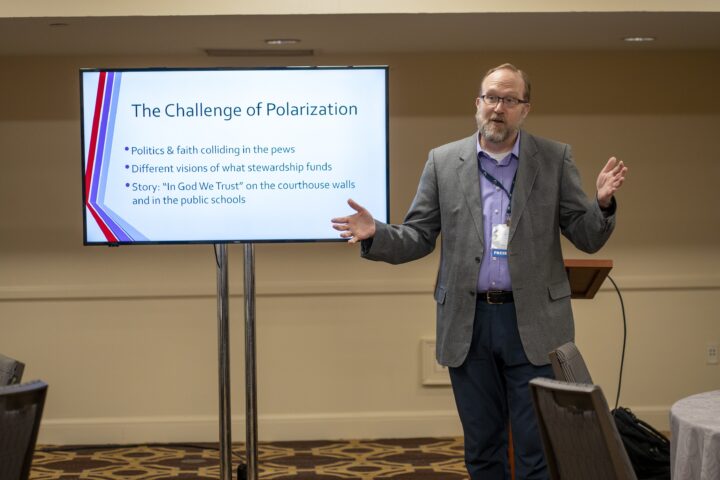
Rev. Greg Allen-Picket opened his workshop at this year’s Stewardship Kaleidoscope by asking attendees to share observations on the political climate in their own congregations. Stewardship Kaleidoscope is a conference presented by the Presbyterian Church (USA) and Evangelical Lutheran Church in America; this year’s conference was held in New Orleans, LA, September 22 to 24, 2025.
His question produced a litany of frustration, anxiety, and dismay from pastors and church leaders.
Among the responses:
- “Suddenly everything is political.”
- “There is nothing that I can say that is not seen by someone as political.”
- “Everything I say is examined for a hidden agenda.”
- “I never know what to expect on any given day.”
- “There is a them/us mentality in my congregation.”
“Politics and faith are colliding in our pews in ways that they have not been in recent time,” agreed Allen-Pickett, who referred to the Civil War split of the Presbyterian Church as an historical comparison. “There are even different versions of what our stewardship dollars should fund.”
But Allen-Pickett, pastor of the First Presbyterian Church of Hastings, Nebraska, told workshop attendees that there is hope for stewardship messages in a time of political division in society and in church. Purple, he pointed out, may be used to describe congregations whose members reflect the full range of political views, but it is also the liturgical color of the two seasons in the church calendar that are focused on Christ – Advent and Lent. “By keeping our focus on the life and ministry of Christ we have been able to have conversations about politics within the word, life, death, and resurrection of Jesus,” he said.
Allen-Pickett shared stories from his church to illustrate that practice. A member of the congregation who serves on the local governing board visited him with news of a proposal to display the phrase “In God We Trust” in the courthouse and to solicit Allen-Pickett’s support. “I told him I didn’t think that was a good idea,” he said. “I think he was shocked, but we had a conversation about it.” The next day, another member came to express her disagreement with the proposal, citing her atheist husband’s opposition; he had also served in the military and felt strongly about the separation of church and state.
“So I have two members of my congregation on opposite sides of a highly charged local issue,” Allen-Pickett said. “I ended up mediating a conversation between them to try to reach some understanding. It was hard, but I tried to model civil dialogue. They both still sit in the pews and sing the same hymns on Sunday morning.”
He shared another illustration about how his church has a long relationship with Catholic Social Services. For one month every summer, church members make sandwiches and pack sack lunches. The program is popular and well attended. “We may disagree about how children ought to be fed, but we are not going to stop feeding them,” he said. “When your hands are covered in peanut butter and jelly, it’s hard to have fights.”
Finally, as part of capital campaign planning, he learned that “even solar panels can be political.” A retired ecotheology professor from nearby Hastings College advocated for installing such panels on the church roof as an act of environmental stewardship. The proposal was met with resistance from some members of the church until a “conservative” member who had installed panels on his weekend cabin touted the economic benefits.
“This two-pronged approach generated support across the political divide,” Allen-Pickett explained. “The church bought into it, and we are one of two buildings in town with solar panels.”
Stewardship, then, includes the financial and tangible gifts with which God has entrusted us, but also the relationships God calls us to build with each other. It is, Allen-Pickett said, “about our very lives and how we choose to live them. It is about how to make our lives a living offering to God.”
He offered four strategies for engagement in an age of sharp political division:
- Listen first
- Focus on shared mission
- Frame conversations biblically and theologically
- Preach with hope
“Almost every week, I say to my congregation that we are the hands and feet of Jesus, sharing the love and light of Christ,” Allen-Pickett said. “Our goal has always been to model the way of Christ. If I can point to the red letters in the Bible and I have built trust with them, they will come to me and have the conversation.”
In closing, Allen-Pickett distributed a handout of a stewardship sermon series he has preached. The first, titled “A Future with Hope!” takes as its text Jeremiah 29:11-12: “For surely I know the plans I have for you, says the Lord, plans for your welfare and not for harm, to give you a future with hope. Then when you call upon me and come and pray to me, I will hear you.”
The second, “Building the Beloved Community in an Age of Polarization,” was paired with a recent book entitled The After Party: Toward Better Christian Politics as an educational resource.
The final sermon in the series is titled “Faithful Foundations: Trusting, Listening, Aligning, Building” and takes its texts from Exodus, 1 Samuel, and 1 Kings.
“Stewardship is more than fundraising – it builds the beloved community,” Allen-Pickett concluded. “Let us share a message that hope is greater than fear, that abundance is greater than scarcity, and that faith is greater than polarization. Then we are building the kingdom on earth and bridging the divide.”
Chuck Toney
Chuck Toney is the founder of C. Toney Communications in Athens, GA. Chuck is an elder who leads the Generosity Team at First Presbyterian Church of Athens. Send comments on this article to Robyn Davis Sekula, Vice President of Communications and Marketing at the Presbyterian Foundation, at robyn.sekula@presbyterianfoundation.org.
 English
  Korean
  Spanish