
3/20/2026
Pastors need to take time for legacy planning
by Robyn Davis Sekula
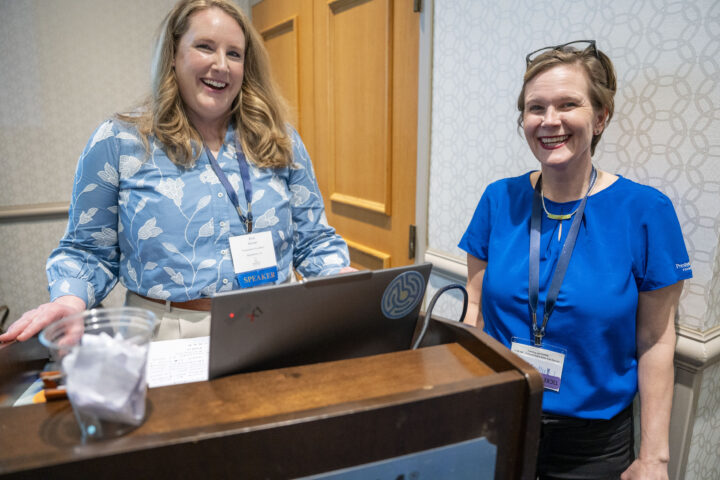
Pastors attending the 2026 Luminosity Conference in Orlando were invited to reflect deeply on faith, family, and the lasting impact of their ministries during a workshop titled “Legacy is not just for Laity.”
While churches often emphasize the importance of creating a will and considering leaving a gift to a church or ministry as part of their estate, pastors don’t always consider their own legacy. The session invited pastors to think through what they want to pass on to those who know them.
The workshop was presented as a break-out session at Luminosity, a conference organized and sponsored by the Presbyterian Foundation and held during the March 9 to 11 conference. Rev. Ellie Johns-Kelley and Rev. Erin Skinner, both Ministry Relations Officers for the Foundation, presented the workshop. Designed specifically for pastors in the Presbyterian Church (U.S.A.), the workshop encouraged participants to think about legacy not simply in financial terms, but as the stories, relationships, and faith traditions that shape generations.
Foundation works in legacy giving
Johns-Kelley opened the workshop by sharing the history and mission of the Presbyterian Foundation, reminding participants of the denomination’s longstanding commitment to stewardship and generosity.
She noted that the Foundation traces its roots to 1799, when it was created as the original trustees of the denomination to receive gifts and bequests from Presbyterians. Today, she said, the organization stewards billions of dollars in assets on behalf of congregations and ministries.
Throughout the session, Johns-Kelley and Skinner emphasized that legacy is not only about financial planning but also about the stories people share and the values they pass down.
As part of the workshop, Johns-Kelley led participants through a reflective exercise, encouraging pastors to write continuously in response to questions about their faith, family influences, and hopes for the future.
“What’s your hope for this conference?” she asked participants. “What brought you to this workshop? I want you to think about your parents and your grandparents. Were they active in church? How did that shape you?”
Planning is a gift to family
The exercise, she explained, was originally shared by the late musician David M. Bailey, whose life and work continue to inspire conversations about vocation and faith. His legacy lives on through the music he created and the ways in which he prompted youth to think through their own lives and their callings.
Johns-Kelley also reflected on her own experience of thinking about legacy after the death of her father, a longtime Presbyterian minister. She recalls that it was difficult to get her own father to discuss what gifts he wanted to leave to ministries and churches that he loved. Making those decisions ahead of time is a wonderful gift to your family.
“Thinking about what we love, what it would be a good expression of our faith, what might be a helpful gift to our family members, all of those are so helpful for those who love you,” she said.
Sharing stories shares legacy
Skinner expanded the conversation, encouraging pastors to consider how storytelling can shape both family relationships and congregational life.
“The power of story is the power of relationships,” Skinner said, quoting writer and Luminosity conference plenary speaker Mark Yaconelli. “In other words, giving testament to our experience generates meaning when it connects us to people, the earth, the sacred, our pasts, our owner gifts and wounds.”
She also introduced practical tools for legacy planning, including ethical wills, story journals, estate planning guides, and charitable giving strategies.
“These tools don’t mean very much when they don’t have your story,” Skinner said. “We need your story to color in the lines.”
Discuss faith with your family
Participants discussed how these practices might help congregations talk more openly about faith, family, and generosity.
Rev. Julie Bailey of Columbia Theological Seminary, who attended the workshop, shared a story from her travels visiting churches across the country that underscored the importance of these conversations.
She recalled speaking with a longtime church member who was concerned that his adult children — though active donors and church leaders — no longer regularly attended worship.
“This older man, one of the patriarchs of a Southern church, was bemoaning the fact that his adult children are elders and donors, but they don’t come to church,” Bailey said.
Bailey encouraged him to speak directly with his children about what his faith meant to him.
“I asked, ‘Have you talked with them about why church matters to you?’ He said, ‘No.’ Then I asked, ‘Have you shared what your faith has meant in your life?’ Again, he said, ‘No.’”
That realization prompted an emotional response.
“Tears came to his eyes, and he said, ‘I’m going to do that,’” Bailey said. “It was an ‘aha’ moment. It seems like it should be easy to make that connection, but we don’t always take the time to connect the dots of our faith.”
Bailey added that the workshop’s themes are especially meaningful for congregations seeking to support older members as they reflect on faith and legacy.
Legacy is in everyday ministry
Skinner concluded by reminding pastors that legacy is already unfolding through their ministries.
“You all are making an impact on those that you serve,” she said. “You are leaving legacy, whether you’re doing that intentionally or not.”
As Luminosity’s inaugural gathering brought together pastors and church leaders from across the denomination, the workshop offered both practical tools and spiritual encouragement, inviting participants to reflect not only on the legacy they hope to leave, but also on the one they have already begun to shape.
Robyn Davis Sekula
Robyn Davis Sekula is Vice President of Communications and Marketing at the Presbyterian Foundation. She is a ruling elder and member of Highland Presbyterian Church in Louisville, Ky. She can be reached at robyn.sekula@presbyterianfoundation.org.
 English
  Korean
  Spanish