
12/2/2025
Incarnational ministry shapes mission, ministry, and stewardship in congregations
by Rev. Jody Mask
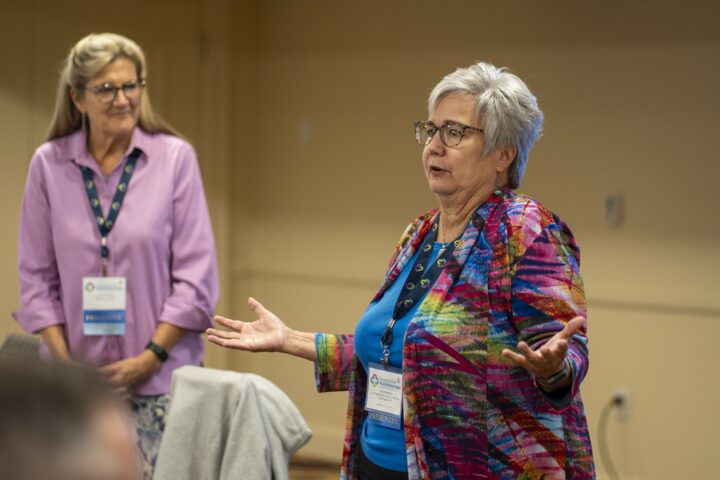
A word like “incarnational” can sound foreign even to folks who regularly participate in the life of the church.
Rev. Gail Monsma and Rev. Laurie Hartzell, both pastors who also serve as coaches for the Presbyterian Foundation, understand this obstacle to communicating the benefits of faithful stewardship to a congregation.
So they framed their workshop at the recent Stewardship Kaleidoscope Conference this way: “leading congregations in stewardship by meeting people where they are.”
Good stewardship practices cannot be lived into without relational ministry and trust.
They read John 1:14 as it is told in The Message: “The Word became flesh and blood and moved into the neighborhood.” This example of God meeting people where they are served as the guiding light of their presentation and the ensuing discussion among those gathered.
Incarnational ministry is leading from within the body rather than out front. It is “in the mess.” As the church is Christ’s body, its leaders and encouragers of generosity embody God’s love by showing up in all aspects of life. Our ministry is forged in our life together — in joys, difficulties, and ordinary events that make up our day to day.
They led the workshop in a table exercise, asking two questions: “Who is Jesus to you?” and “Who is Jesus to your church?”
Responses from the participants to this question included: savior, redeemer, teacher, example, source of comfort, inspirer to love, source of truth, and welcomer.
They then asked how the answers differed between those two framings, and commended the exercise as helpful to church governing bodies and leaders. For Presbyterian contexts, they recommended sessions to preface those questions with a reading of the Foundations section of the Book of Order.
Being aware is inherent to incarnational ministry: aware of yourself, aware of your context, and especially being aware that God’s Spirit is the guiding force as you seek to love and serve both God and neighbor as the Body of Christ.
Part of knowing yourself, they advised, is knowing your theology, and staying true to it within the church you serve or attend. And one effective way of knowing it is living it beyond the church walls, such as where you volunteer. Such consistent melding of belief and practice is what they called “living into love.”
At the same time, this lived theology, this alignment of belief and work, calls for a healthy sense of one’s boundaries. Leaders lead by example, and showing a consistent stance in a loving way, even if it differs from those you lead, commands respect.
As an example, Hartzell recalled a story of a ruling elder in a congregation she served who was adamant about having an American flag in a prominent place close to where she preached. She insisted that she would not preach in front of it because the session had not approved the arrangement. Here, Hartzell modeled a loving yet firm stance rooted in her conviction about who God is and who the people of God are meant to be.
Incarnational ministry is also relational ministry, which could be called “the soil of ministry.” Showing up in relationships is important. Hartzell shared an example of her showing up at local school board meetings and revivals alike, because in her community it was unusual for women to be pastors. In such cases, one never knows how the Spirit of God will use your showing up.
Monsma also offered an example. She recalled that when George Floyd was killed, she reached out to a police detective in her congregation. He asked her to “lift up those police who didn’t like it, too.” Regardless of the situation, it is important to show up for what is important to people, and to do so with integrity.
Part of this practice is developing an awareness of how various people think and using their language when you can. Such contextualization includes understanding cultural nuances, finding common ground, and adapting the message accordingly.
Monsma and Hartzell reminded the attendees that mutual transformation is the goal, as the practice of incarnational ministry changes both ministers and those being ministered to. In other words, expect to encounter God in unexpected people and places, and to be reshaped by those encounters. Hartzell’s congregation of 80 entered into this “dialectic process” (i.e., a merging of ideas) to transcend the usual “building versus mission” tension. They realized that their building was a source of mission that served the local community well. Thus, they raised $800,000 to fix the roof and make other facility improvements.
Another important facet of incarnational ministry is embodying justice and compassion. When we hear the word “justice” outside of church, we may think first of civil punishment for criminal activity. But biblical justice begins with the idea that there is enough for all. Prophetic words, in this understanding, are not just predictions of the future, but calls for the justice of God to prevail.
Such commitment to God’s justice demands standing with those whom society ignores or demeans. Indeed, the presenters argued, that is where we meet Christ.
Monsma shared the example of her church embracing a mission initiative called “Mi Casa Su Casa.” The energy of that endeavor led to a successful stewardship campaign. It really is true that people are more willing to give to organizations and churches when they know that those entities will channel those resources into doing good in the world.
For Hartzell and the members of the church she leads, this missional effort materializes as footsteps and prayers as they hold prayer walks through the neighborhood. Literally showing up among our neighbors is a way to make the church visible, and to remind the community that it is not the building, but those who worship and work within it, that constitutes a church.
For ministers who lead congregations, preaching is also a vital component of incarnational ministry. Monsma said that she often pairs scripture selections with portions of Presbyterian confessions in her preaching. Over time, her preaching has turned more towards a teaching model, as it is important to lead people to know who they are and from what tradition they have been spiritually developed.
Even so, there is no rigid or right formula. The heart of incarnational preaching is the same: know your people, know the language they use, and meet them in their time of need.
As they opened the workshop with questions, Monsma and Hartzell closed it with questions as well: “In Whom or where did you find Jesus today?” They encouraged the participants to practice asking these questions, and to extend that invitation in their contexts. Such mutual questioning is a powerful way to discern God’s will together — not just for stewardship of a church budget, but for stewardship of their embodied walk with Christ, each other, and their communities.
Rev. Jody Mask
Rev. Jody Mask (he/him) is the temporary pastor of Grace Covenant Presbyterian Church in Orlando, Fla. He is an Orlando native who stewards his well-being through distance running, time in nature, and co-creating hijinks with his spouse, Ellen. Send questions or comments about this story to Robyn Davis Sekula, Vice President of Communications and Marketing at the Presbyterian Foundation, at robyn.sekula@presbyterianfoundation.org.
 English
  Korean
  Spanish