
10/19/2023
Gratitude Begins and Ends with God
by Rev. Jody Mask
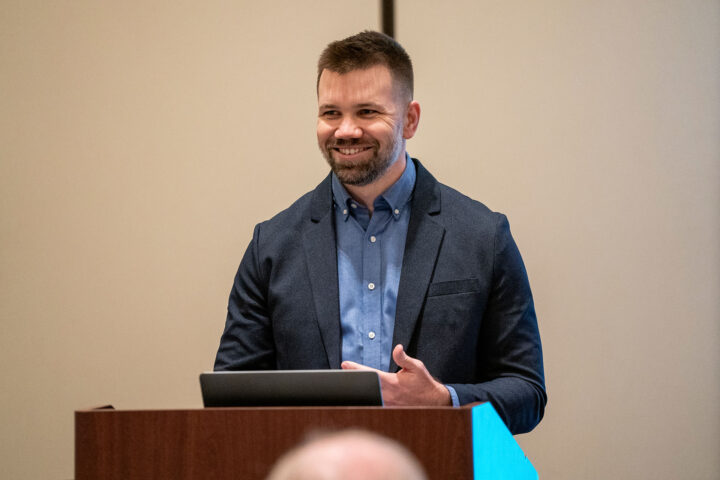
Cultivating generosity within congregations can be tricky business. So it was a bit of a surprise when Rev. Kyle Nolan, a ministry relations officer of the Presbyterian Foundation, opened his workshop at the 2023 Stewardship Kaleidoscope Conference with a reading of Mark 10:17-31. The Foundation is one of the sponsors of the conference.
Entitled Theology of Thankfulness: Making Generous Disciples, Nolan’s workshop was grounded in the story of a rich man who wanted to know the formula for eternal life. When Jesus told him that obeying the commandments was not enough–that he should sell all his possessions and give the money to the poor–the man left him in sadness.
Nolan then asked the preachers in the room if any had ever preached on this story. Many hands went up. “During stewardship season?” Almost every hand quickly fell.
o doubt, this story is a challenging one for preaching when trying to encourage generosity. In fact, Nolan pointed out, many interpreters over the centuries have softened the story. For example, some early copies of the scripture say that the man “trusted in wealth” rather than “had wealth.” And Jesus’ famous quip that follows the episode (“It is easier for a camel to go through the eye of a needle than for a rich person to enter the kingdom of God”) was interpreted in the 9th century as a reference to a particular gate to the city of Jerusalem that camels had to stoop to get under.
But this story is one that resists softening. After the man left, Jesus began to teach the disciples that the coming kingdom of God would upend human society. For the Roman empire of the time, this meant that the patron and client system, where plebeian clients depended on wealthy benefactors, would end. The imbalance of wealth distorted relationships and prevented feelings of genuine gratitude. “What the ancient world needed was to be liberated from the burdens of gratitude, and that’s what Jesus and Paul offered,” Nolan said.
To some extent, contemporary attitudes toward gratitude continue to be shaped by this historic distortion. “When most of us think about gratitude as 21st century folks, we think of a sentiment.”
What Nolan proposed, citing theologian Peter Leithart, is that Christians today should practice “holy ingratitude.” By that, he meant to ignore the impulse to encumber gratitude with feelings of obligation. Leithart writes, “Paul is quite strict: to live as a Christian is to live without debts, including especially without debts of gratitude. Christian givers impose no debts; Christian recipients acknowledge no debts, except to love.” (from his book Gratitude: An Intellectual History)
What is the best way to strip the sense of obligation from gratitude? It is to remember that God is the source of every gift, that thanks is due to God alone. “I thank my God every time I remember you, constantly praying with joy in every one of my prayers for all of you, because of your sharing in the gospel from the first day until now.” So said Paul to the church at Philippi.
Leithart wrote that centering God in Christian gratitude “infuses (it) into every nook and cranny of human life… ‘Give thanks for everything in all circumstances’ is as global a command as one can expect.”
To help people do this, Nolan listed “habits of holy ingratitude,” including writing notes of thanks (remembering to thank God first); talk about your giving (even pastors should do this); and to celebrate time, talent and treasure.
Another practical consideration is to identify mission partnerships that prioritize relationships, so that “the infinite circle” of gratitude could expand. In that infinite circle, God is always at the center, there is no obligation for one to return gifts and gratitude is marked by the “right use” of God’s gifts.
Nolan shared an example of a church that had established a food pantry that evolved into a co-op. By allowing folks who were frequent clients to work in the co-op to earn points they could exchange for goods, they felt empowered and more a part of the community. “If anything is corrosive to patronage, it’s community,” he said.
Echoing this, one of the participants, Laura Bachmann, told a story of her experience in a Catholic Worker community. “Gratitude is used as a cudgel societally, because the people that come for food and clothing look down and act like they are unworthy of receiving it. The experience of gratitude can be suffocating. (The Catholic Worker community she serves) has more of a ‘we have it, you need it, take it’ kind of attitude.”
Nolan reminded participants that “the best way to center God in expressions of gratitude is simply to talk about God, even if it’s awkward.” And he ended the workshop saying “I’m grateful for you for being in a stewardship conference and doing this challenging work.”
Rev. Jody Mask
Rev. Jody Mask (he/him) is the temporary pastor of Grace Covenant Presbyterian Church in Orlando, Fla. He is an Orlando native who stewards his well-being through distance running, time in nature, and co-creating hijinks with his spouse, Ellen. Send questions or comments about this story to Robyn Davis Sekula, Vice President of Communications and Marketing at the Presbyterian Foundation, at robyn.sekula@presbyterianfoundation.org.
 English
  Korean
  Spanish