
11/24/2025
Discerning a call to serve God through ordained ministry
by Mike Ferguson

Continuing a “Leading Theologically” series that’s exploring discernment, the Rev. Zoë Garry invited the Rev. Ann-Henley Nicholson, vice president of Enrollment Management and Vocational Outreach at Columbia Theological Seminary, to be her guest. Listen to their 34-minute conversation here.
Nicholson, a former actor in New York City, told Garry that discernment became part of her practice “well before I was aware I was doing that.” She’s often wrestled with answering the question, “what is my greatest and highest use?”
Asked what questions she’s been hearing recently from students, Nicholson said they include “how might they meet this moment they and the country find themselves in” as well as “how can they articulate what they believe in a way that helps them and doesn’t harm others” and “how might they disrupt what they have come to know about God … and about themselves in an environment that encourages that kind of intellectual and theological curiosity.”
“Some need us to demystify what theological education is. Others are familiar with it and have wrestled with a call to ministry, some for decades,” Nicholson noted. “If they’re invested in the church and they want to see the church continue to exist, then God’s going to continue to call people. Usually when you remind people of that, someone hears a call.”
When Garry was a campus minister, she would ask every senior she could, “are you feeling a call to ministry?”
“I was astounded at how many students would say yes,” Garry said.
Increasing numbers of seminary students aren’t hearing a specific call to serve a faith community, Nicholson said. “I like to say that God’s call always lies beyond the limits of my imagination,” she told Garry.
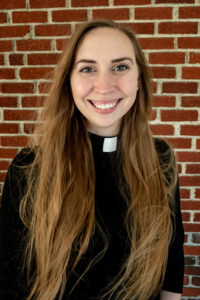
The Rev. Zoë Garry
Possessing a “healthy dose of humility and humanity” is “an opportunity for letting the Spirit come in and do its work,” Nicholson said. “It’s also a healthy recognition that this is Jesus’ ministry we have been called to be part of. It’s not ours.”
When Nicholson was a seminarian, “I had to remind myself that we are a community of shepherds, but we are also sheep,” she said. “That continues to preach to me. If I am practicing my ministry from that place, it means I am acknowledging my humanity and my reliance on others and all of Creation and most especially God, within and among us.”
Our Reformed theology reminds us “that ministry is something we’ve all been called to, whether or not we go to seminary,” Nicholson said. “We believe ministry is not restricted to those wearing robes.”
In the Presbyterian Church (U.S.A.), “we really do hang our hat on the sense that we cannot do this alone, that God is God and we are not. We need each other and we need all the different gifts within the kingdom to be a fuller human and a fuller church.”
Garry asked Nicholson what’s changed in PC(USA)-related seminaries and what’s remained the same. “You’re crushing it with your questions, Zoë!” Nicholson said, noting the “increase in diversity of thought, theology and vocational possibilities” present in today’s seminaries. Some students are called to ordained ministry. Others are interested in chaplaincy work. “More and more are drawn to pastoral care and counseling,” Nicholson said, while others see their future serving in nonprofit sectors or new worshiping communities.
“We are seeing people called to serve a church that doesn’t yet exist, and yet they are faithful to God’s leaning on their life and the Spirit leading them to seminary to discern how they might use these skills,” Nicholson said. “We’re also seeing more and more imagination in our faculty and their openness to the ways they are called to form and transform these current students and this future ever-evolving church.”
“The constant,” Nicholson said, “is that God continues to call people to ministry in so many different ways, which continues to sing to my heart, reminding me that God is not going to leave the church without a witness. I believe this with all my heart.”
People who get discouraged would do well to visit a seminary, Nicholson said. “You will see a variety of people with a variety of gifts who are called to serve our God and Christ’s kingdom in so many different ways,” she said. “Theological education really matters and could not matter any more than right now.”
Asked what discernment tool or practice has been helpful of late, Nicholson named two: CREDO, a week-long conference offered by the Board of Pensions that focuses on ministers’ wholeness and well-being, and the Ignatian practice of noting at the end of the day one’s consolations and desolations.
“There are many spiritual disciplines,” including Richard Foster’s classic “Celebration of Discipline,” Nicholson said. “I’m convinced they’re the best way we can sustain ourselves and lead in a healthy way so our ministries can be healthy and faithful.”
Mike Ferguson
 English
  Korean
  Spanish